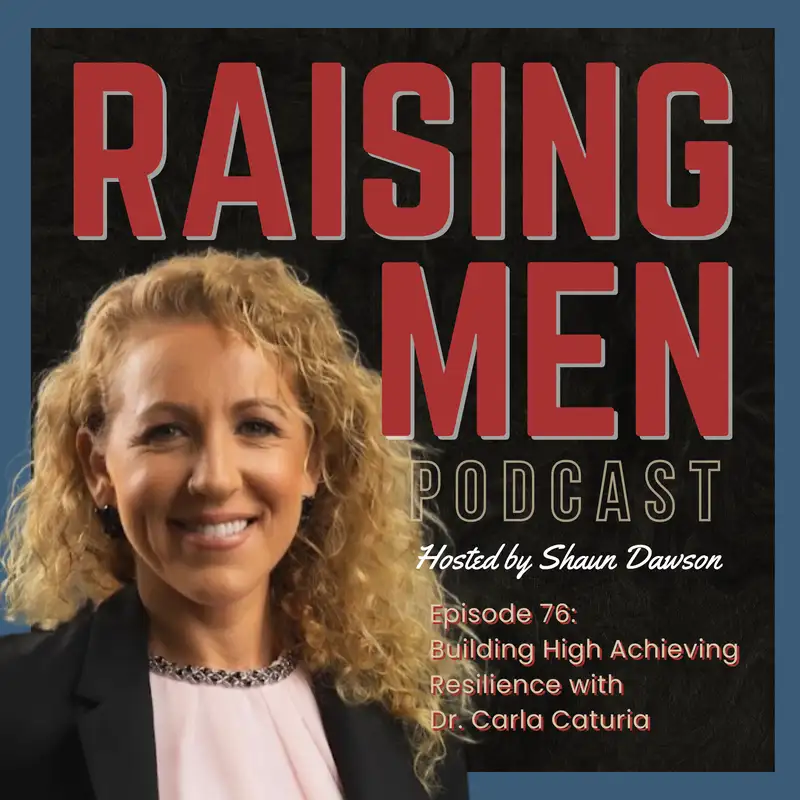
Building High Achieving Resilience with Dr. Carla Caturia
I think sometimes when we praise our kids
they're then they're working for the praise
not necessarily for the improvement
so I think a lot of it's pointing it back at themselves
like that was an awesome play
how did you feel when you made that play
that was a great job on that presentation
you know what did you learn from that
welcome back to raising men
now today on the Raising Men podcast
we're joined by Doctor Carla Katuria
Carla is an elite mental performance coach
she's a former teacher vice principal
and a university professor
with over two decades of experience in education
she's mentored over 10,000 youth and families
and she now specializes
in helping high achieving young people
separate their self worth
from their external performance
as a founder of the house of Rise
Carla works with young athletes
students
and leaders to break free from the trap of burnout
and identity driven to achievement
grounding her practice
in the core philosophy
that success without self is not sustainable
today she's sharing her rise framework
and insights on emotional regulation
high achieving anxiety
and building genuine self trust in young men
Carla welcome to Raising Men
thank you so much for having me
I look forward to our conversation
it's gonna be awesome me too
me too I uh
I this is
this is a topic near and dear to my
my heart
I was one of these people that you are describing um
both from the standpoint of having uh
a lot of achievement when I was younger
but also just suffering from um
uh a lot of kind of crippling
uh
issues outside of
what outwardly seemed to be just a lot of success
and so I uh
I'm I'm excited to
to have this discussion with you
yeah thank you
yeah so let's just
let's just dive right into it
what's the problem here I
I mean you know
you see a young man and he's just crushing it in school
he's crushing it in sports
he just seems to have it all put together
but then behind the scenes is crippled with anxiety
I know a lot of people like this
yeah what's how
how how does that come about
yeah I think
um initially when I started
you know working with families
I thought and I saw some parents
putting a lot of pressure on their kids
and that 100% does happen
um what I've seen more recently is
a lot of
the kids are putting the pressure on themselves please
to please their parents um
you know to get the good job and to get the Atta boy
and I don't think they consciously know that um
but they're you know
kind of feeding off the that achievement
and then that becomes their identity
and they become attached to it
um so I think they put a lot of pressure on themselves
that's when they kind of start to maybe perform at even
a higher level um
but then start to like stop trusting themselves
so they're always looking for
you know someone to say that that's okay or do that
or they're having trouble problem solving and um
they're kind of losing that kid
of curiosity and joy and play
and they've become this kind of like GPA and grades and
you know awards that
that has become their identity
and before you know it they have
you know high levels of anxiety
and they get to the point of burnout
as you stated earlier where they're just like
I don't have time for that
I can't do this I can't
you know and then
their life just becomes overrun with
activities and things and they're kind of numbed out
and they're just this achievement robot per se
and it's how do they get back to themselves
and still be able to achieve
yet through at the lens of a well balanced human being
so let me ask you this question
I
so I was
I was a volleyball player and in that community a lot
and so I know a lot of of
of very elite volleyball players
mm hmm and one of the things that I noticed is um
I I met a lot of
of very high achieving female athletes
who just really burned out on their sport
like by the time they got done with college
they played in college they played at a very high level
they were just
they were done playing sports
uh huh um
and I mean just an extreme version of the burnout
that you talk about
but that seems to happen less with the male athletes
is that just my perception because I happen to be
be um
in a sport that was a lot more dominated by women
or is that something that is more universal
gender wise hmm yeah
no good question
um I think uh
I guess it could be a case by case
cause yes I
I exactly know what you're talking about
and uh
with women and even with women in a career
you know they have their kids and
you know
they're balancing everything and then they just they
they burn out um
but I do have a lot of male athletes that
you know maybe it's school that stresses them out
and maybe not so much the sport
or it is the sport and they're a perfectionist
like a lot of tennis players or golfers
things like that so the question is
it depends so it's hard to say that
you know more females than males
though I do see what you're saying
um and I guess with females too
it's like maybe they're pushing so hard
because nine times out of 10
there's more opportunity for a guy to go beyond college
than there is a girl even though most males don't
don't become professional athletes either right yet
but it can be but
it's more of a realistic aspiration that for
for a man than it might be for a woman
you know so maybe that's
so maybe that's the like I have to give it up
my all through college kind of thing
um there could be that underlying subconscious there
um of I
you know and
and I know they're starting more women's leagues but um
but yeah I've seen it in both
both males and females that I've worked with for sure
um yeah
so that's a tough one
yeah yeah
no I was just
I was just interested from your Vantage point
if you've noticed there and it yeah
it seems like maybe maybe
maybe there is and maybe there's not yeah
how do parents you know what
what's
what's a healthy way to support a young man's drive in
to win in sports or academics
without letting his performance dictate his self worth
without falling into that trap
yeah
I think a lot of it is pointing them back to themselves
versus always the good job
and not that you don't
proud of your kids and shouldn't praise your kids
but inadvertently
I think sometimes when we praise our kids
they're then they're working for the praise
not necessarily for the improvement
so I think a lot of it's pointing it back at themselves
like that was an awesome play
how did you feel when you made that play
or that was a great job on that presentation
you know what did you learn from that
and kind of pointing it back to them
so that they start to just trust themselves
as well as know you're proud of them
of course so I think sometimes that can be
you know we kind of say when they win
we give them accolades but when they lose OK
well what did you learn it it
you know and a lot of the kids I work with it's
you know how are we go into the match or the game on
how are we gonna progress today or this weekend or
or during this this tournament
versus the outcome of the trophy or the win
um
yeah yeah
focusing more on the process than on
on the result and so is that
I mean what about on the motivation side
like how do parents you know
what are big mistakes that parents use on
to motivate their boys to achieve or
you know what is a healthy way
I guess maybe a better way to put that is what is
what is a healthy way to cultivate that drive without
without
running the risk of having them be just so focused on
performance and outcome
that it creates that anxiety that you're talking about
yeah so
I mean if you think about it
like nobody can motivate anyone else
though many parents are trying if they see their kids
I don't know frustrated and struggling on the
on the field then they're like
they wanna fix it for them or solve it
or if they see their kids
I don't know
being lazy and they get pulled out of the game
they're they're
you know like
come on let's go
and really it's not pressuring
it's not emotionally attaching to that
it's not you can't motivate your sons
so it's more about their
the identity driving the behavior
so it's not the pressure
it's not giving them the motivation
but it's seeing them at the next level
of where you wanna see them and
you know not just saying you have so much potential
you know well
you know and
and and giving them Grace when they have a bad day
they might have a bad day
but if you see a repeated lack of motivation
OK that's when you need to step in and
you know it's more about kind of shifting their mindset
to helping them coaching them through
knowing that they're capable
and that there's gonna be highs and lows um
but I see you as this strong smart
uh capable human being uh
and just reiterating that with them
um more so than the
trying to motivate them
or trying to save them from struggle
yeah yeah
yeah it's like
I mean what I'm hearing from you is somehow you
actually I would
I would love to hear your feedback on this statement
so I'm going to restate what I'm hearing from you
and then I want to hear
I want to hear your feedback on that yeah
um
it's like your job
is to give your son the experience of feeling
worthy of life's challenges
and capable of overcoming them
and then worthy of the rewards
that accrue as a result of meeting those challenges
right I at the end of the story
if if you could
if you could do one thing for your son
that's it that's at the when
when he walks out the door at age 18
if that's even a thing um
he feels that way right yeah
and I mean it oh
go ahead go ahead
yes alright
go ahead well
I was gonna say like
many of the families that I'm working with
and the children that they have they
the family potentially like
started a business or did really well in their
their companies
and so they have the means as far as like
a lifestyle where their kids can live a very nice life
and so what
what parents are doing inadvertently with sports
or with volunteering or um
other types of situations that they're creating a um
way for their kids to productively struggle
and to learn and to be challenged
because if you have Apple Pay on your phone
you have a potentially a car and I don't know
all the friends that you need
and you never have to worry about food in the fridge
you don't have any problems per se
there's no reason for you to be motivated
what what are you being motivated for
right right
so playing a sport and struggling through that or
you know offering your time to others and just
I think parents are creating um
and I've spoken to many parents about this
creating ways for their kids to be challenged
ways for their kids to fail and learn from that
and so it's you can fail at volleyball
you can fail at football um
we don't want you to fail at something
you know we want you to fail now
so you can learn those lessons
in middle school and high school
through sports or some other means yeah
and then um
you know be able to have low stakes failures so that
so that you you
you learn how to handle that in a productive way
as opposed to you know
never never failing until you're outside the nest
and then all of a sudden
you can't seem to succeed anywhere
and exactly and it's like
I feel like and this hasn't been necessarily
you know but I feel like middle school is like
it's failure you can fail all you want in middle school
because middle school
you're gonna get passed to the next grade
they're most likely not gonna hold you back
you know that you don't have credits and all that
like you do in high school
so it's a nice it's an
I mean not saying I want kids
to fail but there that's when a right yeah
and that's when a parent can like step back
let their kids handle it
take initiative and speak to the teacher or the coach
and you know
they can kind of let them flounder a bit yeah
so that
so then they can build those skills because they
you can tell them what to do
but until they actually do it
they're not gonna learn you know
I when when I was young
um
sports was a thing like you
you you played sports at school and you know
you were on the high school football team or
and then the high school basketball team
and then the high school baseball team and then
you know some people played soccer whatever right
and and that was what you did
and there weren't really club sports
like maybe there was a little bit of that
or there was a summer camp
that you could go at a university
or something like that but nowadays
it feels like the professionalization of sports
mm hmm it's happening at a much younger age
which means that I mean
I I've heard people talk about oh yeah
your kid needs to specialize in a sport
if you want them to go to college in volleyball
then they need to specialize in volleyball
by the time they're twelve
and I look at that and I'm just like oh
this is not good that this is because it
because what it does is create the situation
that is the antithesis of what you're talking about now
when they're 12 when they should be going out there
and experimenting with failure
it is now really really high stakes
because if they don't get onto the best team
in the club volleyball scene
well then they're
they're gonna get relegated to the lower squad
and then they'll never get on the top on
on the top team and then
you know it's kind of like they're screwed already
and putting that kind of pressure on a 12 year old
just seems to me to create exactly the cycle that
that you're trying to prevent
yeah and I think it depends on your family's values
so
I do have families that go to public or private school
play the sports where the soccer volleyball
whatever it is and have
you know that type of life
and then I do have families
where their kids go to online school
and they play their sport
like they snowboard all day or they do tennis all day
and they do specialize so
the good part about the specializing is
they have this opportunity to like
live this life that is not a
you know sit in a desk and do study hall and be sitting
you know like you have this amazing life where you
you're living your dream basically
so there's a there's the good part about it
and then there's also the
part about many of my kids that specialize have trouble
like doing other things and enjoying it
like taking a break from their sport and just like
eating pizza with their friends and watching a a
I don't know a movie yeah
because they're just so into the sport
which is you know so it's good and bad yeah um
so yeah I mean
you it again
not there's no right answer yet though there is yeah
like when I grew up I was like in AAU
basketball and travel
soccer and softball and all these things
and I played all those things
but it was on a level of like
I don't know
it it felt like we were I was scheduled all the time
but in a good way and I was able to really manage that
and I don't know if
some families are doing it in a much
in a very balanced way and then other families
it's like I have five calendars
one for each kid and my husband and me and
and then it's like okay
well are you living your life
or are you just like calendaring
you know yeah
yeah so yeah
there it's finding again like I said at the beginning
it's finding like your family values
and what's gonna work for your family
and do we you know
what do we want our kids to experience and how
and what's important to us yeah yeah
let's talk about let's talk
about what the solutions look like
so yeah you know
you've developed the rise framework
which is kind of seems like the foundation of
of your you know
kind of principle based solution
talk to me about that what is
what is that framework and
and how do you apply it um
to to this world
yeah so rise stands for resiliency identity
um self confidence and emotional intelligence
and I really believe like
the first step is always handling your state
or the emotional intelligence
so having teens it's never gonna be perfect
you're never gonna get there
you're always gonna have anger
and frustration and other emotions um
but learning how to um
better process those stay in those emotions a lot
a lot
a shorter window of time and just be able to
I don't know I would say more
you live powerfully because not
no realizing that your brain and your emotions
they don't control you you control them
and then what I do with them is we start
you know habits and routines
that's where they start to build some confidence
as they integrate so integrations always the thing it's
they're very I work with a lot of kids and it's and
and people but it's actually doing the work
not just talking to me
but it's doing the work when I'm not there
but then
they start to build that foundation of their values
and then they start to see themselves as resilient
cause they're like
oh I didn't think I could do that hard thing
now I can I see the evidence
and that's where they begin to transform
and they kind of step into this next identity
and then they do that over and over again
cause they're working on different areas of their life
so they begin to transform with their relationships
and then their emotions and
you know maybe it's um
through their sport uh
you know fill in the blank
they there
any part of their life um
and that's how we kind of work through
and then we we start a new thing
and a new emotion comes and a new situation comes and
you know
now there's boyfriends and girlfriends and things
so yeah it
it you
you go through all the all the um
thing but that's
those are the four pillars yeah
that I that I work through with my clients
yeah
and is there a particular age that you want to start
like focusing on these things with or yeah
so fun is yeah
when I started too young or too old or anything
no there isn't
so when I started I was high school
like that was in my mind and in middle school
cause that's where I I spent most of my
my career but I've had a handful of kids 11
10 8
a lot younger than um
what I initially thought um
and I have a lot of young adults
too that you know
maybe they're an entrepreneur in their mid 20s
or they're in college so there is no wrong time
the sooner the better because
you know
the sooner you can get them to think differently and to
to really have that self belief and self trust
the better
um
it just might look a little bit different for an eight
year old than it does for an 18 year old
um but it's still um
it's still
it still works yeah
yeah no
I love that and then
you know so what kinds of
what kinds of results are you seeing out there
it seems to me that there's this really wonderful
virtuous cycle that can happen here where
where the
the practice that you're talking about
identifying those values and and
and doing kind of the
the exercises associated with improving your world
in those four ways um
can create a situation
where you're even better at the things that
it gave you anxiety it almost gave you anxiety to to
to be so good at baseball
for example
and then you actually don't know where that came from
and that's the nature of the anxiety
and then you you start to do this work and now you feel
oh
now I understand a little bit more about why I succeed
in failure about fail about different things
that reduces the anxiety
which in turn makes you better at the baseball right
there's a virtuous cycle there well yeah
it's funny you say baseball
because I was working with this baseball player
and it would be you know
he would he would get up to bat
and if he struck out his first at bat
then the rest of the game forget about it
he was frustrated he's you know throwing his helmet
you know kind of in the dugout
and then when he went to play on the field
it affected his game on the field
and then it affected his next at bat
and so what what with him
it was it didn't
it didn't mean that he was happy when he struck out
after when we were working with
you know he's still frustrated um
but he Learned to recognize his patterns
so first it was what am I gonna do prior to the game
in the practice how am I gonna get my mind right
and so we work on mindset exercises you have to do
just like you have to stretch your biceps and triceps
and all the things you have to kind of do
a lot of kids don't realize
like the mind gym is
is equally as important as the actual gym
and then it was OK
now that I recognize my patterns
and if I do strike out on my first app at
how am I gonna handle this
and you know
what kind of resets am I gonna use during a game
and then after a game
how am I reflecting on OK
this went well this didn't
and how am I gonna shift next time
so over time he yes
began to do better with you know his um
with hitting
and but that was a byproduct the
the real
win was that he started to recognize his patterns
he knew he had to have his habits and routines intact
and if he didn't
then he would see himself strike out more
or not do as well um
so that's the
the transformation isn't gonna be that you perfectly
start to just hit every ball yeah
yet yet that
that will happen more often
you know yeah yeah
you you
it's one of these things I
there's not a good word I
I keep searching searching for a word for this concept
and I would love it if you had one
by the way the concept is
it's something that you can only approach obliquely
meaning that if you strive for hitting the bullseye
you'll miss but if you just strive
if you focus on the process and you focus on
on the the
the if the stuff around
the behaviors around trying to hit the bullseye
then you're far more likely to hit it
yeah I mean
I think it's you know
it's kind of having faith
that it's all gonna work out
how it's meant to work out
and that could be religious faith
that could be just faith in the universe or just
trust because you've seen it happen a bunch of times
well right
and and to that point
you when you don't have the evidence
when you've been striking out
or you've been missing the ball
or you've been getting poor grades
you start to get down on yourself
and you don't see the evidence
you're like I can never do this
but you have to be you have to
part of the practice is reminding yourself
that you have done this before
you can do it again
and just because I'm in a slump right now
doesn't mean I'm gonna be a slump forever
this is temporary
and that but that's where that self belief comes
and that's hard because it's very
it's very easy to believe when we see
you know I make a million dollars
and we see it in our bank account
but it's very difficult
when we don't have the million dollars
and believing we can make the million dollars
so it's the same it's that same thing
so I think um I don't think the word you were looking
for is necessarily faith
but I think um you know
it's really allowing your
like not controlling
and allowing your subconscious to take over
you know I've done the practice
I've done the work
now go go out there and and and let it happen
and that's part of what I work with kids on
is getting into Flow State too
because it's not necessarily just
you know there's gonna be struggle
and then you're gonna have to go like in the shower
take a shower take a break
and then when you're in the shower
you think of some idea that could help you with your
with your game or whatever you're trying to work on
and then when you're you're there
you get into that flow state and
and you're kind of
where your mind and body are just attached
and you just you just feel it
you're not thinking it
you're out of your mind into your body
and then with that that can't last forever
even though we want it to um
then the key after that is to recover
is to you know
physically recover mentally recover
so that you can get back in that cycle again
super important yeah yeah
yeah so it's a
it's kind of like allowing
yeah yeah
yeah I
it's it's such an interesting
I mean I'm um
one thing that I've realized about myself is I'm
I'm kind of a flow junkie
I uh
and I have a number of friends that are that way
and that's
that's something that I have in common with a lot of
the people that I really get along with is
is that we really we really seek out
it's almost like we
it's an addiction getting into that flow state
and we seek out
we don't even necessarily
I don't even necessarily know how to make it happen
but I know that oh
if I'm if I'm flying an airplane
and doing a particularly difficult approach
you know and the stakes are really
really high um
then I'm there and
and it's I
it it
it is it's addictive to me
and that's um
you know that drives a lot of performance in my world
well I think everyone
that's why I mean
I started surfing I can't stop
am I the best surfer no
do I get up yes
and I get up for the three seconds
I got up in the 30 minutes I paddled it
I forgot about the paddling
right because I got up
so I think but I think that that is
it is an addiction and it's a good addiction
but it's technically like the
the chemicals in your brain
the dopamine and all the other chemicals
that's what's happening so it's
you're not taking a drug
or you're not smoking a cigarette
you're not getting it's not that addiction
but it's this kind of healthier addiction
if that's a term yeah
and so if the flying the plane gives it to you
if the surfing if the
you know whatever it is
um you're gonna keep doing that activity until okay
that you've mastered
it's kind of like once you master it
that's why we kind of go on to the next thing
cause we need that intersection between
skill and challenge like yeah
it's that right intersection of
it's still challenging me I can do it
but I'm not perfect at it yet kind of thing oh yeah
this is my entire life experience
you're describing right here
I I
my entire life experience is this
seeking that place where the
the performance curve is the steepest and
and just you know
going out there and improving every and then
and then once it starts to nose over like that
once you get to the place of excellence
it becomes a lot less interesting for me
and that's actually a struggle
because that last 10% is very rare
and so if you really want to I mean
it's one thing
if you're doing it just for the enjoyment right
and you're going out there and surfing
and you're not gonna
you're not gonna be an Olympic surfer
if that's a thing um
and and you're doing it for the enjoyment
then it's you don't you you don't need
you don't need the performance to be that high
but um and
but you have to just take enjoyment in the process yeah
yeah and if you don't it I mean
that's the only way if you if you're
if you're frustrated
because you're not at this next level
then and then you're just gonna sit there and
continue to be frustrated
and that's not a great experience
mm hmm yeah
no I mean you kind of have to
just let it happen you you do the
you do the practice you
learn the skills and at some point
you have to trust yourself
let it happen
and practice and fail and practice and fail
and then it yeah
no I mean that it's kind of it when you were speaking
it made me think like yes
ADHD is a thing and many of us have a tinge of ADHD
but I I remember
you know friends I've had and
you know
where it's like they're always on to the next activity
and I think we see it as a negative of like well
you did skydiving now you're gonna do surfing
you did surfing now you're gonna do this
you know biking or what
but I think people are it's not necessarily a negative
that you're chasing that flow state through
these healthy activities I think it's
it's like once you've kind of mastered it
you can still do it for fun
it's not a problem yet
I feel like I want to master the next thing
and I think that's okay yeah yeah
well and as with everything
there's attention um
on the one hand you
you you want that
by the way that's
that's the very definition of resiliency being able to
you know
go from one thing to another to another to another
but you also need to be able to finish the thing
you're on right
you need to there are things that you have to finish
right you know
there there are it's not like you can um
you know the
the world expects you to complete high school
the world expects you to get
you know right
and and if you
if you get to 90% on everything
and you never get past that 10%
you never actually complete
you know close
a a mentor of mine used to call that
closing the value loop
um you know
it's really easy to get to the 80% level and then
and and then that last 20% is the hardest part
and that's what nobody does
or that's what's relatively rare
and then so
a lot of success in life is
really focusing on the thing that is rare and
because that's what's valuable
and so there's a tension between between
you know flitting from one thing to another
which is a good skill to be able to have
and being able to stick through
and being able to have the resilience
to see something through to the end yes
yes absolutely absolutely
yeah that's
there's a and yeah
some people fall into either category and some people
you know
can do it in a few ways and they finish it out and they
I guess you know
it's a little trial and error as well
but yeah yep
I always love to end these conversations with uh
more or less the same question to everybody
but I always put everybody on the spot so um
so this is my apology for
for doing it to you
but if there is one principle that comes to mind when
when I when I
when I ask you for a principle that every parent
listening should live by
when raising their sons what would that principle be
hmm
well let's see
um could be a number of things
um I think
one thing that I would strongly encourage parents to do
is to take care of themselves
have Grace with themselves
regulate themselves because no matter what
in the teen years you might have a great relationship
but there's always a lot of conflict there
there just is
and trying to kind of just instead of reacting
just regulate instead of correcting
just maybe observe you know and
and when you feel like you want to step in
then maybe just step back
and it's really hard to do those things
not gonna happen every single day
but I just encourage parents to
you know
take care of themselves and take a deep breath and
and you know
allow the productive struggle
and the natural consequences to occur when
when you feel like that
it's okay for your kid to feel those things and
and then that's okay yeah
it's been spectacular Doctor Carla Katuria
thank you so much uh
for coming on raising men
thank you so much for having me
this is awesome and
Doctor Carla Katuria
is the founder of the house of rise
she specializes in helping high achieving youth
build sustainable self worth beyond
their performance
if you want to learn more her rise about Doctor Carla
about her rise framework
or her work with young athletes and families
all of her information and resources are LinkedIn
the show notes as always
thank you for listening to Raising Men
you are a great parent
raising men is produced by Phil Hernandez
this episode was edited by Ralph Tolentino