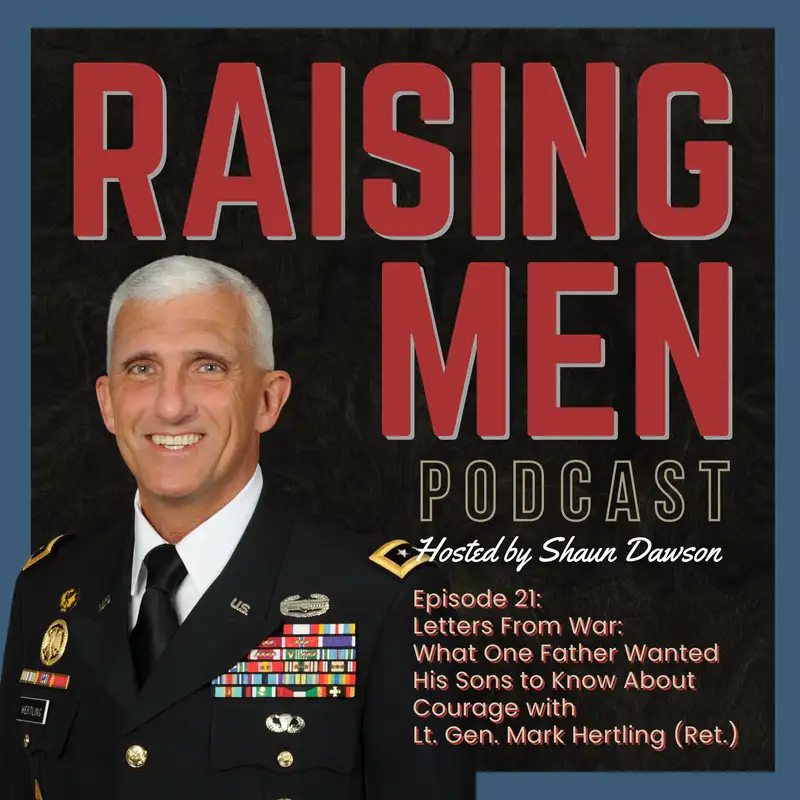
Letters From War: What One Father Wanted His Sons to Know About Courage with Lt. Gen. Mark Hertling
the original thoughts of the young father
who was going to war
not sure that he was going to come back
and then you have the grizzled veteran
right with
with 25 or 30 years behind him being able to reflect
here was the original journal
with all my writings inside
yeah and it was just a daily uh
Journal entry on something
I mean I
I would wake up in the morning
as I explained in the book
and just think what do I know
what do I want Scott and Todd to know about their dad
if I don't return
welcome back to raising men
today on the Raising Men podcast
we are joined by somebody who spent nearly four decades
leading soldiers
in some of the most demanding environments
on earth lieutenant general Mark Hertling
commanded the US Army in Europe
LED the legendary 1st Armor Division in combat
and spent years shaping how the army trains
and develops young leaders
but behind the rank and responsibility is also a father
who wrote letters to his sons while deployed to war
letters about courage about character
about fear
and the kind of men he hoped they would become
if he didn't make it home
these are all detailed in his new book
if I don't return a Father's Wartime Journal
in this conversation
we're going to explore what military leadership
can teach us about raising boys
the difference between toughness and resilience
and the values fathers must
model if we want to raise strong
thoughtful men General Hurtling
thank you so much and welcome to raising men
Sean it is great to be with you
I've heard about this podcast uh
and I just think it's a wonderful opportunity for
young parents to understand
some things they might want to do uh
versus just buying a dog and trying it out on the dog
like a lot of parents do
right you know
I remember I I remember walking into the hospital
while my wife was in labor
and realizing
oh wait a minute
my life is about to be so unbelievably different
in a way that I did not prepare for
yeah and I thought I had prepared
I you know
had done the work and we went to the classes
and we did all of that stuff
and then when the reality finally hit
it was it was a sea change for me
you mean when you have that little human being
that you're carrying and saying
oh my gosh my life is so much different today
than it was yesterday yeah
and you don't get sleep that night and
or any other night
for the next 40 years too
you know
the problems just get bigger sometimes right
definitely so
let me ask you this tough question
right out of the gate how do you define masculinity
oh gosh
um it's it's gonna be based
it's not a trick question
cause I've thought about it a lot
it's based first of all on your character
I agree
it's based on who you are and how other people see you
it's not based on biology or physiology
it's based on the heart it's the ability to
understand your strengths and weaknesses
it's your understanding of how you influence others
and care and respect for others uh
of both sexes it's based on how you present yourself
uh you know
the business world calls
calls that sometimes executive presence
which I think is kind of a goofy word
and I teach MBA students and
and we have debates about what executive presence
truly is it isn't your charisma or your communications
it's who you are across the board
it's what you leave in a room uh
versus how you appear when you enter a room
so all those things I think contribute uh
and everything the character
the values the intellect
the ability to shape others
the ability to influence others to do the right thing
the the portraying of an example uh
that you hope others latch onto uh
those are all the things that
I think contribute to masculinity
and it's not limited to masculinity
cause all those things contribute to femininity too
yeah there's
there's probably a a
a way to you know
it's unfortunate that those
that those words are so a
tied to a particular gender because yeah
you know there are
there are a lot of ways in which men um
need to exude feminine energy
and women exude masculine energy
and that's totally appropriate and good and
and you know the kind of diversity of
of of all of that is it makes us really really powerful
yeah it
it is and I
I think when we talk about the strength of men
it can be exhibited in either sex
when you talk about the nurturing of women
that also can be exhibited in either sex it
you know certainly
I've tried to nurture our children
and the soldiers I've LED
by finding ways that they can
press beyond what they think are their limits
and that has to do with not only strength
but also nurturing them to understand that they're
they're each within
each one of them is a diamond that has to be polished
and and that's what we're looking at not just for
in my business soldiers
but also our children that we want them to become
well I'm gonna use an Army
Army marketing term now
we used to have this very famous marketing campaign of
be all you can be yeah
and and I would change that a little bit to be all
be more than you appear to be
and really reach those outer limits
wow that I'm
I'm really struck by that be
be more than you appear to be is that's a
there's a lot there's a lot to unpack there because it
it implies a capability um
that surpasses your bravado
yeah well exactly
you don't have to be loud to be a great leader
yeah you don't have to be loud to teach your children
yeah uh sometimes
sometimes if you do being loud can detract from it
exactly exactly
um and I think
there are some that see those as male traits
and male characteristics um
but really the book is a reflection of all those things
what what
really is the approach you should take
in terms of inspiring and influencing
and persuading others
and persuading yourself to do the right thing
helping others develop while you're self developing too
yeah I
I I
I wrote down a quote from the book and you said
a real man proves his masculinity by being considerate
protective
concerned and confident and by demonstrating it
and I think that is so perfectly put
well thank you for that
that's good I
a couple things came through
as I was reflecting on the various journal entries
truthfully that
you know I would
I would come in here and and begin
you know in each journal entry from 1991
I would do a a
a much longer reflection right
and so there's no
there was no research involved in this
it was just kind of off the top of your head
yeah and
and my wife kids me
because every once in a while she would come
she would come in and uh
you know
to just say hi or bring me a glass of tea or something
and she would say you know
most times I was in here sobbing and I think it was
I think it was because I had so many epiphanies
in just sitting back
and reflecting on things that I had done
and had said and had accomplished and had failed at
that in reflecting on all those things
you really kind of put together your life story and
you know the
the comments about leadership and
and male characteristics and character
and what we do and how we choose our values
and how we exhibit those values uh
all became much more important to me
as I had a chance to reflect on this journal
I can imagine yeah
the the reflections are like are
are three or four times as long as the entries
themselves and they are where the real it is
it's really kind of
an amazing format that seems to have come together
accidentally because you have
the original thoughts of the young father
who was going to war
not sure that he was gonna come back
and then you have the grizzled veteran
right with
with 25 or 30 years behind him
being able to reflect on that that
that that
that young man and yeah man
what a what a
what a great what a valuable thing to be able to
to look over your shoulder on I
it's you're
you've done a real service um
especially for those of us
just starting out on our fatherhood journey
my kids are 7 and 7 and 3 um
it it's
it's a real service to us
well what I
what I'll tell you is there was
I had an internal debate on how I was gonna do this
after our son presented us
presented me with the journal
yeah that he had typed up
he had taken my handwritten document in a book
and here is just for you it's on the desk
here was the original journal
with all my writings inside
yeah and it was just a daily uh
Journal entry on something
I mean I
I would wake up in the morning
as I explained in the book
and just think what do I know
what do I want Scott and Todd to know about their dad
if I don't return
and I'd pick a subject
some are very sublime and some are very ridiculous uh
you know it goes all the way from values and friendship
and love of your wife to MRI's and
you know you know
those kinds of things I mean
it was a hodgepodge of stuff
so when after he asked me to expand on it
with the rest of my life stories
I delayed a month or two because I was thinking okay
how how do I
how am I gonna do this are we gonna put the
the journal entries first and then just write
you know stuff about my life afterwards
yeah and
and then one day I just woke up
and this is when I really started diving in and
and got excited about it I thought
I'll just take each one of the journal entries
which are as you know
are about a page yeah
and just reflect on that same topic
so it it gave me an automatic outline to follow
and it was so incredibly easy
Shawn to
to write this uh
but it it
you know each day I
I would try and do one uh
reflection on a journal entry
and I just had so much fun doing it my
my wife said she'd never seen me so happy in
in my life you know
when I was going into the cave here
and thinking about life's lessons
you know I love that
that is a that's
that's such a beautiful let's
so let's talk about how the book came about
and so I I want to start on December 20th, 1990
so given how the first Gulf War played out
it's easy to be surprised that before that happened
we were worried about major American casualties
you write that you were worried that
that there's a really good
a coin flip
chance that you weren't going to be coming home
well I wasn't worried about it
we were told that yeah
and you know we
to set the stage it was in November of 1990
we were in Germany with two little boys
eight and 10 year I'm sorry
seven and 10 years old and
and we were told
well there
there were a couple of units in Kuwait
or in Saudi Arabia at the time
defending against another attack by Saddam Hussein
in Saudi Arabia he had already conquered uh
Kuwait right
and uh
but it was you know
the 82nd Airborne is sometimes called a speed bump
because there they have no tanks
they have no heavy artillery and
and at the time the Iraqi army was the fourth
the fourth largest in the world
well uh
Saddam Hussein had just finished an 8
year war with Iran which was catastrophic
um
he had used nerve gas against his fellow citizens
and the Kurds in a place called Halabja
so this was not a guy to be trifled with
excuse me I'm sorry
so we were told to watch TV in early December
because there was gonna be an announcement
the announcement came over our Armed Forces Network
television in Germany at the time
from CNN that was relatively new at the time and uh
it said it was Secretary Cheney
Secretary of Defense Cheney saying
we're gonna send the 7th Corps from Germany to uh Iraq
now the 7th Corps is a organization that consisted
at the time of about 140,000 soldiers
our division was one of those
First Army division was one of those
so this was the first anybody had heard about it
in Germany there was no advance notice
I think maybe two or three people
knew this announcement was gonna come
so for the next several hours
uh I was exchanging
information with different people in our cavalry
squadron a reconnaissance squadron
that we knew would be out in front of the division
when we eventually conducted operations and uh
not the next day but I think it was the day after that
we went into an intelligence briefing
and our intelligence officer in the division said
the first cat the 1 1 Cav 1st Squadron
1st Cavalry is likely to suffer up to 50% casualties
and my mind immediately went to
holy smokes I've got a coin flip of coming home yeah
and I've got a wife that I love
and two children that I love
and they're young and I'm gonna widow her
and the two boys aren't gonna have a father
so I started thinking about how I could prevent that uh
and and mitigate it
and I came with the idea of writing a journal
on different subjects so I went into
we went into that war in 1991
went into combat suffered some casualties in our unit
I was one of them when we had 33 soldiers injured
from an artillery attack and
when I came back home
here's the spoiler alert that I tell everybody
I did survive as so did the rest of our squad
so came back home and uh
you know the boys were at that point 8 and 11
cause they had both had birthdays while I was away
and
they didn't want anything to do with my reflections
of this journal so I threw it in a foot locker
wow when they became older and they went to war
I got it out and showed it to them
and they both have had multiple tours in Iraq now
since the wars of the 20th
21st century
and one day about three years ago
uh they looked at the journal
gave it back to me
and I threw it back in the foot Locker
yeah one day about three years ago
our youngest son Scott asked my wife
where's that journal the dad had
and what he did was um
take it and type it up
and he inserted pictures in a word document
and in Christmas Christmas morning of 2024
we were all here at the house
and the kids had just opened all their packages
and we were
we were suffering from those four cups of coffee
with Kahlua inside of it
that you always have on Christmas morning right
and the kids were making their Lego
and doing their things
and Scott came up to me with a box
handed me the word document
and I opened it up and suddenly
all the smells and sights
and sounds of the desert from 35 years ago
came to mind
but then he said something that was really important
he said dad
you know my
brother and I read this journal
and we knew what you were doing
you were trying to prepare us if you didn't come home
he says but you've since had 35 years of experience
you've gone to war multiple more times
you've had new friends
and you've moved all over the world
he said this was once a gift to my brother and me
he says now
you gotta make it a gift
and something for your entire family
cause now you have 5 grandsons and 2 new granddaughters
step step granddaughters
and he says make it a gift for them
I think and I've told this to other people
I don't think
he believed I would ever do anything with it
cause I'm very much of a procrastinator
but once I got my head into it
it became really a gift of love back to him
and uh
it took me
probably about six or seven months to write the
the rest of the book yeah
and I sent it off to him as kind of a surprise and
and uh
he was somewhat shocked saying hey
you really did something with it
and he loved it and I read it immediately
and we both talked about potentially publishing it
so that's what we've done for other people too
so that's the story we're all fortunate that
that he did that and I mean
I could just picture that um
that scene on Christmas morning with the kids playing
with all the toys and yep
and the and the
the warm mugs of of Kahlua and just him
him breaking out that typewritten
um that typewritten book
it's it's a beautiful scene
it was and it
and it also showed I mean
I think just the closeness that we've had as a family
because when you are in the military and you move in
you know I spent 38 years in the military
and we moved 23 times during that period
um one time I was out by you
we were assigned to the National Training Center in
in uh California
yeah it's just
just down the road from San Diego
uh huh and uh
you know when you move your kids that many time
and they go through six or seven different schools
and you find yourself
and they left friends and left sports teams
and those kind of things and had to start over
what we tried to teach our kids were hey
there's gonna be a lot of requirements to adapt in life
but the one thing you can always come back to is family
and so they are best of friends
and I think we're a very close knit family
because we did have those kinds of
new environments that were constantly pressuring us
and new requirements to get on a new sports team
or make your name in a classroom
as they have done so
that's part of leadership and family and raising kids
too
you know the
the the last entry
uh in the book you
you have a prayer
uh by General Douglas MacArthur written when he was um
uh the Allied Supreme Commander in the Pacific
I understand right
and uh I
I had never seen that before before uh
reading that part of the book and
and um
it was moving enough to me that
that it it made it onto my wall
good that's great
I OK
you can't read it from there but uh
and I'll probably post it
put it other places in my house too
I I want to be able to share this with my boy
um but I'd love to go over this in detail
if you're up for it I am up for it and
and what I'll I'll share with you if I can
yeah but if I only
it all started when our first son Todd
was born
because this was a prayer that I had seen
when I was a cadet at West Point
along with the cadet prayer
which is important to me and I mentioned in the book
as well as the honor code and all the other things
and
the values that they teach you at the military academy
but I saw this MacArthur prayer and I remembered it
and so when we had our first son
I showed it to my wife when he was still an infant
and we both teared up
because it is exactly what you want for your kids
yep and we kept it on our wall
much like you have it on your wall
but then when our sons got married
and they had their own sons
uh
my wife arranged to have it calligraphied
and they're
they both have it in prominent spots in their home
so it's a constant reminder to them
and I'm sure their boys are gonna see it
as they grow up too
so let's dig into it let's dig into it
so it starts um
he says build me a son
oh Lord
who will be strong enough to know when he's weak
and brave enough to face himself when he's afraid
yeah um
go ahead it I
I mean I
when you know that it's coming from Douglas MacArthur
yeah and truthfully
I'm not a fan of his
I think he had a little bit too much ego
but he was a great military commander sure
um
but when you know it's coming from him
you can also translate those words into what he's seen
in in two wars
World War 1 and World War 2 right
um and it wasn't just for his son
but he's seen it as being reflected
in other men that had served their country
so he was I think
compiling not only his biological heirs
his sons but he was talking about all the soldiers who
truthfully as a commander
they were my sons and daughters too
yeah they were part of a professional family
so those are the things you look for in people
who will do what the country asked them to do
so face himself when he's afraid
uh brave enough to do that is somewhat important
you know because you're all
everyone who goes to combat is afraid
yeah you know I
I I worry
I I mean
I think that true healthy
excellent masculinity
means
that you're strong enough to know when you're weak
and you admit that and yeah
and I think I worry that our modern
modern culture
and this is part of the crisis of masculinity
that motivated me to even start this entire endeavor
and I worry that our
modern culture is cultivating the opposite of that
that it's turning us into this performative culture
where
the appearance of strength is held in higher regard
than actual strength what
what do you think about that as a sentiment
what do you think we can do about it
or what do we do about it from a tactical standpoint
with our own sons I
I actually think that's a great observation that
that swagger
in our society has become a term that people aspire to
they want to show performatively
using your word which I think is a good one
that
they are
they are more than they appear to be
but they do it in performative ways
as opposed to looking inward
yeah and saying how
how can I be better how can I there's
there's another there's a story somewhere in the book
I don't know if if you saw this one yet
and I know you just started reading it
about a guy I met on a plane who was a uh
jeweler and he
he bent my ear for an entire overseas flight about
and all I all I wanted to do was sleep right
I've been there but
but it was such a fascinating story about
diamond polishers and what they do to bring out the
the the value of a diamond
yeah and how it's intense work
it's hard work cause they're small uh
you have to know the tools of the trade
you can't cut the diamond in a certain way
or it will break it and to devalue it and and
and I use that as a metaphor for growing other people
true that
you have to polish the diamond in people that you meet
but you first have to polish it in yourself
and let other people help you polish your own diamond
you have to listen and be more receptive to uh
critiques or counselings
or finding your own way of admitting
of admitting when you're wrong
and it takes kind of a brave guy to do that
a brave person to do that uh
that's all you know
that first line in that prayer says so many things yeah
about brave
what true bravery is and being able to face yourself
and that's a good segue to the next line
he says
one who will be proud and unbending in honest defeat
and humble and gentle in victory
and it talks to your you know
strength isn't swagger and bravado isn't courage right
and you you write that elsewhere in the book
and those you know
strength and courage
are something different than they appear
on the outside yeah
right
we we've seen that uh
just recently in the Olympics
I was thinking about that line in the Olympics because
yeah the
the athletes that I valued um and
and some by the way
in our society would call them losers
uh but
you know the
the thing that continuously amazed me this year
in the Olympics yeah
was the the minuscule difference
between first place and last place right
I mean we were talking about hundreds of a second
in some cases there were ties after a
you know a long downhill slalom run
there was a tie for a for a silver medal
that's unimaginable to me
unimaginable having been an athlete
you know and and
and I've lost a couple of swimming races by a hundredth
or a tenth of a second yeah
and and you
you know you say
oh man
you know that's what
what could I have done better
and the
the attempts at becoming perfect for the athlete
yeah is something that's just amazing
but what's fascinating is the true
the ones with true character
that I watched during the Olympics
were the ones who understood that today was not my day
I got second place instead of first by one
one thousands of a second
a nanosecond right
um
and yet they were unbending in that defeat
and the ones that won
I thought that the ones you could tell
who had a lot of character
and who had been in the sport for years
and even some I won't name names
but who had won every single event in their life
right and suddenly didn't win in the Olympics were
you know they understood why it was just that day
and a snowflake hit him in the face
while they were going down
and it caused him to be one
one
one millionth of a second off the first place platform
you know right
yeah it
it's it's always amazing to me when
you know a bunch of people sitting on our couches are
are watching that thousands of miles away
and somehow
we feel like the people that we're watching are losers
I mean there are no losers in the Olympics man right
it is exactly really hard to get there right
right and the
I mean the fact that you're even in a position
to qualify for the Olympics
it means you're in the top 1% of well and
and think of that even more
they've spent an entire life preparing for this right
and because of that conditioning and all
of that it's yeah
it is it it
it the the
the stars have to align in a particular way for you
even to be able to go to the Olympics
because it's every four years
yeah but if they
if they win yeah
they're they're humble about it
right and because they know how tough it is
and if they lose they also are unbending
which I think is
a pretty important indicator of a person's character
yeah I agree
the next line says and this one hits me really hard
it says build me a son
whose wishes will not take the place of deeds
and then you wrote
words are wind while deeds endure
how do you instill that
or how did you instill that in your boys
or how do we instill that in our boys
um
yeah that
that that one is really tough and it talks about
instead of being a commentator
being an action figure that
you know it gets to uh the
the the so called man in the arena
the one that suffers the slings and arrows
the one that is fighting for what's right
as opposed to just wishing it would happen
uh you know
in this in this age that we're in right now Sean
I can't tell you how many people uh
put on my social media page or write directly to me
because they've somehow find a get
found how to get my address
uh why aren't the generals
doing something about what's going on in our country
and first of all it's
a lack of understanding of what a democratic
society is but secondly
it's a wish for other people to save you
yeah um
and the question that I always like to give back
but I don't is what are you doing Ryan
what are you doing what
what did you vote because
you know
30% of our people voting is not really all that good
yeah
so how are you helping change things that you don't
like
run for Congress run for something
you know get on a school board
and I think all of those things
and you ask how do you
excuse me
how do you instill that kind of things in your child
yeah my
my wife when we were first married uh
she she was a
this was 50 over 50 years ago now
she had a what they call like a thing that you knit a
a
what's it called the
a stitchery I guess it's called sure
yeah that
that was always hanging in our house
that said our children are watching us
what we do speaks much greater than what we say
yeah so
the exhibiting of an example
is one way of getting your kids to act
as opposed to wish um
yeah that's my answer to that question
I had a situation this past Monday my
my son 7 year old son
he does basketball
on Monday nights and he loves being good at things
he hates being bad at things and he
he loves to talk about how he's
you know the best basketball player meanwhile
he's never really played basketball
he hasn't he hasn't practiced
he hasn't yeah
he hasn't he's not good at basketball
and I really struggle with this thing
because I do not want to dampen his enthusiasm
about playing basketball but I also don't want him
I want to convey this lesson about
about words being wind and deeds enduring
and and the fact is
that we kind of get a dopamine hit
when we brag about how we're gonna do something
even if we haven't done it yet
and it's not it's not the full dopamine hit
we would get from accomplishing the thing
but it's it's not insignificant either
and you can sort of
get hooked on that dopamine hit about
you know talking about what you're gonna do
and it's a really really negative cycle
if you end up getting
sort of addicted to talking about stuff
instead of addicted to actually accomplishing things
yeah one of
one of the things that is just coming to my mind is
there's a great quote from Michael Jordan
and he's probably been replaced as the head
basketball model for most of the generation
of your kids maybe yeah
yeah but
Michael Jordan was probably one of the best
basketball players that ever lived
yeah and I remember a lot of kids saying
or I remember hearing a coach saying
you wanna be like Michael Jordan
yeah yeah I wanna be be just like him coach okay
guess what there's a quote that Jordan once said
that if he missed one day of practice
he noticed it if he missed 2 days of practice
his coach noticed it if he missed 3 days of practice
the fans noticed it so
it was important to practice the sport
every single day wow
and that's that's being an action figure
as opposed to being a wisher
I I wanna be like Michael Jordan
Michael Jordan is my son's favorite basketball player
well then there you go
born in Chicago and
and he's the most famous Chicago ball
and so I uh I will tell him that quote and that
that's gonna give me a good
tactical way to deal with exactly this issue well
you just don't become Michael Jordan
because you wanna be right
you gotta put some work effort into it right
you know yeah
Michael Jordan
didn't become Michael Jordan because he wanted to be
right
there's a lot of people that wanna be Michael Jordan
and there's only one of him
and he did it because of that 1
2 3 day thing yep
I love that um
the next line is a son who will know thee
talking about the Lord and that to know himself
is the foundation stone of knowledge
now elsewhere in the book you write um
you you have a quote by Marcus Aurelius
and that quote is that
the soul becomes dyed with the color of its thoughts
now and there is so much
I think
we're living in an age where there's just a ton
of sloppy thinking right
and just you know
people believe things are true that can't be true
and things like that how
how do we cultivate epistemological hygiene in our boys
or you know
heck man how do we
how do we do it in ourselves
how do we make sure that what we
that
that our convictions are actually bounded in reality
yeah I think it's
it's driven by a continuous self assessment
um and it's
this is something I I mentioned to you before I
I teach an MBA a group of MBA students and the
and I teach them strategic leadership
and the foundations of leadership
and the first couple lessons are really focused on
self analysis who they are
what they know who
who who they wanna be
who are their who are the people that light their fires
and what do they represent
in fact they do two papers
the first is a a snap quiz in class
I give them 20 minutes to
to do it and it's a write down who am I
and I don't want your accomplishments
I don't want your your CV or your biography
I want to know who you are as a person
and then later on in the in the course
I ask another I do another drill like that where I say
who lit your fire who's the one
you know I ask them all to close their eyes and say
think about who's the one person in their life that
really lit their fire yeah
and I give them about two seconds and then I say okay
open your eyes
and what I found is everybody in the class has someone
yeah there's an immediate thought on somebody
often it's two or three people who lit your fire ants
uncles mothers fathers
teachers coaches those kind of things
and and I asked them a question of
what do you think they did that lit your fire
and and they all talk about they were honest
they had integrity they spoke the truth
they developed me they made my life a little harder
but they saw my potential and they held me to standards
those are the kind of recurring themes that come about
and I think in the last quote
you just mentioned on MacArthur
it's all about continuously doing a self assessment
yeah how did I do that
how did I handle that situation
what did I do and then not only that
but the other thing I teach these MBA students
I give them an exercise a homework assignment
where they have to go back to their teams
and ask their teams
what do I do that makes it hard for you to work with me
wow what a great exercise
you know and and most of them come back and say well
my teammates didn't want to tell me that
my boss didn't want to tell you're doing great
you're doing fine you're awesome
but everybody has something that they can improve upon
so there's a constant requirement to say
going back to the polishing the diamond
how do I better polish my diamond
and what input do I get to improve myself
on a daily basis
a key essence of leadership is learning
and growing every day
and developing trust with other people
so those are the things I think in order to get that
to meet that demand in that line of MacArthur's prayer
there's got to be a continuous self assessment
and self analysis of who you are
on on YouTube
there's a there's a debrief of uh
some blue a Blue Angels flight team and yeah
I saw that okay
yeah and I
you watch these guys and and the the
the memory that comes out to me is
they were talking about
this high speed pass that they do where
where the two f a eights line up belly to belly
and they fly I mean
it looks from the ground they're
they're 50 feet above the ground
and from the ground
it looks like they're two feet apart
it's just nuts and they're and they're
and they're approaching at 400 knots
so the the total close rate is 800 knots and
and it's just unbelievable
it is such a great demonstration of precision
and excellence in piloting
and you watch that part of the debrief and the um
the there's no there's
there's a lead pilot that
it sort of
establishes the altitude that you're going to do
the fly by
by and then
and then the other guy just keys off of
of that guy and so the lead pilot was talking about
he says yeah
you know when I
when I approached the the
the knife edge high speed pass
and I was about
I was about 15 feet low on the beginning of the
of the of the knife edge
and I was just sort of blown away by two things
first of all the amount of precision
like the fact that I fly airplanes
I don't notice if I'm 15 feet low doing anything and
and that's just absolutely amazing
but the fact that this is
you're getting so finely ground into the
into the details to to expand on your diamond analogy
you're using such fine grit at this point
to polish that diamond it's
that's where excellence is
you're still this guy is still
coping to the fact that he was 15 feet low
in spite of the fact that
that he's that excellent at what he does
and that's what it takes yeah
we in
in the early 1980s the US Army established our
National Training Center in California
near you and part of the
the dynamic of that
is a continuous assessment of what units were doing
based on doctrine
first time that's ever been done in terms of a
what we now call an AAR an after action review
so every mission was filmed
radio devices were recorded
we saw maps we saw where people were because of
you know tracking on the ground
and you could literally break down an operation
and detect every single problem
it's it's a bigger part of what you were talking about
with the Blue Angels yeah
because after every battle
we would pull everybody together
show them the films do this
do that and that's what the Air Force does it
or at the Navy does it at uh
Top Gun yeah
and you saw okay
here's the mistake I made
I can't do that anymore it's not right
you know it's gonna cause problems
and it's not as effective as it should be
those are the kind of things
we've got to instill into our personal lives
as well of taking a reflection
you know when you have a fight with your wife
you know both of you go to your
your your separate corners and think about okay
how did I handle that poorly
and what should I have done differently
and and
you know again
this is an old guy talking
but I've Learned a lot of lessons about how to speak
better with my wife sure uh
to try and understand her a little bit better
as well as making my own argument a little bit better
the the next line is lead him
I pray not in the path of ease and comfort
but under the stress
and spur of difficulties and challenge
you know our role as
as fathers of boys
is really to provide those difficulties and challenge
don't you think absolutely
and I think I say in my reflection on that line is
as a father or as a parent
you wanna make it easy on your kids yeah
you wanna help them grow not fall off the bike
do thing you know
and and sometimes
you know hate to say this as an old grandfather
but sometimes you gotta let them get hurt yeah
you know so they learn the lesson
it's the the hot stove technique okay
you gotta let him touch it sometimes yeah
as long as there's no permanent damage I
I I'm happy to let my kid hurt well
and that's that's the risk mitigation
isn't it yeah
you know if they can learn from it
that's good if they hurt themselves
that's not so good but
you know if you just keep saying hey
get away from the stove they'll never learn uh
and and that's a
probably a very poor example
but it's interesting that there were times
my wife and I have talked a lot about this
there were times in each of our son's life
where we purposely did not intervene
yeah um
in terms of decision making
uh we talked about that before we had the show about
you know
the issues of relationships and things like that
yeah but
you know sometimes you just gotta learn and
and suffer through things
so you can make it better
and realize how much you're made of
and that's what that
that part of the prayer is all about
and the next line says here
let him learn to stand up in the storm
let him learn compassion for those who fail
and to me that
might be the purest distillation of healthy masculinity
I've ever seen a man stand up in a storm
and he has compassion for those who fail
right yeah
it's it's a great line
yeah and it
it happened to fit because we were in Desert Storm yeah
um and compassion to ones who fail were
in the case of 1991 were the ones that were
took their fear beyond fear
and put it into the cowardice category
and you can understand why they were doing it
um but that comes back later in life
when you realize that sometimes
people aren't just built to meet your standard
so sometimes you've got really got to help them do that
uh through a variety of techniques
so that again
polishing the diamond helping them grow
helping them be the best they can be
um yeah
that's a great line too in it
you tell a number of stories in the book about the
the way that you I don't know
interact maybe is I don't know the right way to put it
but with your enemies so that
that compassion to those who fail
extends to your enemies
and you have this
it it seems like
you have this respect for the fact that
the guy on the other side of the rifle
is is also a human
yeah and
and he believes in
as strongly in his viewpoint as you believe in yours
and
and you know
if he if he falls
he's failed and
you know you don't vilify him
you don't
there is
you need to have your own
you need to bring your own humanity to the engagement
and and yeah
um I had a
I had a conversation with my boy yesterday
he had a really tough day yesterday
and the nature of the tough day is
there's a guy in school that is
he's a little bit of a bully to my son
and my son is so this guy's older and he's bigger than
than my son my son is very big
he's uh
he's only in um
you know he's seven years old
but he he looks like he's about 10 or 11 really
okay and so the
the rest of kind of society sees this ten year old kid
and they're like man
why is he acting like a seven year old
and the fact is he's seven
and that translates into he gets picked on by
by older kids and then
so there's a kid in the school that is just sort of
relentlessly picking on my boy
a little bit and it's not
it's not so bad that you can go to the school
but it's not nothing either
and so my son has to deal with this and um
we talked about a specific event that happened
something specific this boy said
I said listen man
you know
you have to recognize um
that this boy has a tough life
and he takes it out on you
because he thinks that you have an easy life
you don't any more than anybody else does
um but you've got parents that absolutely love you
and you've got you know
you've got you've got a good life
and I don't think this kid does
and I know that it stinks to have to deal with this
but you should keep that in mind
boy what great advice from a father that
that is awesome
um and it
it will build character in multiple ways
uh I
I would think that
it would build character from the standpoint of him
trying to get an understanding of another person
which we need more of yeah
in today's world yeah
but it will also that character will be um
that it will reappear in later life
he will remember the kid that picked on him
yeah and how he stood up to it
yeah I mean
it will come back over and over again
my my wife has a story about
she was she's very short
she's 4 foot 11
and she was a cheerleader in high school and
and she continuously tells a story about other girls
picking on her making fun of her
yeah and it's interesting that
my wife is all kinds of accomplished
and she's a beautiful woman inside and out
but she keeps going back to that story
so it was a part of her character and how she built it
and it's now reflected
in how well she treats other people
cause
she Learned lessons that she didn't want to repeat
from that woman that
or the girl that was picking on her
and that's something that your son can probably
but it it's tough
you know it's tough when they're seven years old to say
hey son
you're building character
in 30 years you're gonna be really happy this happened
yeah yeah
I remember my dad saying that to me
and it it fell on deaf ears
but he was right yeah
he was cause it is part of who your character is
getting cut from a team
or winning the state championship
that's right
all inserts things into your character that
that come back over and over again in good and bad ways
that's right yeah
the next line is
build me a son whose heart will be clear
whose goal will be high a son who will master himself
before he seeks to master other men
one who will reach into the future net
yet never forget the past
I I
of that entire line
the one that I'm most enamored with is
master himself before he seeks to master other men
yeah um
and again
it goes back to what we've already been talking about
self analysis
requesting critique
but the looking into the future is also important um
you know we were just talking about your son
not wanting to go 30 years in the future
to understand how he's building character today
as a seven year old right
but you know
it is that here's why we're doing some things sometimes
and as a parent
boy isn't that the truth too
I mean you have to make some hard calls with your kids
and as long as you have an understanding of what
why you're doing it and what you're doing
the plan for the future
of what you're trying to establish in your children
becomes critical important
critically important yeah
you know you
you write um
in that part of the book you write
you have you have a lovely quote that is
integrity provides clarity
vision gives direction
and self discipline grants authority
and memory teaches humility
and I just love this role of integrity
of vision self discipline and memory
as you know the building blocks upon which you can
you know really build a great life yeah
I think you know
you just remind me I I don't know if I use this or not
but it's a quote that I always come back to uh
a yogism where he once said if
if you don't know where you're going
any roads gonna take you there yeah
that guy uh
and and that's the vision piece
what are we trying to achieve
yeah with our life and our children's lives
uh what kind of lessons are we trying to teach them
yeah uh
responsibility uh
accountability integrity
not lying um
the kinds of values that
that most people respect in others right
those are how how do you
those things just don't happen
they occur you can't wish them to be um
you know that's why I think
getting a dog and allowing your kid to take care of it
is probably one of the better lessons Learned because
sure they take responsibility for things of a living
human thing you know yeah
not human but a living thing yeah
and it goes on to say
and after all these things are his add
I pray enough of a sense of humor
so that he may always be serious
yet never take himself so seriously
isn't that a great vision for when you think of a
when you think of a great man
you think of Winston Churchill
for example
that's that's masculinity
isn't it yeah
not taking yourself seriously
and having a sense of humor yeah
I mean I don't wanna be around people that don't laugh
I like people that smile yeah
and it and it's especially useful in crisis situations
oh yeah um
you know if
if you can say oh man we're
we're in it now uh
you know but boy
we're gonna come out of it
it's it's a approach of positivity that I think uh
we can instill in our children yeah
of looking forward to doing something
even though it's hard and having a good time doing it
uh making the memories that
that you can always rely on
where there's lessons involved
and hey
remember when we did this and here's what came of it
you know those kind
and then laughing about it and having a good time
so yeah that
that is a great that
that is a great way to end this prayer
don't you think I think so too
um he goes on to say
there's two lines left and
and he goes on to say give him humility
so that he may always remember the simplicity
of true greatness the open mind of true wisdom
and the weakness of true strength
yeah the
a guy gave me a book about 2 years ago
that he had written
he asked me to review it and I was hesitant
I I don't know where he came up with my name
he was some university
professor at the university of Puget Sound
so he says hey John
could you review this book for me
I said okay
what's the name of and he says uh
he says well
I'm a history professor
but I put this great research together
the name of the book is generals and Admirals
Criminals and crooks and I thought wow
did I do something right I don't know
what does it mean
that I'm being asked to review this book
yeah so he said no
no no
he says it's not a slight against you
he says
I just think you would be great in assessing this
so I read this book and
there were seven stories of different generals
and admirals through history
who have really who had really failed
and it was all because of their egos
yeah they believe their own press reports
they thought they could get away with things
that they shouldn't even try
similar things like that or they
they didn't hold to their professional values right
and it was fascinating each one of the stories
I thought link back to an overgrown ego
yeah which usually comes with rank and position
sure and
and what I found is
some of the greatest leaders I've worked for
in the military
were not the ones that puffed up their chest
but they were the ones that
you know listened and heard
you know use their eyes and their ears
uh in ratio to their mouth yeah
at 4 to 1 yeah
in terms of listening and hearing
or seeing and hearing and speaking in that ratio
and it just shows that you should be
forcing yourself to learn from others
on a daily basis and be humble about who you are uh
so McArthur did not
truthfully exhibit some of those traits haha uh
but he certainly wanted to have
and perhaps that was a deflection hey
I'm gonna grow my kids to be something that I
that I perhaps had a a human foible about yeah yeah
which that's all we can ever hope for right
yeah yeah
I I feel like um
like sort of the performative aspects
the aggression the dominance
those sorts of things are
are kind of the Dunning Kruger peak of strength right
and real strength is wrapped in humility
if you if you
you ever meet someone who's really
really strong
they don't need to tell you how strong they are
they don't need to brag about
you know be more than you appear to be right
yeah yeah
the last line is so powerful and
and he says he says
then I his father
will dare to whisper I have not lived in vain
and that line man
that line in the prayer is so heavy and it just
it hits you it kind of
it places this unbelievable weight of meaning
on the father's life on the character of his son
and when when you look back
and you look at the men that
that your own sons have become
was there a moment where you get to whisper your
those words
when when do we get to do it
um you
you get to do it throughout their
their life hmm
um you know every
you can see a reflection and that's
truthfully
why I get emotional talking about this stuff
yeah because you can see it when they're 10 years old
and they win a prize in school
when they're 16 and they're on a sports team
when they go off and do something great in their 20s
um and and
and when they come to you
uh when they're 40 and 45
like our two sons are now 42 and 45
yeah and they still ask you questions
hey dad
how would you handle this right
hey dad what
what do you think about this
hey dad
I want I want to buy a new house
is it the right time um
it was
it was interesting
a couple years ago when our youngest son
Scott was uh
he had his two new sons they were toddlers
one was three and the other one had just been born
and the three year old was going crazy in the house and
you know doing what three year olds do
and he he turned to my wife and I and he goes
hey daddy says this is kind of a catch all
but I just want to let you know
that I apologize for everything
that I ever did to the both of you
ha ha ha cause
cause
cause he was experiencing that moment with his kid
yeah and
and we laughed about it at the time
but boy isn't that a
a a father's understanding of how to raise children
yeah yeah
um there was
you know it's
it's just
there's a I think it's Mark Twain
who said he couldn't believe how dumb his fuck
when he was sixteen
he couldn't believe how dumb his father was yeah
and by the time he was 21
he couldn't
he couldn't realize how fast his father had Learned
all sorts of things so
so it was basically you know the
the difference of a 16 year old giving you a hard time
cause you're a boomer
and you don't know what you're talking about
to suddenly they're asking your advice yeah
so that that I have not lived in vain
occurs all throughout your life
it's not just at the end yeah
it's the the men that we build
it's how we contribute to our society
with great men and great women too
yeah I'll expand your show a little bit right yeah
yeah well
and and one of
one of the key
lessons that I've had from this whole project
has been that
I mean I care very deeply about raising great men
and I've been real public about the
reasons I care about that
um primarily due to the masculinity crisis and
but in order to raise great men
you have to be a great person yourself
and that and that
that is they need
they need people to look up to
and you know
that that applies whether you're their father
or their mother or their aunt or their uncle
or just somebody they meet on the street
and and so
yeah I mean
that the the audience of
of of this project is
is not just men it is
there is a uh
I I wanna comment on what you just said cause it's
it's wonderful and it's a term that I use a lot
there was a there is a book called once an Eagle
that most soldiers read
and it's a story of a guy named Sam Damon
who is a soldier he joins the army during World War 1
and they follow him through
and he has a best friend in World War 2
who is killed in action his best friend
and he repeatedly
goes back to his friendship with this guy
well this guy has a son
and his son also joins the army
and now at the end of the book
Sam is an old retired general
and the son is a brand new lieutenant colonel
fighting in Vietnam and they have a conversation
and his son's friend is talking about nothing
but his career and he was all caught up in careerism
and making the next promotion
and doing the advancement and selling out other people
I mean he was implying that
and Sam says to him he pulls him aside and he says Sam
uh Sam says to Joey
he says Joey
think about this he says
in life
if it comes down to being a great and honored soldier
with a lot of rank or being a good human being
he said choose to be a good human being
because that is what will make you a great soldier
yeah and that sums it up yeah
yeah you get both things that way right
right
so when you look back on a life
dedicated to military service
your your yourself
your sons um
you know your spouses that's
it's not it's not just you that
that has to be dedicated um
it's everybody it's the whole family
the children everybody
there's so many sacrifices and there's benefits
right
in balance
do you think it was worth it and
and why I was afraid you were gonna ask that question
somebody asked me the other day um
that he's I can't remember how the question was phrased
but it was along the lines of
you've had an interesting life from I
I think it was
you had an interesting life from a soldier
uh a leader and a family perspective
and they said which one was the hardest
and I said being a father
I they didn't say family perspective
they said father's perspective
yeah and I said being a father
yeah and it
it kind of surprised me they said
why do you say that you seem like a good father
and the reason I say that is because I see our two sons
who are great fathers I mean
they are absolutely off the chart kind of fathers
yeah and I look back at my life um
and say I didn't
I had a whole lot of foibles
I had a lot
a whole lot of character flaws as I was younger
and the balance that you just talked about
was not there
uh it was
you know the profession normally came first
yep and then the family
and it's a mistake that I made
and I think that a lot of people make too
and it's just because of all the things
we just finished talking about
in terms of how how
how you think other people see you
what value do they put on you and uh what's
what's the thing that you should focus
most of your attention on
my wife got it right she's
she's the anchor of the family
yeah um
and it's because uh
she also has a quote that she always uses
that
the greatest work that you'll ever do in your own home
is the raising of your family
yeah uh
and I often failed in that
I can look back and be reflective
and write a journal about it
but I admit as
you know in the book
a couple of times that
I didn't quite
live up to some of the things I was saying
and I think we all have to face ourselves in that
if we really want to raise great kids
yeah um
and raise men like you're saying
you know as
as the son of a father who was like that too
my dad
um
his career was everything
um to him it
it it felt even that it was more important to him than
than we were yeah
and I think that you know
I mean he was of a similar generation to you and
you know part that
like our culture was really about okay
you know as a man
you're a provider and that's really all you are
that's the worth that you bring to the world
and he did that I mean he he crushed it in spades
but there's one other thing that he did that you did
too which is he married an amazing woman
and she
my mom
she pulled way more than her weight in that respect
and that
that was the biggest favor
and the biggest service my dad did to me
yeah and sounds like you did that to your sons too
I the same thing
exactly the same and
and I'm seeing their the sons do the same thing
that they've married good woman and
and the thing that we've seen in terms of relationship
and the best kids that can be raised are when you're of
like mind uh
of with these kind of things
and I'm not sure how much my wife and I talked about
how we were gonna raise the kids
but for some reason I think we saw
see things the same way
I was a little bit harsher than she was uh
but that's okay too I mean
you gotta go to mom when Dad's being mean to you
yeah um
but but we were on the same page
yeah and I
I think that's an important aspect of raising Men
as your podcast is named
when the parents really have the common vision uh
like from from that old movie drumline of one band
one sound right
yeah
even though you might play the instrument differently
well I always like to finish up uh
these conversations by asking everyone
pretty much the same question and uh
and that one is if you could give us just one principle
um
about how to raise excellent men in our modern culture
what would that principle be
love just love and develop trust
um treat them
even though they may be 3 years old or 20 years old
treat them as fellow human beings
and understand that all the things that
that we do in our society to treat others
should be applied to our children
as well teach them on a daily basis
teach them something new and uh
make sure that they install that in their
in their brain bank uh
through a variety of ways
and the last thing in that long list of one
things that you ask is yeah
have have fun while you do it
laugh at yourself yeah
uh when things are failing
go in some special room with your wife and say
oh my gosh did that just happen
our son if I can
I can if I can give this tip
our son I don't have my phone nearby
but our son keeps a journal on his notes
on his note page on his phone
and he's
and we're part of the stream that he sends it to
and it's it's his two boys
and what they're saying on a daily basis
I did the same thing and it's hilarious
yeah and
and you can tell the frustration of the parents
but as grandparents many of the time we're laughing
it's glorious until we cry
it's glorious yeah
so yeah
rebel in who they are and who they're becoming yeah
those are some of my one things that is perfectly
perfectly stated you know
general hurling I
I
you could be forgiven for just resting on your laurels
and sitting on a beach somewhere and
you know staying out of the fray
and just enjoying a glorious retirement
you had an amazing career
you uh
um and yet you're doing all this other stuff
and I just you know
I want to let you know that um
I appreciate it
thank you so much for your decades of leadership
and for sharing the lessons that you've Learned
thank you for the book it is
it is a really really great um
I wish there were more people who would um
share with you know
their lives with the kind of honesty that um
that you have in this uh
in this book and so uh
thank you thanks so much for uh
for taking it on well
I appreciate it Sean
and again I'm gonna say it one more time
it was so good to be with you
this was
one of the best conversations I've had in months
so I appreciate your very insightful questions
and just your opportunity to
to have a conversation with me
um it was fun
so thank you and thanks for what you're doing
thanks for what you're doing too
thank you so much and if you want to learn more uh
from Mark Hurtley please grab a copy of his book
it's called if I don't return
a Father's Wartime Journal
and you can also follow his leadership uh
insights and commentary online
he's a contributor to the Bullwork
he's on uh
on Twitter and X on LinkedIn
and uh
and you'll find all of
the links to all of those things in the show notes
thank you for listening to the Raising Men podcast
until next time you are a great parent
raising men is produced by Phil Hernandez
this episode was edited by Ralph Tolentino