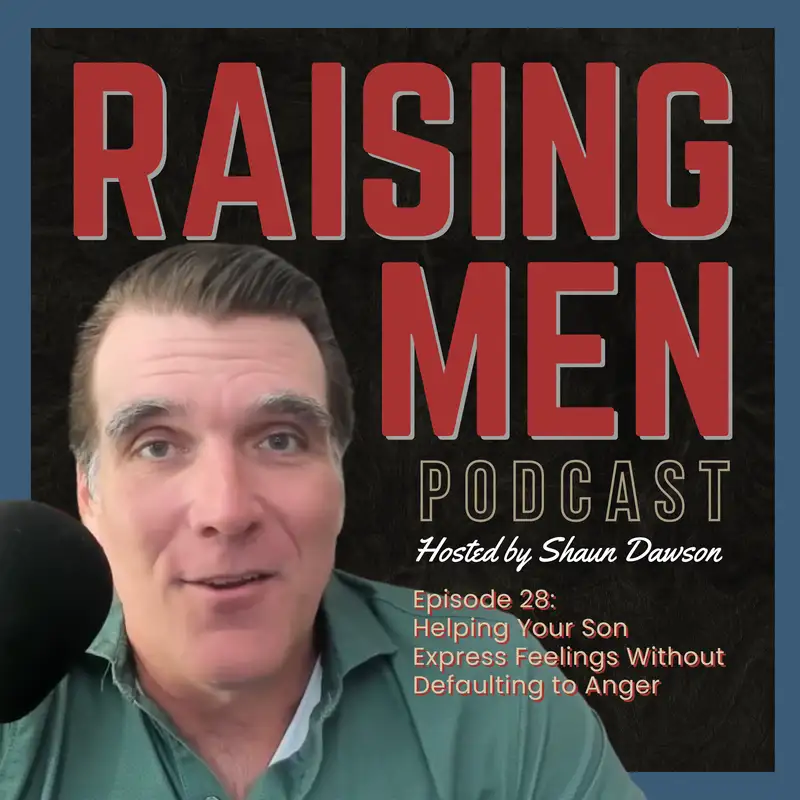
Helping Boys Express Feelings Without Defaulting to Anger
Shaun (00:01.186)
Welcome back to Raising Men. I'm your host, Shawn Dawson. Now, if you've been listening for a while, you know that we've got a bit of a motto. We don't just raise kids, we forge men. But forging anything requires heat, it requires a hammer, and it requires a blueprint. Today's Q &A is all about that blueprint. We're gonna dig back into the collective wisdom.
of our past guests, the thinkers, the warriors, and the psychologists whom we've sat across to answer the questions that we've been getting on the show. So I want to remind you of something that we talk about often. Strength is not the absence of struggle. It's the ability to recover and lead through it. It's not the workout that makes the strength. It's the recovery afterwards. So today,
We're going to look at why our sons hide their feelings behind anger, how we stop the cycle of accidental parenting and drop it into rage when we're exhausted, and how to teach a boy that losing isn't the end of the world. In fact, it's the beginning of his growth. So let's get into the mailbag. The first question comes from a mother who writes, my son is 10 years old.
Whenever something goes wrong, whether it's schoolwork or a disagreement with his brother, he doesn't tell me what's wrong. He just gets irritated and starts yelling or he shuts down. Why does he only show irritation or anger instead of just telling me what's actually bothering him? Okay, I hear you and I absolutely deal with this and it's frustrating when you want to help and all you get
is a prickly exterior. And I think that this can be particularly challenging when it's a mother dealing with a son as opposed to a father dealing with a son because we just communicate differently. But either way, we have to look, I think, at what's happening under the hood. So in our February episode, Why Boys Are Falling Behind, author Steve Biddle shared some fascinating research.
Shaun (02:24.214)
on the biology of boys, and we've talked about this before. He pointed out that from infancy, boys' nervous systems can actually be more reactive to stress than girls. Boys are less resilient than girls are. So when a boy feels overwhelmed, his engine is running hot, but he hasn't learned how to shift gears yet. He doesn't have.
the actual part of his brain that does that, the prefrontal cortex is underdeveloped. So what you're seeing is anger might just be the only gear that he knows when he's feeling vulnerable. So Eric Davis discussed this in Beyond the Battlefield too. Our traditional model of masculinity often teaches boys that shutting down
or being stoic in the kind of colloquial sense is the only way to be a man. And so if a boy is taught that being a man means avoiding soft emotions, as Eric Davis puts it, he loses the very passions he needs to fuel his purpose. And so far from wanting to suppress, our natural instinct is to try to suppress that anger, especially in boys.
because it can be scary, boys are big, boys are strong, they can act out in physical ways that can actually be dangerous to their siblings or even to the parents sometimes. But tamping down that anger is not, or certainly fighting fire with fire, which we'll get into later, is not the right way. Or it's dangerous way because that runs the risk of causing your boy to lose the very passions that he needs.
to fuel his purpose. So Ryan Walton also touched on this a little bit in our March 18th episode. He noted that many men coast through their lives because they've learned to numb their emotions to avoid pain. So when your son is showing emotion, he's likely, maybe he's numbing fear, embarrassment, or a sense of failure. So.
Shaun (04:44.886)
Ryan argues that true emotional control isn't silence, right? It's not suppressing your emotions. It's about actually having the strength to face what you're avoiding. So the tactical fix is instead of meeting his anger with your own irritation, instead of fighting fire with fire, you need to kind of.
I don't give both of you guys the grace to recognize that his high performance engine is stuck in this high rev and he needs a little bit of emotional anchoring. He needs that the gears to shift. So one of the things is not to demand an explanation at the heat of the moment. And man, do I fall prey to this problem all the time.
I, it's like, I think that when my kids are acting out, they're perfectly rational and they're just doing exactly the thing to piss me off that they know will absolutely make me absolutely angry, unbelievably angry in the moment. Obviously that's not true, but it feels that way to me. So the first thing is don't demand an explanation in the heat of the moment. There's a couple reasons for that. First of all, as Eric Davis suggests,
there's a little bit of intentional discomfort by letting your boy sit with the struggle. But the other reason is that your boy just simply doesn't have access to his Sherlock Holmes brain in that moment. He won't be able to craft the explanation at the heat of the moment. So anything you get is actually gonna make the problem worse because he'll feel embarrassed about it later on. And the most important thing you need
is to stay present and to be his secure base. Another suggestion is to lead from the front. Obviously, if you want him to be able to speak the truth about his feelings, you have to model how an adult speaks about their feelings as well, how an adult handles failure, how an adult speaks the truth, especially how a man does it, right?
Shaun (07:10.912)
And so this goes back to making sure that your son has healthy, positive, masculine role models. And then the last suggestion is to, I don't know, maybe there's a way to channel that energy, help to funnel that anger energy into something productive rather than a shutdown or a lash out. Does he run around the block? Does he build something? Does he get it out?
Get it out in a video game maybe. There's trade-offs there, but are there ways of figuring out how to channel that energy into something productive? The second question is something that I really, really, really struggle with, and so I definitely wanted to talk about it. Here's a question. I find myself yelling when I'm tired, reverting.
to how my own dad treated me. It feels like I'm on autopilot and I hate that about myself. How do I stop that monster version of me from taking over? Man, I have talked a lot about this and I really struggle with this because ironically, I am not an angry person. I have not historically been an angry person. I take things in stride.
I'm very measured, I try to think things through, I very, rarely react, and my default is to turn inwards and to be cerebral and think about things. But when my kids were born, it was almost like they knew exactly what the buttons were to make me instantly angry. And because I had spent so many years of my life not being an angry person, I never really developed the skill.
on how to deal with anger in a healthy way. And so, you know, I call this the autopilot trap. And when our physical and emotional reserves are at zero, our brain stops being creative. It just shifts down into this total reactive Conan the Barbarian brain. And it just reverts to habit. And so we default.
Shaun (09:35.289)
to the operating system that the grooves have worn in our brain. Even if we know, and that might be an old operating system, and that happens even if we know that the software is pretty buggy. Doesn't matter what we know. It matters, we're kind of on autopilot in that case. so, Devin Kuntzmann broke this down in our episode from chaos to calm.
And that's an excellent episode to listen to if you're dealing with this sort of thing. And she says that yelling is almost always a battle of egos. So when we're exhausted, we lose the ability to lead with influence. So instead of doing that, which is hard, we try to lead with raw power. I'm big, I'm strong, I'm just going to force you to do what
But, and so what we're trying to do is make the problem stop immediately, just to get a rest from it. And so we're gonna use volume to force compliance. But as Devin points out, you're gonna end up with a short term result there, but you're damaging the long term connection. You're also teaching your son that the person with the loudest voice wins the argument, not.
the person with the best argument or the most integrity. Ryan Walton challenged us on this in a different way during our session, The Danger of Coasting. Ryan talks about how most men coast through the most important parts of their lives because being intentional requires an immense amount of energy. And when we're feeling that anger, we don't have a surfeit of energy. We have
We have a real shortage of it. so yelling is the ultimate form of coasting. We're just dropping into this sort of natural, you know, like prehistoric way of dealing with things. It's the path of least resistance. Ryan's philosophy is that we have to lean into the discomfort of our own fatigue. Easier said than done. And instead of letting the exhaustion
Shaun (12:02.274)
dictate your reaction, you just have to acknowledge the truth of the moment. I'm tired. I'm frustrated. And if I'm not careful, I'm going to fail this leadership test. We have to remember the stakes. Steve Biddle reminds us that our sons are constantly downloading our behavior. They don't just listen to what we say. In fact, they don't listen to what we say at all most of the time. They mirror
how we handle pressure. And so if you're gonna handle pressure that way, he's gonna end up handling pressure that way too. So if your default is to revert to your father's old patterns, you're actually passing down a legacy of reaction rather than a legacy of leadership or pro-action. So the tactical fix is thinking about how we shift from just the default accidental.
way of dealing with things to the intentional when we're running on empty, especially. So borrowing from Devin Kuntzmann's approach, you need to identify your yellow light physical cues. Do you have a tight chest? Do you get hot in your forehead like I do? Clenched teeth? When you start to feel those things, you absolutely have to pull over. You have to...
take a break, you have to get a break. You cannot lead a child when your own engine is overheating. that's, so my wife and I practiced early on, started with a one, two, three magic system. And the beauty of that system is that you end up counting the child when they're making you mad. It just gets them out of your hair for long enough, know, sending them to their, to,
you know, their room or wherever is a way of keeping them from making you get angry, from getting a rise out of you. And so as you start to feel those things, see within yourself those physical manifestations, then you can actually push out, just reflexively do, you know, do the one, two, three magic thing, count the children, do whatever it is that allows you to take a break.
Shaun (14:29.888)
Another thing that you can do is declare the fatigue. Instead of yelling, just announce to the child, speak the truth, tell your son, I am very tired right now, I'm starting to feel angry, I'm getting really frustrated, you're making me very, I don't know. You shouldn't say you're making me frustrated. That's not the right way to put it. I'm getting very frustrated, I'm gonna take five minutes to reset so I don't get mad, I don't start to yell.
and we'll handle this then. I struggle with this a lot in the car, especially when the kids are in the back seat and they're just harping at each other and it's just this endless just chirping and bickering. I will often, like just, it'll tip me over and I will scream at them and I regret it every single time and I apologize every single time usually, you know.
five or 10 minutes later when I'm back to relax. But man, I've been working on a way to try to get them to just be quiet, just to get them silent without screaming in their faces. And so this is just by declaring, hey, I'm getting really, really frustrated. Are you trying to get me frustrated? This is not gonna work out well for you. When I'm frustrated, bad things happen for all of us.
So just, you know, just own it, right? And declare it.
Ryan Walton also suggests to stop coasting on your childhood programming. Some of our childhood programming is probably healthy, but not all of it is. We need to be intentional about it. Write down the top three things that your own dad did that you hated and create a replacement procedure for each one of these. And I love this suggestion. When you're in the nice, calm, thinking normal mode,
Shaun (16:35.832)
Figure out a replacement procedure for each one of those three things. Figure out what the trigger is, and then figure out what your replacement procedure is gonna be.
develop a new habit. So when your son pushes a button, you're not reacting. You're gonna just execute the new procedure and you can iterate that and make it better over time. So breaking the cycle isn't about being a perfect parent. It's about being a leader. It's about owning up to your mistakes. And when you mess up and you're gonna mess up, it's fine. Nobody...
For the most part things will be fine Just own it own it immediately. That's an opportunity to model something healthy as well show your boy how a man apologizes how a woman apologizes and Then get back to the mission
I hope these answers gave you some tactical ground to stand on this week. Again, I would love to thank our virtual guest panel whose wisdom we leaned on today. Steve Bidoff, Eric Davis, Ryan Walton, Devin Kuntzmann. If you haven't heard those full episodes, give them a listen. There is so much tactical gold in these conversations. I'm telling you, it's really, really great. And it'll help you navigate.
those messy leadership tests or these times when you don't feel like you're executing at the best of your ability. Please like and subscribe and keep sending in those questions. I absolutely love hearing from you because it reminds me that we're all in this together and frankly, I feel a little bit less alone at all the ridiculous mistakes that I'm constantly making. Now remember, you're not just raising a kid, you're forging a man. It's gonna be hard, it's gonna be messy.
Shaun (18:40.174)
It's gonna feel like starting from zero. Keep it up. My name is Shawn Dawson and this is Raising Men. Remember, you are a great parent.