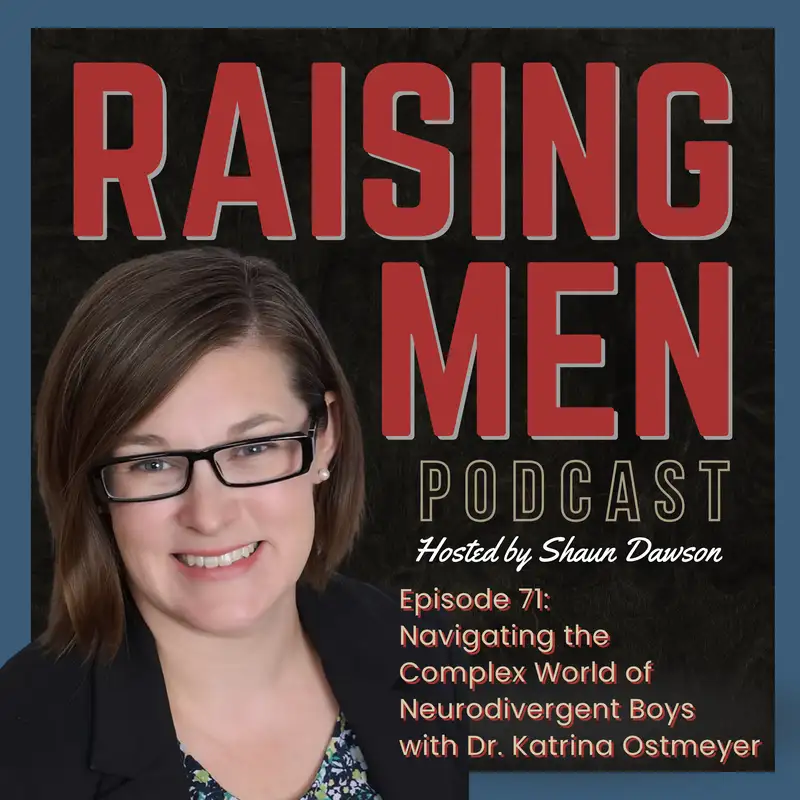
Navigating the Complex World of Neurodivergent Boys with Dr. Katrina Ostmeyer
I'll see people coming in and saying like
I'm pretty sure I have autism
and I was like I'm
I think you might be just a little quirky
and that's okay
and now
that also causes problems for people'cause they're like
I want that label because I want to be part of
I mean maybe we need
a label for more more quirky right
I mean like I I
I want to be able being able to name something
gives me a way to characterize it in my own brain
and decide what it is I
I get that and maybe
maybe we're just doing people like that a disservice
by not having a point and a way to label that
hello welcome back to Raising Men
today we're gonna tackle something
I am really excited to learn about
but I don't know that much about today
and that's one of the most common uh
complex landscapes of parenthood
which is raising sons
whose minds don't fit into the standard box
and our guest today is uniquely qualified
to answer that Doctor Katrina Ostmeier
is the CEO and founder of a company called
beyond the individual and she's an associate professor
of the practice at university of Kansas
she's a licensed psychologist
and a board certified behavior analyst
who has spent her year her career
tailoring care for children
who require more than the standard
cookie cutter approach but perhaps most importantly
she's in the trenches
she is the mother of her own neuro divergent boy
and she understands that behind the clinical diagnosis
is a son that needs to find his footing
and figure out how to thrive in our world
Dr. oshmayer welcome to raising men
thank you for having me
so now you you lead a clinical practice
you teach at the university at
the university level
and you're also a mom of a neurodivergent boy
so tell me about how that
the synergies
between your professional life and your personal life
yeah it's
it's always interesting um
having a background when I went into this field
I didn't start having kids
I actually had my son when I was in graduate school
hmm and um
there's a lot of times where I have moments when
we had some of the hard things
where I was completely unsure of everything
I had Learned and all of my career was true
not true a lot of guessing and second guessing myself
and hoping I'm doing it right
which I think a lot of parents feel
um as my son's getting older
he's almost 15 now I feel
more confident in some of the things that I was taught
and them being true but
having a better understanding of
how that translates to real life
has been really impactful in what I do in my career
and honestly um
working with my son and I have a daughter as well
who has some similar qualities
has really LED me to how I've shaped my career
over time
and actually how I run my clinic at this time
and what I teach my students
you know my understanding
and please correct me if I'm wrong about this
is that boys are diagnosed with behavioral disorders
and that sort of thing
at much higher rates than girls is
that is that right
yeah and it's interesting because um
we'll see neuro
neurodiversity or neurodevelopmental disorders
such as autism ADHD
um intellectual disabilities
things like that just present really differently
and boys and girls based on there
there's questions that bio and how we socialize them
right but um
we do see boys are more likely to be um
noticed as like acting out
oh like he's really fidgety
he's not listening he's all over the place
and so when we're looking at that
we see
most of these diagnoses are
diagnosed more highly in boys
but there's a question of whether
they actually do occur at greater rates
or if we're just our diagnostic criteria are biased to
to boys yeah
yeah I'm
I'm interested to know I
how do we disambiguate neurodivergence from like
just being a boy natural male energy
I always talk about um
a couple of different things and
and there's two pieces to this
um first is
are these behaviors or these things going on
are they causing problems
so that's number one that's question number one
and then question number two is
are these problems because uh
the environment has some issues in it
that are making these problems
or are these problems because
this child's not able to meet the expectations
they need to um
to learn or or
you know get through the day and
and meet developmental milestones
and so it's that two part uh
question that I always
look at whenever I'm diagnosing as well because
you know there's a lot of variation in the population
and things like activity level
and social motivation and social skills
and it's really not a problem unless it's a problem
is what I tell people
man interesting
so let me drill into that a little bit
it's really not a problem unless it's a problem I
my son's experience going to school um
was a little bit shocking to me in the sense that
he did not have a nice
smooth entry into that whole universe
and he was very fortunate
because he had a principal of his TK
and kindergarten school
that it was a man and was very sensitive to
it just seemed like he understood that this is boys
and he's gonna take some time to learn
uh huh and I don't know if that would have happened if
if there were a different principal
or if the principal was a woman honestly
and I'm interested in your take on that yeah
I and a lot of what I do is actually providing
tiered interventions in schools
and um it is really interesting because um
with a district that my company and I have worked with
in the past one of the things that we started with
is working a lot in kindergarten and preschool
classrooms and one of the things we were seeing
we were getting called in for kids that were
struggling in those classrooms and
we were like well
you know there is an expectation here that maybe
most 5 and 6 year olds can't really meet
you know
in terms of how long they sit attention and focus
and that maybe some of this is normal
variability and attention right
not I don't think that
45% of the kids in your class have ADHD
or a behavior disorder the
the those numbers aren't quite what we expect
yeah and so when you talk about that I
I do feel very strongly about that that um
a lot of times when we're looking for
what's the answer for why a child is
struggling in the classroom
or has a behavior problem
or what they call a behavior problem
if we're gonna treat it anyways
the treatment is actually going to be
let's change what the classroom looks like
around this child
and we might do some skill instruction
but we would do that anyways in school
because every child needs slightly different um
teaching and most kids
you know 80 to 90% of kids
if we're doing it well in the classroom
should be succeeding without any
particularly individualized intervention
and so if I see a classroom where that's not happening
especially I'm gonna question that um
and then also we have like
these 10 to 15% of kids
who maybe need a little bit more right
and it doesn't mean that they have a disorder
it just means hey
you know what I came
into school and you know what
um maybe I didn't do a lot of sitting
maybe I've been a really active kid playing outside
doing other things like that
and now the expectations
I have to sit for long periods of time
and I just don't have that skill yet
that child
might need a little bit of additional intervention
but it doesn't mean he has a disorder
if that makes sense yeah
that that's my boy haha
that you just described I mean
you just he's got so much energy
and he has this desire to entertain people
and he just loves organizing things
and I mean and
and and I
I get you know I
I have a real sensitivity to this um
because when I was young it was
it was when add was just coming into the forefront
and there was a real question um
about whether or not you were just
whether to to what extent
in any particular school or environment or whatever
it was a real thing which it's definitely a real thing
but or it was a way to get the kids on drugs
so they're a little bit more
malleable and controllable
at 8th in 8th grade or whatever
and um
the school system tried to put me on
on Ritalin and my you know they
they suggested strongly that
that they should that my mom should do that
and my mom threw a fit and um
didn't let it happen
if she hadn't done that
one of my great passions in life is flying airplanes
and it turns out
that if you have ever been diagnosed with add
or ADHD or any of that stuff
then
it's a lot more difficult to get your pilot's license
or at least it used to be um
such that it would not have been possible for me
I never would have gotten into it
and no she had no way of knowing that she
but what she knew is that she wasn't gonna
like she was gonna take this really seriously
and she wasn't just gonna roll over on whatever
you know the school was saying that they wanted to do
and she she protected me in a way that
I don't know if a lot of parents are doing that
or necessarily would do that
or would have done that back then
I think I think it's a lot different now
I think that the diagnostic criteria are probably a lot
more firmed up and
and you know
the kinds of expectations
like people like you come in and go
it's not 45% it's more like 10 and
and you know
like let's let's let's
let's make sure that we solve this other ways first
I don't think that was present back when I was
you know 10 and um
and so like it
it's it's a
it is a it is a complex thing
you want to make sure that you
help everybody in the way that they need to be helped
and that you know
at the end of the story it
the most important thing is that the
the kids thrive yeah
and that you know and
and as long as you approach it from that standpoint
then I think that's the right call
yeah and I always
I think about um
when we're supporting kids and families
and in schools and systems
uh that we have a lot of tools
and one of the things is you know
back in yeah the
the 90s
we were seeing that hey
if you get diagnosed with ADHD
the recommendation is medication right
and even today
if you look at the American Academy of Pediatrics
the recommendation is a combination of medication
and behavior therapy for a diagnosis of ADHD
interestingly though
there has been a shift
and there's a lot of literature and discussion about
whether first
when we make these diagnoses
do we look at behavior therapy and systems
intervention first and then consider medication
and it can be a little bit different in
like more of a mild to moderate case
uh with some of these diagnoses versus a more severe um
case of course
as well and so
I always look at like
what are the things that we do and the tools we use
um and I
I think of my son for example
uh we did
we started recognizing um
differences for him around two and a/2
3 years of age and um
we're having some pretty significant consequences
of some of those uh
experiences and so we started with some pretty uh
intensive behavior therapy
just doing it on our own um
just because
without a diagnosis of something like autism
the types of therapies we were doing are not available
with insurance in the state of Kansas
and so we we did all of these things
we did a lot of accommodation
this kid we met with this school
we're like we're really worried
we really struggled in preschool
he went into kindergarten
this kid he's like
I like structure I like
he's like I was struggling in preschool
what we found out is
cause there wasn't as much structure
and so kindergarten 1st grade
he did great
2nd grade kind of fell apart
and for us
we had done all these years of behavior therapy and um
there were just some things that we could no longer
you know control and where the things that I was like
hey could we do more in school
probably is it feasible we're gonna get those things
no and so at that point
we did decide to do a medication for him and for him
I feel like it was necessary
um I am quite sure that I have ADHD
every one of my students will tell you that
and I I have systems in place
and I ask my students to accommodate me sometimes um
but I've never
for example been on medication
I don't I think
I have all the skills that I need to be successful
so I don't feel the need for it
and we've had the conversation with our son
for example like you
this is your choice
how you choose to manage this as you're getting older
um
he probably
he was also premature and has some other things
so
he probably will be looking at some kind of medication
regimen of some sort as he gets older
but I do also really believe in the choice
and even speaking of airplanes
you know and flying
I had a client who was on medication and had ADHD and
um he was very much
interested in getting his pilot's license
so what we did is
a bunch of testing to show that he could manage
and have attention and focus as he got older um
and and he had to prove
like you said he had to prove that he could
fly without the medication
in order to get his license
yeah and and
and you can do it and
and now it I mean it's
it's now a lot
more possible than it was when I was younger
yeah but man
that's great and
and I yeah
and you know they
they also they
they just wanna make sure that there
that if someone's gonna be flying up over cities
that they're gonna be safe and they're not gonna
you know run into any buildings and
because there's enough of that happens without
you know having medical reasons for it happening um
let me ask you this you know
I
is neurodivergence even a disorder
we refer to these things as disorders
but you know
to what extent is it just
people's brains work differently
and that is you know
that's just the way things are
and characterizing as a disorder
has negative connotations
and I love that you asked that
because I think there really has been such a shift
in how we look at this in the last 10 years especially
and so when we think about neurodivergence
we started out with what we call
neurodevelopmental disorders
like ADHD autism
etcetera and in our previous diagnostic manual
we were DSM4 DSM4TR
these diagnoses carried a lot more weight
than they used to and they used to have a lot more
as you kind of talked about
negative connotation associated with a problem right
and over the last 10 15 years or so
we have seen a shift one is our
our diagnostic criteria is different and
and especially in the case of something like autism
the criteria is actually pretty murky at this point
for some of these level 1 cases
um but there is a community within this so um
people who say hey
I feel outside I feel othered
I'm clearly feel different than
than the than the rest of the people around me
and so it became more of a label of a community and um
it's been interesting actually
as a diagnostician
that I'll see people coming in and saying like
I'm pretty sure I have autism
and I was like I'm
I think you might be just a little quirky
and that's okay
and now that also causes problems for people
because they're like
I want that label because I want to be part of
I mean maybe we need a label for more
more quirky right
I mean like I I
I want to be able being able to name something
gives me a way to characterize it in my own brain
and decide what it is I
I get that and maybe
maybe we're just doing people like that a disservice
by not having
a point and a way to label that
yeah and
and I think that's the thing is maybe it's um I
and I really try to affirm
it's like yeah your
your brain is like you said
your brain's a little bit different
but one of the things is if you like
look at neuroimaging
one of the reasons we have such a hard time replicating
neuroimaging studies is because
everyone's brain is just a little bit different
and they all work just a little bit different
we all have unique strengths and weaknesses
our brains are shaped by our experiences
and so we want to see some of that
um we
we expect and want to see
divergence across the population um
but it's
and this is where I always kind of go back and forth
it's like you know
you can be a part of a community
and not have to have a problem
and that's
the thing is a disorder says you have a problem
and this is something that you need intervention
you need support you need something different
and I often into a lot of what I
my work when I move from diagnostics to
you know therapy
it's how do you recognize your own personal strengths
and stretches and how do you work with those
to have the life you wanna have
and be able to be in all the environments
you wanna be in
so you're not losing out on opportunities
um and that's one of the other things too
we've seen with the field is moving away from
let's treat this let's fix this to more of a
what do you want your life to be
and how do we help you
recognize what you're working with
and do so effectively
I love that I love that framing um
because it takes a a positive approach as it's
it takes a a positive approach as it's
it's like the difference between health and illness and
and saying okay
well your goal
let's define what health is for you
and then like
help you get as close to that ideal as you can
as opposed to oh
well let's catalog all of your sicknesses and then
and then deal with them one at a time
right and
and then you know
of course when you define what health okay
well health to me means
you know I can
I can bench press a certain amount
and I can run for so long
and I can do all those things well
for somebody else it might be different
you know
somebody who doesn't have the use of their legs
then they're not going to be able to run
in the same way that I can
but they can define health for themselves in
in in a way that is meaningful
that has the exact same meaning to them
as mine does to me and
and so like and then okay fine
we're gonna accommodate the
person's lack of
the use of their legs by giving them a wheelchair
and that's as opposed to treating an illness
or treating something that's bad
we're enabling something that's good
and I think that that's a much
more healthy way to look at this kind of thing and
and and for for
for everybody for the for the parent
for the boy and I think there's a real lesson in that
yeah and I think it's
I love the strength based approach
for a lot of reasons and I even go back to I
I read an article um
an evolutionary psychology about um
ADHD specifically
and they did a little study looking at people
with a Berry picking um
kind of paradigm where it's like people who had ADHD
when they didn't find berries
they were more likely to move on to the next patch
and so one of the things
when you think about having people who
are gonna sit there
and really look for every last Berry in the patch
and people who are gonna move on
and find the next patch you need both
of those type of people in our population to survive
you know and so I was left to think about like um
yes there's differences and
and for some of the people um
with neurodevelopmental disorders
they may need a lot more support than others
but they also bring so much value and um
strengths to us as a population in society
and I always like to think about that and
and try to work with families and
and kids themselves and adults to
to see like
what is it that you want and what do you bring and um
what do you enjoy
yeah I
you know that
that tendency to look for the next patch um
you know there's a word for that
when you encounter it in children
and that's Defiance
hahaha and I
you know I think that
my own personal reflex in dealing with Defiance
is to meet it with my own version of Defiance
and it's like it's a challenge right
and I need to suppress that challenge
that's my reflex
I fight that reflex because I also recognize that
that's not a healthy
nor effective way of dealing with that experience um
you must have a tremendous amount of experience in
in in dealing with that that um
that dynamic tell me about
you know what
what do I do when my boy is just not
doing what I want him to do
well and this
I'm gonna give you an answer that's uh
probably less simple than a lot of people want
when they come to talk to me about this um
the first thing I always say is um
I'm trained as a behavior analyst
and one of the very first things we learn is
we describe behavior instead of label it
and then we ask why is it happening
and um
and I get this a lot where it's like
so and So's just a bad kid
they're being defiant they're being a brat
you know all of these labels
that can go along with these behaviors when
when it's difficult to deal with
and um
one of the things that I'll say is like
but why is it happening and one of the things is we
we can look very functionally and say like
what's happening outside is like well um
you know they just want their way
you know we call them my way kids right
so do I I'm gonna be really honest
and yeah no I get that
for me as an adult
it works super well for me to push back
sometimes I it's just
I've Learned when it's worth pushing back
and one is not and sometimes
I make a mistake and push back when I shouldn't
and I end up with egg on my face
everyone does it it's fine
but um
with kids I think about okay
why is this happening
so maybe there's something I'm not understanding
I think of a kid maybe who has like rigidity right
it's
I just really feel a need to finish whatever I'm doing
and if it's not finished it really bothers me
now life can't always be finished
so I might still have to teach skills
to deal with that discomfort but um
we may say like let's talk about it why um
I also gonna look at motivation
the
the reality is that everybody prefers to have their way
and if I am seeing like
in this moment where we're being defiant
I'm gonna say OK
here's what I need you to do
here's what you wanna do
we're not doing this in the moment
by the way that's too much talking
but the moment the moment is the worst time to do it
the moment is the worst and it's like
but what are we gonna do we see how we change behaviors
actually
through consequences and through repeated consequences
um I actually deal with it less with my son
more with my daughter
it's more of the defiant one in our house
but I do have a
bit of a memory of the same way in my house
yeah vivid memory
when she was 3 and she we had cottonwood seeds
and she wanted to get all these cottonwood seeds
and keep them as pets and I'm like
do not bring those in my house
um and one morning
we're getting ready to go to school and everything
and I said if you walk out that door and get
and we should call them fuzzies
get a fuzzy there will be a consequence
she looked me dead in the eye
thought about it for three seconds
open the door went and got it and and
and it was worth it to her in that moment
her brother's face though
was just
he was like oh shocking
he's like mom's gonna lose it
and some I'm
I would love to say I'm a perfect parent
I never lose it with my kids
I never yell I never lose my temper
the reality is sometimes I do
but that was one of my parenting moments
I was like I actually did it right
and I said
I need a minute to think about your consequence
everyone get in the van we're going to school
I had a really similar situation with my brother
with my son when he was about 3 years old he um
he used to carry this backpack and it was loaded
I mean this thing must have weighed half of his weight
and I mean he just had everything in there
and he would carry this backpack wherever he went
and we went to Legoland one time
he loves Legoland
and we have a Legoland here where I live and um
so we go fairly often
and we went to Legoland
and he brought his backpack with him
and that was this is really frustrating for me
I hate the backpack he
it's all over it's
it's it's always in the way
it's you know
he he goes to the play areas
then he leaves the backpack places
then we have to find the backpack
we have to remember to take it with us
it's this it's a
it's a flipping nightmare
and this happened and for
you know
about two or three times he had left a back backpack
and I said okay lake
if you leave the backpack again you
you need to manage your backpack
and if you leave the backpack again
we are going to leave Legoland
and he he's like OK
OK and then he leaves the backpack and we can't find it
and so I go I find the backpack and I said alright
we gotta go and of course
that results in an absolute full on meltdown screaming
I have to carry him out of the park
we go to the car everything gets calmed down
and I said listen
and and he was screaming the
the the um
the the outburst was all about
you know he
didn't want to leave Legoland
I wanna stay I wanna stay I wanna stay and I said
listen
do you wanna stay at Legoland or do you wanna go home
he goes I wanna stay
I you know by this time he's pretty calm
he's
he's we've gotten over the thick of it and he's like
I I really wanna stay at Legoland
I said OK
I'll tell you I'll make you a deal
we can stay at Legoland but
only if you leave your backpack in the car
and
it was agony for him
you could see
him mulling it over and thinking it through
and then he looks at me and he says
we can go home
he wasn't willing
to leave that backpack in the car
and this was so frustrating for me
because I hated the backpack
and you know what eventually it just went away
and he didn't need the backpack anymore
and it was okay
and I had to create a bunch of rules around like
I didn't wanna have to carry the backpack
I didn't wanna have to manage the backpack
but if he wants to manage it
and he wants to carry it
and he wants to keep track of it
then it's actually a lesson for him
like his desire
and to have that backpack around
doesn't have to be a problem for me
it can be an opportunity for him to learn
responsibility and all of those things
and I had to reframe it in my mind as that
or else it was just gonna drive me freaking crazy
hahaha and it still drove me a little crazy
but I actually but
but because I reframed it in this other way
it I I
I think it actually came out really
really well and
you know now he doesn't have it
now he still packs a lot of stuff in his backpack
he likes to have he likes to have options and
you know so he likes to
he doesn't like to be bored
and he likes to have options
and so um
but you know he doesn't carry his backpack
and I think that's that was a great example too
of like using consequences and and
and problem solving right
you can't
you can't problem solve in the middle of a meltdown
right you can't reason and that's a reflex
it's so great
like we're just wired to step in and just make it worse
it's it's brutal
yes and you wanna fix it and you don't wanna
you don't wanna kick
pull your kid kicking and screaming out of Legoland
and I have as well done that
so I understand that um
but it is like in the moment
it's like you can give choices and
and that's the thing is
people might see that even as Defiance
because if you have framed it as
you need to leave the backpack
and we're gonna go back in
um he's not one
getting the opportunity to learn that responsibility
and learn those management
um techniques
and he's you're
you're working with motivation
you're teaching them you need to do as I say
and when we're thinking about raising kids up to be
successful adults
whether they have neurodivergence or not
it's you need to learn how to manage your choices
and choose
what are going to be the things that work best for you
as we get older at 3
we only think about what's good for us
but as we get older
we do have to start considering some other people
around us but um
learning that lesson at 3 is so impactful
and I think it's also hard too
cause it's one of those things
like you talk about that backpack
for a child let's say with autism
that backpack may be that item
then they are 15 and they want that backpack still
and so they may like when we talk about this
a lot of these things
kids just kind of grow out of and they figure it out
and with kids with uh
certain types of neurodivergent
uh disorders or neuro
uh excuse me
neurodevelopmental disorders
um
we might have to teach like
you can be okay without the backpack
um but that's where
you know we might do some more um
specific interventions
and help build the environment around them
to learn that they can do that
and we're gonna have to be
the adults who have to manage that for them
and help them learn and it can take a little bit more
effort yeah
yeah I I
yeah and so
I mean because
one of the things that I was basically wondering about
this is is
is at what point do things become
like needing intervention
and what I'm I'm gonna put words in your mouth
as a way to help gauge my understanding here
but what I'm hearing from you is that these are all
you know I mean
we are all gonna face these challenges
and there are strategies and tactics
and techniques that we can use to handle these things
and just because your son
your three year old
wants to carry a backpack everywhere
doesn't mean that he's gonna wanna do that when he's 25
and and you have to deal with that in the
you know in
in the moment anyway
whether
whether there's neurodivergence or not
and so you deal with that
and then at the point
at which you can't use the normal channels
to deal with those things
that's when you know
raise your hand and go get help
and that becomes a natural thing to do
yeah and I think one of the things is that um
working with children and I'm one of those people I
I work in this area
but I also will be the first to say like
our definitions were very black and white
in these definitions for diagnostics
and the reality is that
the answer is not so black and white
it's like oh
this is ADHD versus
this is autism versus this is anxiety
it's not that clear actually
um and we treat it like it is but
and so one of the things I'll tell people is like
you know when we have people come
especially
into the training clinic at the university of Kansas
um a lot of it
I was like yeah
we're just this is just parenting
we just need some parent training
so we kind of know how do we do some of those things
like how do we manage the backpack situation and
and you know
kids are not born with instruction manuals
we figure it out as we go
um but we have a whole science and like
here's how we do it uh
in ways that tend to work better
um and so for some time
for some families we might not even have a diagnosis
we're just like let's do some parent training
let's see how this goes now
it's when that parent training piece is like
it works a little bit or we plateau
we still are having a lot of time and effort
and problems that's where we start thinking
what else is going on here
and what other tools do we need to bring in
um and I'm
I'm a let's
let's start with the simple intervention first right
and then let's see
what we've got and then let's add a little bit more
let's see what we've got and then if it's
we still have questions
or things are not working the way we expect them to
that's where we need to go
look for some more answers
and maybe do some more testing and things like that um
and so I think that
that's an area where I might recommend
people go and ask for more help
another one is especially with the early um childhood
so that birth to about five
if we see kids are not meeting developmental milestones
right so they're not talking or maybe they're talking
but they're not con they're not building that
back and forth with other people
they're not learning they're not toilet training
um like we expect some of those things
um those can be signs that we have a neurodevelopmental
disorder where we might need actual interventions
to help accelerate uh
their development and the thing is
that we see
the brain is just a lot more malleable and plastic
um when we're young
and so if we are seeing those delays
we do recommend going and maybe looking at uh
certain diagnoses because those diagnoses help
they're kind of a ticket to some of these interventions
to help accelerate development
um but we see that with those interventions
we can actually kind of change that trajectory
so we're seeing fewer issues as they get older
how do you manage the risks
of so I I could think of
I can think of a some
some risks and opportunities with um
with those sorts of interventions in terms of like
the strategic implications right
so 1 one of the risks of being sort of labeled with
with ADHD for example
is that it
in the mind of the the child
I can imagine it it can become a crutch
oh well
or an excuse right
oh I'm like this because I'm ADHD or whatever it is
so that's one of the risks
another risk um
might be that um
well let
let let's
let's stick with that one how
how do you manage that
and then on the other side of that
how can you reframe it as an asset right like
like
no you don't
you don't have a disorder
you have you have an asset
you're one of these
10% of people that goes into the new patch
and seeks out like
this is a really really important society capable
and this is where entrepreneurs live
this is where people people build things and
you know create the new world that we're gonna live in
you're that type of person and that's a superpower
and so like how do you
how do you manage that how do you cultivate
you know the
the the
the identity that no
this is part of one of my superpowers
as opposed to this is this affliction
and I and I actually come a
slightly different um
a slightly different approach
when I talk about this with kids
both my my own and my clients
is I always talk about
everybody has strengths and stretches
like you have things that you're really good at
and things that are harder
yeah and we have this shortcut
a label the label is just a shortcut
for us to kind of understand
some of the things that are harder for you
or easier for you and I say
so let's talk about these things
what are things that you're really good at
what are the things that that are easy for you
um and maybe it is
you know I think about I use my son as an example
cause I can't talk too much about my clients
but my son for example
um he can get very hyper focused on things
he can and he's a very gifted musician
just amazing and he's
he can compose
and he's been able to compose since he was 7 years old
which is beautiful and I was like
your brain is pretty unique right
most people can't do that
now he sometimes doesn't believe me
but we've often told him like
no dude but this is pretty cool
um
now let's talk about the things that are hard for you
so for him he can get really easily overwhelmed
or when we were learning music or learning piano
he had had pretty significant perfectionism
and I'd say every single
time we sat down to play meltdown
we had to work through that
and he had to learn to be okay with mistakes
and so I said this is this is your stretch
so it doesn't mean we don't work on it
doesn't mean we just accommodate everything
I always talk about accommodation
with the goal of building the skill
or a way of doing it so you can meet the expectation
and so um
even me as an adult
I know that I can struggle to keep track of things and
and I and I uh
am very curious I go through lots of Berry patches
is one of my problems and um
but I tell people like at
at work I have somebody at my clinic
I said hey
can you help put this down on on our systems
so we built out systems and I said
can you help me keep track of this
and remind me if I don't get to it in three days
and then my students I'm like hey
here's the system please call me out
don't feel like you're calling me out or it's a problem
if I miss something
just remind me cause I probably lost track of it right
and so I I build systems so I can do it pretty well um
it's gonna be imperfect
because I do have some difficulties
with organization and planning
despite that's what I do for a living um
but I've I say here's
here's the accommodations I need
and I ask people to help me out
and that might be the answer sometimes or for my son
it's we're out of place now he's he's right as well
and and he has a 5:04 at school
and it's like hey
when you need to take a test
we're just gonna go to a different room
because it's just hard
with all the other stuff going on around you
for you to focus and we want you to do your best
and or if he's feeling disregulated
he needs to just step out
take a drink of water
and be able to go back in the classroom
and by having those little things that really are not
in my opinion I'm like
these are not significant interventions
they they had more significant interventions
when he was younger but we can work to a way where like
that's just something anybody can really do
as long as there's some understanding
in the environment yeah yeah
I don't understand why this is why that's
why that's controversial I
I mean like
why doesn't everybody get to just go take a drink
when they're just right
let's just let's just set up the system
such that that's something that people can do
you don't have to have this label
you don't have to I I mean
it it just feels like it's counterproductive
to turn that into a big deal
as opposed to no
and sometimes
people need to go take a break and you know
they get really anxiety when taking these tests
and that's just part of that's part of life
yeah and
and that's the main thing is I always say it's
we don't we're not gonna remove the expectation
we're gonna or we might for a period of time
I always say we may need to accommodate
cause we need to meet kids where they're at
if they just don't have the skill
me asking them to demonstrate
a skill that they don't have
is not gonna work but I say
I'm not gonna just say we're gonna accept this
I say what can we get you to
let's work on that skill and let's work on this skill
and we really wanna focus on these are your stretches
everybody has to work on their stretches
so for some kids they're not the fastest runner right
but you know what you still have to go to PE
they're still gonna have you run
and you're gonna get better right
and maybe you wanna play sports
and so you're gonna have to
you know yeah
that's right yeah
so so I think that's the thing is everybody has those
and this is just a shortcut to understand
some of the things that may be easier
or harder for you and um
but you have to tell people and
and we have to figure out what it means for you
as an individual and
it seems to me yeah
and and your own unique
you know this label
whatever it is ADHD
might apply to you in a different way
than it applies to somebody else and
and you know
it it it's
it's meant to give you a shorthand for describing
some of you know
a collection of the attributes
that make certain things hard
and certain things easy but
that doesn't mean that it's the exact same for you
than it is for Joe and
you know everybody's
everybody's everybody's different
everybody has a tough time
everybody struggles and that's just
that's part of life and we gotta get past it yeah
I I will say there's one caveat to
as I'm talking about this
I'm talking about kids like with ADHD
or maybe what we call level 1 autism
where so they're gonna go live independently
and they'll have skills
and they can completely do all these things we
we do have a component of individuals
with neurodevelopmental disorders
such as like intellectual disabilities
or profound autism is what we call it
and these might be people who are going to need more
support um
as they get older so they may
you know never live on their own
or maybe they can't communicate right um
and there
we need to maybe look at that a little bit differently
and we're gonna look at behavior differently and
and honestly
when people see an individual like this and
you know out on
the street they
they usually approach that person a little differently
too so
there may be some places where
I'm only gonna get you so far
so for some uh
kids I work with we're not going to get to the place
where we're going to have me
you know be sitting in the classroom all day right
it's not going to be the best place for them
and we're gonna say
what are the skills that we need to teach
so they have as much autonomy and independence um
as they can have um while being safe and
and giving them the opportunity to be part of society
and I think that's also really important as well
to remember we've got that other side of this
neurodiversity spectrum as well
yeah
now well
so I always like to end these conversations with the
the same question and that is if
uh give me one principle that every parent listen
should should think about or should know when
in their attempt to raise excellent men
so I think it's meet your kids where they're at
don't make excuses for them
but help them help them grow
we have and and use use the resources
and help in the ways that you see
as most important and effective for your child
in the moment cause that is our
that is our goal at the end of the day
is not to have a perfectly behaved child
it's to help um raise
functioning successful and happy adults
yeah I think that's exactly right
where can people learn more about you
and beyond the individual
yeah so people can find us at our website
at WWW dot beyond the individual
dot com uh
we're also on Facebook Instagram and LinkedIn
um and if people are interested in our services
uh we can work across 44 states
uh through Psych Pack
so uh
we do provide telehealth
and then more local to the Kansas City area
um interventions in office and home and schools
and all those links are in the show notes
uh Doctor Osmair
thank you so much for sharing your perspective
and educating me on this complex and fascinating
interesting topic um
and uh
and and giving us just uh the
the uh
the benefit of your insight
I really appreciate you being a guest on the show
thanks for having me and to everybody listening
thank you for being part of the Raising Men community
be sure to like and share and and
and interact with us in the comments
and remember that you are a great parent
raising men is produced by Phil Hernandez
this episode was edited by Ralph Tolentino