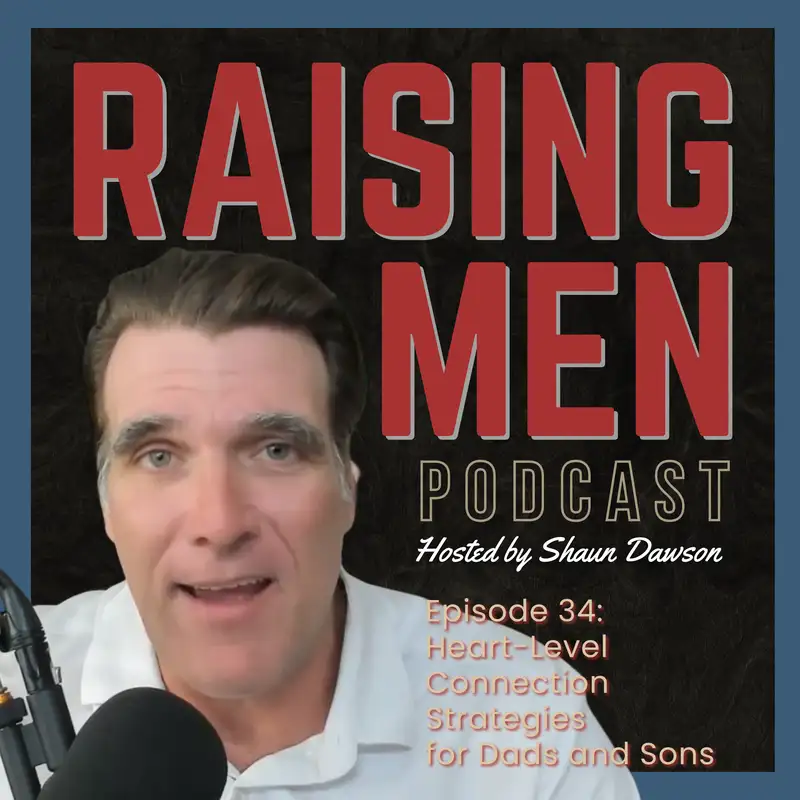
Q&A: Heart-Level Connection Strategies for Dads and Sons
Welcome back to Raising Men.
I'm your host, Shawn Dawson.
You know, I started this journey with kind of a single uncomfortable truth.
Our sons aren't just watching us, they're becoming us.
That is generally the theme of today's Q &A session.
We've got two questions.
One is from a dad who feels like his old school playbook is out of date.
And the other is about a phenomenon we've all probably seen.
A kid who is just soulful and an emotional genius at home, but turns into a silent statue
the moment he hits the playground.
Now, as always, we're going to dive into the collective wisdom of the incredible guests
that we've had on this show, from therapists and...
psychologists to green berets and tech leaders to see how we can update our operating
systems and help our boys navigate a world that often asks them to hide who they really
are.
Our first question comes from a listener who identifies as an older dad.
That uh hits home with me, I'll tell you that.
He writes, I feel like the world
is moving too fast for my old school advice.
I was raised in a strict suck it up household, but that doesn't seem to work on my son.
My efforts to toughen him up seem to make him even more fragile.
Am I thinking about this the right way?
So I hear the humility in that question.
And by the way, I feel this greatly as well.
I kind of had a similar experience to you growing up.
We often fall into the trap of parenting on autopilot, just doing what feels right.
And a lot of the times, what feels right are the grooves that have been worn into our
brain based on how we were brought up.
So we essentially repeat the patterns that we inherited.
But as my guest, Damien Gomes, who builds AI systems for a living, he put it really well.
He says, we're not...
building an automation, we're helping our sons find their own operating systems for life.
And one of the core metaphors that I like to use on this show is the two brain metaphor.
I often talk about the Conan the barbarian brain and the Sherlock Holmes brain.
Now, the Conan brain is the amygdala.
It's survival driven, it's reactive, and it's kind of limited to
just emotional responses, mostly being one acceptable male emotion, which is anger.
The Sherlock brain is the prefrontal cortex.
It's the logical side, it's observant, it responds to things as opposed to reacts to
things, and it's capable of empathy.
Dr.
Gloria Vanderhorst pointed out that while the Conan model was
once adapted for survival, it is often maladaptive in the modern world.
And so if we only teach our sons to be aggressive and brave while cutting off fear, we
make intimate relationships much more difficult, maybe impossible for them later in life.
So updating your OS means moving from a system
of control to a system of connection.
Updating your operating system doesn't mean throwing away your values.
It means redefining what these things look like, like strength.
Christopher Veal, a Marine veteran, shared that true manhood isn't about the armor or the
walls we build.
And he argues that vulnerability is actually a form of leadership.
That when you admit mistakes or show emotion,
You're not weakening your position.
You're building a drawbridge of trust for your son.
Simon Rinne, who grew up in that suck it up culture of the 80s and 90s like I did,
emphasized that the playbook is changing.
He suggests that mindfulness, bringing the subconscious to the conscious, is the ultimate
upgrade.
It allows us to pause between a child's behavior
and our reaction allows us to consider that reaction and try to get the best outcome,
meaning the outcome that is most aligned with our deeper values.
As Eli Weinstein noted in his work on his transition from dude to dad, we have to unlearn
the silence of past generations to build new patterns of emotional strength.
Now, dad,
Your old school values of hard work and protection and provisions, they're still vital.
They're really, really, really good, especially in this kind of modern world where the
values are kind of crumbling or the institutions that used to instill those values are
crumbling.
But the update you should think about is emotional literacy.
uh Johnny Miller.
taught us that our nervous system is the upstream lens through which we experience our
family.
So if you can regulate yourself before you relate to them, you're already running the most
advanced software that you probably can.
Our second question is, my kid is emotionally brilliant at home.
He's kind, he's expressive, and he's deep.
But the second we're around other people or at school, he shuts down.
How do we help him navigate this?
Now, Dr.
Gloria Vanderhorst had some good insights on this too, I think.
She talked about something that she calls the masculine ritual of safety.
And it goes to kind of a central hypothesis that I'm working on right now, which is that a
lot of the things that
I think we believe that men don't do, right?
Men aren't expressive.
Men don't wanna talk about things.
Men wanna kinda be on their own and all of that.
Those things aren't true.
But what is true is that men don't feel safe doing those things and so they don't happen.
Dr.
VandeHearst explained that unlike women who...
often dive directly into emotional sharing, men and boys often require a ritual or some
kind of process or posturing before they can feel safe.
They feel the need to establish their status or toughness in the room before they can
bring their real worries into the light.
So your son, when he's coming in and not
engaging the way he is when he's feeling safe at home, he's got a survival mechanism
reading a room that he perceives as potentially judgmental and he doesn't want to step out
of line.
In fact, research shared by Dr.
Vanderhorst suggests that infant boys are actually born with a broader range of emotional
expression than girls are.
Because society and oftentimes even well-meaning caregivers, including us, unintentionally
discourage intense reactions in boys.
And so our boys learn to narrow the room and limit their expressions for safety.
And that is kind of extinguishing their fire.
So when we see our boys shutting down,
our instinct might be to push them to be ourselves, almost shaming them into not being so
shy.
And we have to be careful not to do that.
We need to not shame them for their protective shell.
I have a theory that shame is never a good idea.
And I'm not sure whether that's 100 % true.
But certainly in our relationships with our kids, I think it's really overused.
Paul Kix used a beautiful metaphor here, I think, which he called it the Brooklyn Bridge.
He explained that vulnerability is like the tensile strength of a bridge.
It's the ability to flex and sway under pressure without breaking.
If a bridge is too rigid, it becomes brittle and it snaps.
Ken Mossman, who works on dismantling the lone wolf myth, points out that boys often
equate vulnerability with weakness because that's what they see modeled from us.
If they see us hiding our cards in public or not being willing to be vulnerable, they're
gonna do the same.
So, how do we help them bridge the gap between their private brilliance and their public
persona?
How do we do it in the moment?
The first uh nugget that I might see comes from Dr.
Michelle Watson Canfield.
And that's about connection before correction.
We talked about, in that episode, we talked about the castle metaphor.
Heart level connection is what opens the drawbridge into the inner walls of the castle.
So if you try to correct his public posturing without that connection,
He'll just pull the bridge up tighter.
So, you know, get down to his level, look him in the eye and say, man, it seems like
you're feeling pretty shy right now.
That's understandable.
I feel shy often as well.
What do you think we could do to feel more outgoing or safe or like you are at home?
Like remember when you sang that song in front of your aunts and uncles or whatever.
You can also model the redo.
If you find yourself posturing, maybe you were aggressive in traffic or you...
You shut down during a social gathering and started browsing your phone or something like
that.
Talk to him about it later.
Simon Rinne and Ryan North both emphasize the power of the repair.
It's such a powerful thing.
Say, hey, I noticed I was acting out a bit.
And I was acting tough earlier, but I was feeling nervous.
And this is how I dealt with that.
If he sees you struggling with those same sorts of things, he'll be able to address that
later.
And you also need to think about addressing the root need.
Dr.
Van Der Hor suggests that many of the behavioral masks are actually a cry for belonging.
He's acting a certain way in public.
He's likely trying to figure out where he fits.
So maybe we can help him reframe his internal emotional brilliance as the secret strength
rather than something that he's afraid to show people.
But as we wrap up this Q &A, I want to leave you with one operating principle that has
come up time and time again over a lot of episodes.
It comes from many of our guests.
But Michelle Watson Canfield said it really, really clearly.
She says, never underestimate the power of your presence.
You don't have to have the perfect updated OS today.
You don't have to know exactly what to do.
to stop the posturing, you just have to be willing to show up and be present.
And that doesn't just mean physical presence, that means intellectual and emotional
presence as well.
Fatherhood isn't a destination, it's a constant process.
It's about trying and failing and having the courage to try again.
Remember my principle that excellence is failure.
If you wanna dive deeper into any of these concepts, I highly recommend checking out the
full episodes with any of the people that we mentioned here.
You can find links to all of that and links to their work in the show notes and other
resources at Raising.Men.
Until next time, keep it up, man.
Keep doing the work, face what you're avoiding, stay curious, and remember that the man
that you are is the man that he will be.
I'm Shawn Dawson.
This is Raising Men, and you are a great parent.