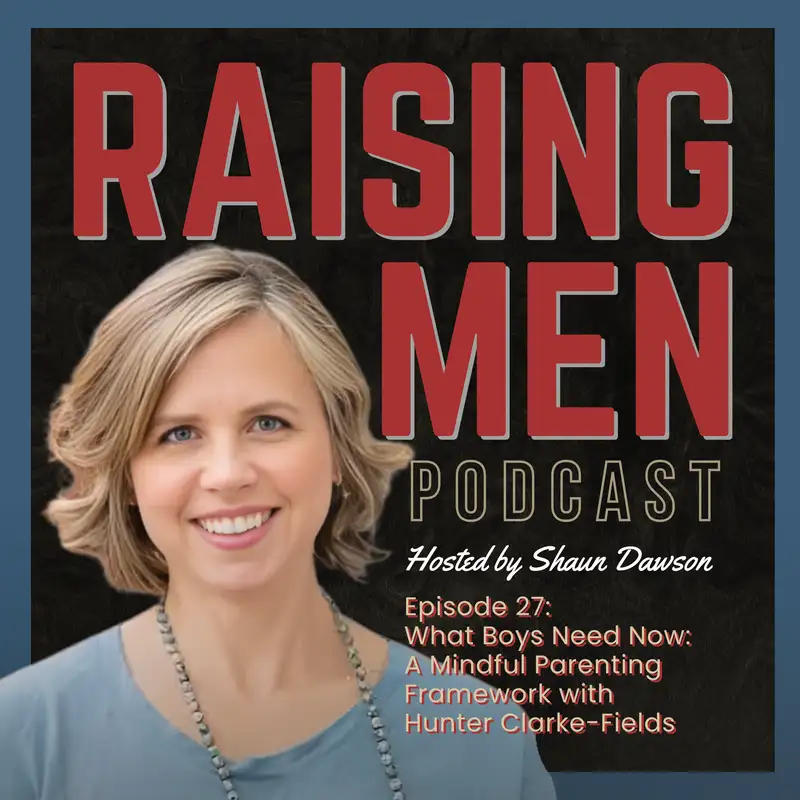
What Boys Need Now: A Mindful Parenting Framework with Hunter Clarke-Fields
it's parents themselves
like we have to have a lot of compassion for ourselves
and we have to take a good look at ourselves
and to be able to take care of ourselves
because this is an incredibly
incredibly hard job and I think just the
raising good humans
comes from a place of deep compassion for parents
cause it's so hard to be a parent
we're so we have so little
you know in the United States
we have very few resources directed at parents
and very little support and we're all on our own
hi welcome back to raising Men today
on the podcast we're joined by Hunter Clark Fields
she is the best selling author of Raising Good Humans
and Raising Good Humans every day
and she's a creator of the Mindful Mama podcast
and Mindful Parenting training
Hunter's books bring clarity
wisdom
and real tactical tools that we can use right away
so let's jump right in hunter welcome to raising men
thank you I'm so glad to be here Shawn
I think it's it's an honor to have you
I I really
really appreciate you taking the time
so tell me what is a good human to you
that's a good question I mean
when I think about that what I want for my kids
and what I want for other kids is
I want them to be um
to feel comfortable in their own skin
I want them to feel
you know
secure and comfortable in their own skin so that
and so they can process their emotions and they can
go you know
make choices
and go out into the world and do what they wanna do
you know kind confident kids who are
you know a
a a little aware of themselves
aware of themselves aware of others
but I want that feeling of
just comfort in their own skin
that's kind of really what I'm
what I'm going for
for when I think about a good human cause
then from that secure base of solidity and security
then they can just make all kinds
of decisions about the world and how to be
yeah you need a secure base to thrive and
you know that's
that's really what you want for your kids right
you want them to thrive maybe even more than you did
yeah yeah
yeah I mean yeah
you do want it kind of more than
than you did
but I think that one of the interesting things about
you know parenting is that
it always sort of points back to ourselves
you know like we have um
enormous influence on the
the sort of emotional weather in our household
um in our kids
you know as far as like
feelings and a sense of security and ease go
that's those are things that um
you know we humans
we inter are like we feel each other's feelings
yeah very palpably
even through zoom you and I are talking
you can you
you'll be you know
without knowing whether I'm tense
or whether I'm not tense
or all of those different things
and I can see the same about you
and so when you're in the same room
in the same household with your kids
they can feel that so much
so we have
you know we want that for them
we want them to thrive so much and
and but it's important to realize that like
the best parenting that we're ever doing
is in modeling so if we're show
you know we can't just tell them how to be
and hope for it for them we have to
we have to live what we want our kids to learn
we have to show them how to
how to do those different things right
we have to model right
I think that's the most important thing is that
you know
you know we all want our kids to be able to
stop crying and calm down
and regulate emotions and things like that
but they need to watch us do it
so we need to so for a lot of us
we need to sort of learn how to do it ourselves
cause I mean
at least for me
I was taught like just don't cry and go to your room
basically don't have those feelings or whatever it is
right and
and and really we have to recognize that um
you know
there's nature and there's nurture and nature is really
really strong
and kids come in all kinds of genetic flavors
et cetera but we do have enormous influence
and not so much in like what we're saying or doing
but like who and in who we are and how we are being
yeah I have been uh
blessed or cursed
depending on how you want to look at it
with a son who feels everything so deeply
that I became aware at a pretty early age for him that
at how much my unregulation impacts him
I so for example
we'll be I
I take him to school in the mornings
and it's it's a seven minute walk
but for me
it feels very important that we make absolute sure
that we're not late
that was a triggering thing for me as a child
my mom was always dropping me off at school late
and then the kid gets punished
when the parent is completely out of their control
it's it's horrible and
and so I feel a great deal of anxiety in the mornings
if we're not on time
and there will be times where I will be like
come on man let's go
we gotta go we gotta go
and I'll kind of get on him about that
because of the anxiety that I'm feeling
and it completely spins him off the rants
and we've had situations where in fact
and and one of
kind of
my central principles about sending him to school is
I don't
I will not send him to school when he's in a frenzy
when he's unregulated
because I'm gonna get a phone call from the principal
it happens 90% of the time
and it's a negative experience for him
it's a negative experience for the school
for the other kids everything
so what we'll do instead is just take
a walk around the block so
it turns out that if I get all stressed out
and unregulated and start pushing him to move faster
and all that stuff number one
he's gonna move slower number two
he's gonna be unregulated and then we're
we're not even gonna be able to go to school on time
we're gonna have to walk around the block
for 10 minutes
yeah it takes so much longer yeah
I mean that's the interesting you know
there's all the communication skills and
and raising good humans and
and people push back against them like oh
but that takes so much time
but it has it takes so much longer
when everyone gets totally disregulated
and your kid is losing it
and you're losing it it takes way longer yeah yeah
it's like you're
you're you're driving a train and the train
you know if you if you push the train too fast
it'll go off the rails
and then you gotta get the train back on the rails
somehow
it takes way longer than if you just slow down by 10%
and took the corner at a nice
leisurely pace you'd be fine and you'd be on your way
well I'm glad you're seeing that about yourself
I mean I was like that I was totally like that too
like when my kid was 3 and 2 and we
we walked to a school too
actually like a five minute walk away and um
and yeah and time pressure was such a thing for me and
and I think someone asked me yesterday in an interview
someone said like you know
what would you you know
what advice would you give your younger self
and I would say
tell my younger self to kind of slow down yeah
slow down man because
because yeah it
it it always makes everything worse
when we get disregulated
and that's not to say that like we're gonna
like we're gonna not be perfect
we're gonna yell we're gonna lose our cool
that's definitely gonna happen for everyone
even for people who are listening to parenting podcast
right like it's definitely gonna happen right for you
and that's okay like
it's good like our kids don't need perfect parents
they don't need you to be perfect
in fact it would be terrible for them
if you were always perfect and regulated
and like they never saw a human losing it
yeah they wouldn't know how to deal with anything right
so you know
we need to be ourselves we need to be imperfect
but yeah like getting ourselves
getting so anxious ourselves
you know when we get
when we get anxious when we get um
frustrated when
when we yell none of those things do help a situation
they they
they generally don't like yelling
you know makes it so our kids go into fight
flight or freeze there you know
that cuts off you know
then their their nervous system cuts off
access to the slower parts of their brain
the prefrontal cortex area um
they they literally can't learn then
anything you want them to learn in that moment
about what to do better so it's
it's not a skillful tactic
but it's something that um
one thing that was important for me to understand
cause I I would feel that late pressure
and I felt a lot of anxiety when my kids were little
and I felt a it was a lot of frustration
it was really difficult
and that brought out my temper and I have this
I have a bad temper yeah
and I
what I had to learn about my own yelling was that um
was that a it it's not it's not my fault
like it's not something I'm choosing
it's something that that my own nervous system
my own fight flight or freeze system is activated
and it sees my child as a threat
I never woke up in the morning and said oh
I think I'm gonna like
yell at Maggie at 7:30 on the way to school like no
like I never ever once did that I never made
and you never feel good about it after it was done no
you never feel good about it
you're no one's making a conscious decision
if you're listening to a parenting podcast
you have never once made a conscious decision to
yell at your kid right right
this is something that is a a reaction and
and it's unconscious reaction
that's just happening without conscious thought
so it doesn't make sense to berate ourselves for it
cause you never consciously chose to do that
but it is your responsibility
so we can train our nervous system
our body
minds to more skillful means bit by bit over time
not that we will ever be perfect
but we can train towards more
more skillful means and
and it does help enormously
cause we gotta live what we want our kids to learn
we gotta show them how to do it right
you have this great story early in Raising Good Humans
where you talk about the absurdity
of yelling at your kids to be quiet
yes and it's that
that illustrates it perfectly
I I have almost never read
I mean there's like 10 words that
where you where you convey that story
and it's like wow
that hit me straight in the eyes
and it was so concisely and so well put the
the metaphor that I like to use for that is
you know we have the two brains
we have the cone in the barbarian brain
and we have the Sherlock Holmes brain
and the cone in the barbarian brain is that fighter
flight or freeze thing
and you need you actually do need that brain if
oh yeah
the oncoming car is coming it's
it's a good thing the parent arm come out
yeah the parent arm
yeah that's what controls the parent arm
but the vast majority of the time when you're
when you wanna drop into that brain
it's not the right thing
you want to stay in Sherlock Holmes brain
because that's where you
have access to the learning the additional context
all of all of the other stuff and
and if you're in um
if you if you drop down to Conan the barbarian brain
then it it's
it's just pure potentially it's pure chaos
and the same true
this might be explaining why me and my dad
who I got my temper from had a
like an obsession with Conan
the barbarian when we were little is that right
how funny yeah
that you know
that was a surprisingly great movie
Red Sonia it was a surprisingly great and in fact
Arnold Schwarzenegger has has um
he's written a book
um called
and now I'm drawing a blank on what it's called uh uh
be useful and it's spectacular
it talks it
I mean
it it
it it points out one of those absurdities
like yelling at your kids to be quiet it
it's he's
you know grew up in rural Austria
and decided that he was gonna become
a leading man in movies in the US
and then set about to make that happen
and you think about the absurdity of that goal
I mean imagine being 16 with him
and he tells you this goal
you would make fun of him for
and yet look what he did he
he did it and it it
the book is the book is really really good
go Conan yeah um
yeah there's
there are a zillion parenting books out there why
what makes raising good humans special
you know it's funny
cause when I wrote it I didn't
I was like I'll be so happy if like I sell 3,000 copies
yeah like
and here we are 750,000 copies later
it's crazy it was really
it really surprised me um
and I think I've thought about that and I think
of course
I've had like some amazing luck as far as that goes
cause nobody who's made it
really
done some big things doesn't have a good dose of luck
so I do want to acknowledge that
but like I think it's
because
this is something I felt like I was really bad at
I was struggling in I was I
you know I share very honestly my
my struggles and my failures
and then I was like and this is
and I was in a place of desperately wanting to know
like people would all these parenting coaches would say
well you have to like pause before you respond
I'd be like but how
how do you pause you know
and I really really wanted to know how to
how to do these things and I really
I guess I you know
what I bring to the table is that like
at the time there was a lot of advice
great advice about how to be skillful with your kids
and
but I couldn't implement any of it when I was activated
when I was disregulated you know
and I was anxious trying to do my best for this kid
and I had a temper and I'm all
I'm highly sensitive like your son right
so I had all these things and I
it would all go out the window
as soon as my stress response was activated
so I think this it's to me
it's like you know
some of the best ideas are the ones where you're like
oh duh
of course right
like of course
we can't
make a choice about how to respond
until we can regulate ourselves
you know of course we can't do those things and we
we and
and there are ways to do it
and I had you know
started to study Buddhism and mindfulness as a teenager
and so I realized like oh
this this tradition
you know this
and all this research backs it up
has all these ways to regulate ourselves
to be more peaceful to be more steady
to be like
the calm mountain that our kids need us to be
right they need that really desperately and um
and I I really wasn't that and I
and and I I
you know had bits of that
but like I
I was able to sort of cultivate that a real steady uh
steadiness in me without changing who I am
will becoming more of who I am but but um
but yeah to
to recognize that you know
it's parents themselves like
we have to have a lot of compassion for ourselves
and we have to take a good look at ourselves
and to be able to take care of ourselves
because this is an incredibly
incredibly hard job and I think just the
raising good humans
comes from a place of deep compassion for parents
cause it's so hard to be a parent
we're so we have so little you know
in the United States
we have very few resources directed at parents
and very little support and we're all on our own
yeah and um yeah yeah
we've lost a lot of the institutions
there's not as the families aren't as big
and the grandparents aren't around anymore
and the cousins aren't there and
mm hmm yeah
yeah no
no aunties to tag off with if you're a single parent
like if you have two parents in the household
like you're like oh gosh
thank goodness I have another person there
some of the hours of the day to tag off for but
you know that it really humans should be
we should have like
10 other people that we could tag off for
absolutely because think how regulated we would be
think how steady you know
the the kids could have this such a steady influence
and I think that would be really
really healthy for us to have that
you know
for kids to have lots of different attachment figures
that and then parents could have space to breathe
cause it's so intensive when kids are
little humans take a lot of intensive care
I mean a giraffe baby plops down 4 feet falls
is born falls out of the sky 4 feet to the ground
and then stands up and walks around
that's like a what like a
the equivalent of like a seven year old maybe right
human like it's just like we're
we're we're
you know it's very intensive for us
yeah no
that is so true
part of what strikes me about raising good humans is
and what makes it unique for me is how authentic it is
it comes from your own personal journey
and how tactical it is and like
these are the specific tactics that I'm using for my
I get really mad all the time
and I know needed to kill that monster
and here's how I did
it is basically the story of the book
as far as I can tame the monster
I mean it's still there
but yeah right
okay that's fair
yeah tame the monster
but it's amazing like with practice
I think that's the thing that's really important
and key is that like
these are things that we can practice and train
like we have this neuroplasticity
we can train our brains we can
you know bushwhack a new uh
path through the the woods of our brain
um but uh
but yeah like it
and we can train our brain
so then even like at some point
when my second daughter was like 9 years old
so this is like 10 years after I had started to
to practice all these things and started to learn and
and at one point she
we had while watched a movie and we had movie night
and then she was supposed to go to bed
she was 9
so she could go put herself to bed and get ready and
and I was like she was being nudgey
so I was like
I'm gonna just read my book and ignore her
and she's gonna just go to bed oh
she's being nudgey and then from the stairwell
she said something and she like laughed at me
and it was like
like it was like this
I was this whole new trigger that came out
like I was just like from zero to
you know 100 in like a second right
you know I was so angry all of a sudden
cause she had been nudging and nudging
and I stood up and I was so actually
in in retrospect I was quite proud of myself
because I stood up and I yelled
but I yelled
I am so angry right now and then I open the door
and I threw my poor library book down onto the carport
and I walked up and down the street for 10 minutes
until I calm down
but I was so proud of myself for yelling
something skillful yeah
rather than like you what's wrong with you
et cetera no blaming and shaming language
I yelled an imessage haha
I'm so angry and I was really proud of that moment
that is yeah
I I think that encapsulates
that encapsulates the skill right now
it's I mean
you're gonna feel angry that's fine
the the
the skill is in handling it in a way that enhances
your relationship with your kid
and as opposed to ruins it
yeah ruins it
it damages it damage yeah
yeah yeah
I could feel the damage happening with my oldest child
when she was little and I could
I was really scared you know
it really scared
and you kind of have to give yourself the Grace
of understanding that okay
mistakes were made that's okay
and then you move on
yeah exactly
and also I think it's so important to understand that
you can always always begin a new
you can always
always start and practice and heal things
it's so fascinating um
you know uh yeah
I taught mindful parenting to um
a low income community in Wilmington
Delaware and a grandmother was there
cause she was taking care of her 6 year old grandchild
and at the end she shared yes
things are going better with the 6 year old
but she shared with me that she healed
her relationship with her adult daughter
which was so exciting I
I mean it just made me feel amazing
but for like in my own circumstances
I remember thinking
I can see in my daughter you know
my oldest daughter got the worst of me and she
I could see these you know
I saw her like bark orders at her younger sister
and I was like oh God
that's what I sound like oh no
and I I used
I used to think you know
oh you know
they say the first three years are so
vital for your development
and maybe I just I would just worry that
maybe I really screwed up my kid
even though I've
I've done a lot of changing and growing and I've
I've really
really Learned and practiced some skillful means
and but anyway I
I would worry that from time to time over the years
when I would just she's just um
she's kind of an intense kid
and seeing her
kind of intense reactions and snappy reactions
sometime with other people
but then and I worried that like
she was a little not compassionate with others
because I was snappy
because I was stressed and not so compassionate
I got think with her sometimes when she was little yeah
and I would worry about that
but then
there was this time when she was maybe 14 or 15
and we had a a dog then and I had had the
a scary incident
where the dog met another dog out on our street
and there was barking and there's growling
and it really scared me and I was really upset and I
came inside and I was like
talking about the dog and I was really upset
my younger daughter who's normally
she's like very sort of intuitively compassionate
and she's she was kind of like getting upset at me and
and defending the dogs and I was just like
and really upset
and my older daughter said to my younger daughter
you know can't you see that mom is upset right now
and she said to me mom
do you need a hug and I was like yes
yes I do need a hug
and she came over and gave me a hug
and I was like oh
I didn't ruin my child too
oh my gosh
I was like I'm not only I'm getting a hug
but I also didn't ruin my child
yeah
yeah I
I you know
children are very resilient if
if you if you allow them to be
and you don't want to rely on it too much
but it you can give yourself the Grace
that there is no specific incident
pretty much that ruined them for life
and that it really is a Marathon
not a sprint yes
and you know
there are I mean
I could think of a handful of things in my childhood
that
that really impacted the way that I look at the world
but they were
examples of a trend right
you know
they were just kind of emblematic situations that I
that the touchstones about a more generalized trend and
um and so
you know without that generalized trend
those those specific events would not have had
the significance that they do
yeah there's a pattern yeah
and I think that we can also you know you know
we know that yeah
we're gonna be human we're gonna mess up
we're gonna
there's gonna be damage and conflict that's
that will happen that's
that happens conflict happens in families every day
all the time and that's normal and of course
but we can um you know that repair is so
so important and it
it really goes a long way and you know
just of course
us saying I'm sorry to our kids and and I
I had a you know I had a couple
I had a
you know moments when I
when I apologized to young Maggie
when she was like 6 years old
for my yelling in the past
and I you know
cried and cried and just
I apologized to her and it was for me impactful um
of course to do that but but yeah
it's um
and then someone asked me actually a little while ago
um you know thinking about you know
I have my temper
because my father has an intense temper
he's an highly sensitive person raised in a
a generation that of course
you know where things that we would call abuse are
were normal then you know
and um
and so I used to be very scared of him at times
he was also very like
affectionate as well he was like
I could definitely rely on him to be very affectionate
and cheerleader but also
he scared me sometimes
and I remember someone asked me recently like oh
you know what if your father
you know like apologize to you
and I was like oh
my God wow
I mean it was such a shocking idea
like I
I it was so hard to imagine yeah
yeah it was so hard to imagine
but I could
see that it would make such a profound impact
on him too
even probably yeah
and you know
as a grown adult woman
like with almost grown children now
like it would
it would make a real profound impact even now
so I think it's just to say it's never
never too late to to practice skillful means
and to heal those relationships
you know you
you almost I mean
certainly unintentionally
did a natural experiment with your two kids
where the first one got the full brunt of of
of the old hunter
and then the second one got the a
a lot more of the new improved
mindful hunter
more relaxed yeah
what differences
have you noticed about the way that they are
or the way that your experience was
raised them
what were the different outcomes that you've gotten
as a result of that experiment
I mean well
they're very different people
so you know who's right
and so yeah
the variables are isolated
you can't you can't assign causation yeah
yeah I mean
I think though my younger daughter
I mean she is more um
she has been kind of
naturally a little bit more emotionally aware
a little bit more relaxed
a little bit more in tune with things
um
she was also just like an easier baby
and I'm not sure if like
my first child
probably got more anxiety hormones in the womb
you know because yeah
I was more anxious with the first one
so there's so there's
so there's no way to sort of tease apart anything
but yes she did get and
and you know
she was more open to um
me talking to her about all kinds of things
like all those awkward conversations
you have to have about sexuality
and all those kind of things
she was more open to those conversations
and is a little more open to some of those things
you know she
we can talk and actually
she and I um
yeah I don't know we
we get along very well I mean
I love both my daughters enormously
but yeah the youngest one uh
is you know
I travel well with her
like we take care of each other well
I don't know she's a
she's a very cool um
balanced person and I think she
she benefited from a a more relaxed parent for sure
yeah interesting
you know I
I
in keeping with the the the
the sense about the tactical nature of your book I
I wanna talk about
I'll tell you a story of something that
that happened with me and my son
and I would love to get
your feedback on how I handled it and
and what I should have done
how I should have thought about this and
and what I should have done differently um
my son when he was three and a/2
was terrified of escalators
he he spent his entire life not being
terrified of anything
he used to jump in the deep end of the pool
even though he couldn't swim and
and then he he developed this
this fear of escalators for no reason
just all of a sudden
was terrified to go down escalators
we would have to use elevators anywhere we went
and this irritated me it felt like it actually
frankly it
it was a trigger for me
because I felt like I was a failure as a father
because he wasn't tough enough
to go down the escalator he's three and a/2 years old
and it felt like he was just being a weak
it felt like he was being weak
and I wanted to teach him that no we
we overcome our fears and we do this
and I felt like it was it was an opportunity to do that
um now and
I was pretty you know
I didn't
I didn't ever force him to go down an escalator
I I
I I didn't
I didn't mess with him in that way
but I felt this urge to
to want to impart this lesson to him
and we went to target one day and we were
he had allowance he had $11
and we he wanted to spend it on toys at target
the toy section of target
in the target that we went to is
is upstairs and there's an escalator
he could go up the escalator just fine
but he just couldn't go down
so we went to the target and we grabbed his
we got we grabbed
so he wanted to buy um
a set of Hot Wheels cars and they were
you get five Hot Wheels cars for $6
so he could afford since he had $11
he could afford one pack of Hot Wheels cars
but they were running a special
and the special was
if you buy two packs of Hot Wheels cars
you get a third one for free
oh my gosh and he was so close
he was so close $1 away
and so I told him I said listen
if you're willing to go down the escalator
I'll make you a deal I'll give you the extra dollar
and you'd be able to buy three packs
instead of just one
do you want the deal
and he goes yeah
yeah yeah
I want the deal I want the deal
so we got the three packs of Hot Wheels cars
and we approached the escalator and I said listen
we were approaching the escalator
I said listen
I'm here for you whatever you need to succeed
on going down the escalator
I will do for you you need me to pick you up
you want me to blindfold you
you want me to just carry you down
you want me to force you down
you want me to stay away whatever you need
he goes okay okay
just hold my hand so I held his hand
and we approached the escalator
and we got one step away
I stepped on the escalator and he says pause
pause and he whipped his hand up from under mine
and I start going down the escalator and he freaks out
and so I run run back up and he has a total meltdown
it lasts 45 minutes he's screaming
he's crying he's like freaked out
and at some point 30 minutes into it
I'm like
I'm the worst parent in the world
I I can't believe I've done this
I'm so sorry like
let's just forget the deal man
let's forget the deal and he goes no
I want the deal I want the deal and
he we finally got him regulated again
we finally we came up with an approach
we decided we were you know okay
we're gonna hold I'm gonna hold his hand
and we're just gonna walk really
really fast
he's gonna close his eyes and um same exact thing
happened
we got to the top of the escalator and he goes pause
pause but it was too late by then
he was stepping on the escalator
and I just pulled him on and I held him tight
and he started like freaking out a little bit
and then about a third of the way down the escalator
he relaxed and he started getting happy
he started realizing okay
I'm gonna get my thing and this isn't so bad
and he felt this elation at the end of it
he was thrilled and he's that he succeeded
he went home and he told his mom and he got you know
his extra 10 cars and he was really
really happy but
the whole point was to get him
not to be scared of going down escalators
and it didn't work yeah
what happened the next escalator
he was
terrified of escalators for another year and a half
um it made the fear worse
and then it just went away all by itself
huh huh
and I don't know I you know
I can see a lot of things I did right in that situation
I feel like my mind
my my my heart was in the right place
I feel like
I feel like I shouldn't have impuned this sense of like
weakness about this thing on him
but okay
I feel like I was right to try and teach him the lesson
but I I feel like overall
it was a mistake
and I feel like I should have done something different
and in fact I think if I just would have left it alone
two months later
he would have not been as scared of escalators
and it would have been fine
oh I feel for you because yeah
I that's such an understandable impulse right
you want him to be
I would have wanted my daughters to be strong
and to get over the escalator thing absolutely yes
I would have
I can completely relate to that feeling of wanting to
have your kid get over this thing
and it's so hard like
to accept that
we don't have any control over their stuff right
like it's not on our timetable
like we're not gonna make them read
when we want them to read
we're not gonna make them
you know what I mean
there's like all these things that we can't
that it's it's doesn't it
it really
like us interfering with doesn't really do a lot with
um so I can
I can relate to that that wanting to do that yeah
I think um
when we start to use things like
um when we try to manipulate our kids with things
like bribery or honestly
like
a punishment and reward are two sides of the same coin
right um
that um
that then kids do feel coerced right
like they they can
they feel that and it's kind of like um
it's kind of like you know
when you slow down when you're speeding on the highway
and you notice there's a cop ahead
and you slow down when there's a cop there
but then you're back up to 65 or 70 what after
you know a minute or two right
like it's doesn't
there's no intrinsic
you have no intrinsic motivation to not speed
you're just speed not speeding not to get caught and um
and similar with like reward so
you know when you're working with things that are
extrinsic motivators like rewards
you know or or bribes or things like that there's no
there's no intrinsic that
the child has no intrinsic reason to
wanna change this thing
they're just trying to to get this extrinsic reward
and that's not like the most quality change
if you manipulate the behavior in some way
it's not really coming from the inside out right
it's coming from the outside in
and so it's not a great way to learn a lesson
or to make change honestly
you know um
you know if you don't
don't hit your brother
or I'm gonna take this thing away from you
you really want your kid to learn like
don't hit your brother because hitting hurts people
yeah we don't we don't hurt people in our family right
yeah that's not who we are yeah yeah
exactly
and you really wanted him to learn to do the escalator
so that he could just do it
and it's fun
and it's easier than getting on the elevator
or sometimes it's really hard to find the whatever
you know yeah
I really I didn't want him to be limited by fears right
yeah like
like it's an irrational fear
recognize it as such and you know
push through it yeah
yeah but he wasn't ready to do that
that's a skill I wanted to impart to him
but you know
he's three and a/2 yeah
three and a/2 it's
it's um
you know I guess I would have invited you kind of
at that time to say like
you know um
why do you feel so
like to turn the attention back to yourself
you know why does
why do you feel so strongly about this
you know what is this um
you know to explore like
what is your own fear
and to kind of carry your own baggage right
in a little in a way
you were you have some baggage and you were like
here son
take my baggage take my bags yeah
you hold the baggage right
um rather than carrying it yourself right
you had some stuff going on around that
but you projected it all onto your kid
and rather than wait for him and his timetable
um yeah
I love that analysis I think that's exactly right
it's something that overall
I think it was successful
and I mean he really did have a feeling of elation
but I felt this vague sense that I've done
some things wrong there and it's really
really good lesson
it's funny cause we have to walk a middle path
you know like there's some people who
you know like there's some people who
you know we have to use our power sometimes right
as parents like yeah
all in all
like as you get to the ends of raising good humans
which you haven't gotten to yet
but like that that part
like there's a whole part about the use of power
and the more we use power
there's an inverse relationship between power
and influence
and I believe that one of the reasons why
we have this trope of like
the rebellious teenager
and the teenager that hates you
is because teenagers are not rebelling
against their parents they're rebelling against
the unskillful use of power that parents have used
for many
many many years
and they've disciplined
in a way that builds resentment to to um
teenagers by using power using
that's exactly right
using punishments and things like that
so using the power of
you can't have the iPad or you can't have the car or
you know I was grounded different things like that
and so teenagers will resent parents at that point
and then also
teenagers then have a lot of their own power
so they can call a friend to pick them up
and then they're out of there right
you so
but if we can use less power and use our influence
more use more of that intrinsic motivation
then we have a beautiful
bunch of influence left when our kids are teenagers
and this is so
so this is a really important conversation
because it is very true that when you have bigger kids
they have bigger problems right yeah
it's less intensive hour to hour
but bigger kids have bigger problems
so you do want to be there and be an influence
in their life um
so but it's also it's not like it's
it's a the messy middle
like it's not like you're never gonna use power
like I remember holding my daughter down
so that I could put that car seat on her
you know what and or take the medicine or yeah
I'm sorry I have to hold you down
like you're screaming and your body is bucking
but
we can't drive this car unless you're in the car seat
and I I
remember reading a story of a parent
who was so dedicated to gentle parenting
that they said okay
you don't have to walk in the car seat
and the kid walked along on the like
side of the road with one parent
while one parent drove along slowly like
I'm sorry I just don't have the patience for that like
and that's a little crazy if you ask me
like it's just a little crazy
totally agree to say that
and I mean I it's not sustainable
so that's not sustainable that you
they they they don't have
you know
they shouldn't necessarily really have that much power
right like we want to of course
respect our kids bodily autonomy
and we want to teach them all those lessons
and things like that but at the same time
like
when your son came on the escalator that second time
and and you just held him there
like that was probably the right choice
like help him get over it
it's like kind of like
like helping them get in the pool right
like you're using some of your your power and your
you know to to kind of make the like
let's get through this situation yeah
and so it's not like that's one of the
I think the things about that
we have to recognize
is that we can use more and more skillful means
and we should
should learn like more and more skillful means
and like we gotta cut ourselves some slack
it's gonna be messy and it's gonna be like
there's gonna be some awkward
uncertain moments and you're gonna be like
oh I should have done this differently
and you might even go you know
say to your son hey buddy
you know what that time where I
I did this thing with the Hot Wheels in the eye
you know I'm sorry yeah
we talked about it a lot you know yeah
you can do that right so it
it's gonna be messy and it's not completely you know
I think it's dangerous to go to the extremes and say
it's it's I
you know it should always be
you know of course
like the do as I say
because I say it that that doesn't make any sense
and that's unskillful
and that isn't doesn't teach your kids good lessons
right but also the complete opposite is
is also unskillful right
so but there are
there's a path there's a middle path and it
it is a little messy but but
but that's where we wanna walk yeah
there's
one thing that I've Learned through this entire journey
is that there is always a tension
so if you ever find yourself thinking
oh no
it's always X you're 100% wrong yeah
you will you
you you need to find the tension
and you need to figure out where that
where that middle is
yeah
absolutely yeah
so I always like to
finish up these conversations by asking
more or less the same question of everybody
and the question is
what is one guiding principle that you believe that
parents should hold on to as
as they raise their children in in our culture today
hmm that's a that's a
this is sort of a weighty question one day
it is it is
and and there's again
there's attention you yeah
there's there's a real value in like OK
what comes to mind right then
but then there's also you all
you also want to be deep and meaningful and
and all of that to I guess
take however much time you need
I think I would say to that
you know
my invitation for a principal would be
to invite people to slow down
and to give yourself some space to make
to make choices and and give your kids space to
to you know
I think we get so sped up
like we fill every second with like glance
you know
seeing if we've gotten a text message or whatever it is
and you know
we got all our activities and our schedules
and we're going so fast
and we're on all the teams and things like that
I guess I would invite people to slow down and
and um
protect childhood protect kids
you know ability to be bored
and to play freely without adults guiding them and um
and to just serve slow it down and protect childhood
and slow yourself down
so that you can appreciate where you are
big time I
I love that sentiment hunter
thank you so much for sharing your wisdom with us today
this is Hunter Clark Fields again
she's the best selling author of Raising Good Humans
and Raising Good Humans Everyday
the mindful Mama podcast
and the Mindful Parent Training
um
all of the links for those things are in the show notes
this has been raising men and you are a great parent
raising men is produced by Phil Hernandez
this episode was edited by Ralph Tolentino