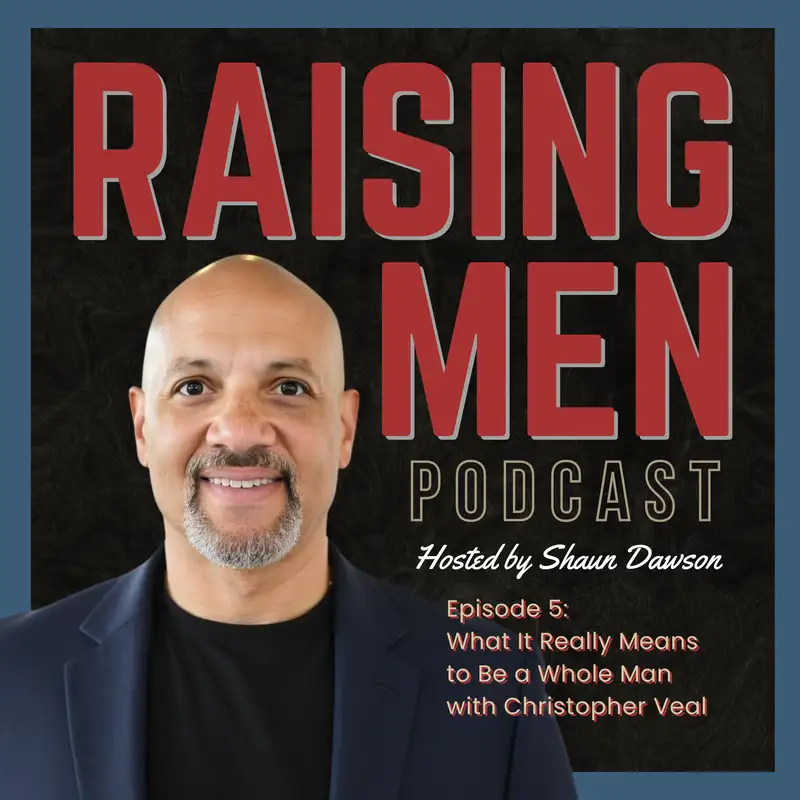
What It Really Means to Be a Whole Man with Christopher Veal
Yeah, I think an important distinction that that I think we can make there is the concept of excellence versus perfection.
Christopher Veal:Oh, yes.
Shaun Dawson:Forget it. And I think in a lot of ways, we expect perfection out of ourselves.
Christopher Veal:Absolutely.
Shaun Dawson:And we confuse that with excellence. Mhmm. We think excellence is perfection, but it's not. Excellence is a process. Welcome.
Shaun Dawson:Today on Raising Men, we're joined by Christopher Veal. Christopher is a former marine officer. He's a leadership coach, a TEDx speaker, and the author of a book called The Whole Man Evolving Masculinity. Christopher describes his mission as to challenge and to what strength really means and to help men embrace vulnerability as a path to deeper connection. We're going to explore how masculinity has been misunderstood in our culture today, it takes to raise emotionally aware sons and why being a whole man is more than raw power.
Shaun Dawson:It's about the power of presence. Christopher, thanks so much for joining us here today.
Christopher Veal:Sean, thank you for the invitation. And I'm very much looking forward to this conversation.
Shaun Dawson:Me too. Now you've lived in two, what I think of as two very different worlds, and you could correct me if I'm wrong about that, but it's the military. Mhmm. And then there's leadership coaching. Right.
Shaun Dawson:And obviously there's some synergies there, but what first made you question the version of masculinity that you and I grew up with?
Christopher Veal:Right. Well, I'm gonna I'm gonna try and be brief here because I could go on for days about this. It really started so my first job out of the Marine Corps, spent nine years as an infantry officer in the Marine Corps. And my first job when I got out was in construction, doing project management. So you think about military and especially the Marine Corps and you think about construction, very male dominated culture.
Shaun Dawson:A lot of testosterone And in those two
Christopher Veal:it's not a knock on either. That's just simply the way they are. But when I was working in that construction job, I was married and my wife became pregnant. And so as I was going through the process of waiting for, well, we didn't know it was going be a daughter, we waited to find out. But as we were going through that process, I started to look into the Family Medical Leave Act and paid parental leave, which was allowed here in the state of California.
Christopher Veal:It was a small company that was family owned and so, you know, a little bit in house. I had to teach their HR about it. But I share that because if you had told me probably five or ten years before that about taking leave as a father, I wouldn't have even the idea wouldn't even cross my mind. Yeah. But I realized because I grew up without my father really being involved in my life that I wanted to be engaged in my child's life.
Christopher Veal:So I knew I wanted to take that time off. And as I was educating my organization about it at the time, I had a lot of and again, I'm not knocking those men because those guys grew up with the way and the modeling that they had. I had comments from men, you know, people that were older than me and some that were my superiors, making comments like, What are you doing taking maternity leave? They couldn't even say paternity leave or Don't you know that raising kids is women's work? There was a lot of that culture in it, And that just steeled me even more saying, there's no way I'm gonna fall subject to this.
Christopher Veal:And so that's really what had me start to begin to explore what this was about for me and and how did I want to show up as a man. Because a lot of the trap that we fall into as men is it's this either or thinking. And I really am a big believer is how can we be a both and. So the example I like to use is, and I say typical man box thinking, you've probably heard that term, you have to be strong, you have to be the breadwinner, you can never show emotions, like all that stuff that feeds into a lot of toxic masculinity. And instead of saying either I can be a breadwinner or I can be a caregiver, what's it like to explore what is it like to be a breadwinner and a caregiver?
Christopher Veal:What is it like to explore I can be strong as a man and sometimes say I need help and I'm struggling. And so that's what really started me going down the rabbit hole.
Shaun Dawson:Yeah, I think of it the metaphor that occurs to me about this is, is we're a castle, right? And we think of ourselves as a castle and the strength of a castle we think of, oh, the castle has big, long, thick walls and it completely surrounds the castle and they're very high and they can, they can withstand any attack. Right. But the strength of the castle, the real power of the castle is not the walls. It's the size of the area inside.
Shaun Dawson:It's the size of the protected area, the area that is allowed to thrive under the castle's domain.
Christopher Veal:Right? Absolutely.
Shaun Dawson:And I think that a lot of times, at least the historical way that we viewed masculinity has been, we think about how strong our walls are, and I'm not going to let anything in and all of that, but that, but optimizing for that causes us to create this very small castle that might have this tiny little garden that's barely able to feed us and our family. But what we really want is an enormous castle that is able to, to, to have multitudes and have the entire village thrive under the protection. Right. And that's what being a that's what real masculinity is, isn't it?
Christopher Veal:Right. Well, here's something to play with that metaphor more. What if we were in a place where we didn't even have to have the walls? Right. Right.
Christopher Veal:Because the other thing with the walls is yes, it protects you from things outside, but it also doesn't let things in. And by the way, it isolates you and keeps you contained too. And so while you, you fall into the belief that it's keeping me safe, it's also isolating and keeping you from others, and community and connection is something we crave as humans and it's something that we need. And so we have to be mindful that we don't fall into that trap either.
Shaun Dawson:I'm with you a 100%. Now, when you look at young men today who are, who are growing up into this world that our, that our culture has created for us, what do you think that is going right there? What do you think they're getting right? And what do you think that is missing?
Christopher Veal:What do I think they're getting right? And I love that you started with that too because so often we go to what's not working. It's important to do that, but I'm a big believer in how do we celebrate what is going well. So I think there's a couple things that really stand out for me. One is when I look at, and I'm gonna speak in a very general term because I'm not a young man, not by a long shot, but I think that a lot of them are starting to challenge some of these outdated norms of what it means to be a man, and I use the air quotes of that.
Christopher Veal:Right? Yeah. You know, I think back to growing up, I mean I'm a Gen Xer and when I think of my grandfather who was a large influence in my life, you know, he grew up in the Great Depression, you know, and really had to live a hard life. And so, the way he was shown to be a man and had to be a man was different. But I think some of these young men now are starting to look at, Okay, that model that you have maybe doesn't work for me and how do I want to show up?
Christopher Veal:So that's something I celebrate because I'm all about how can we expand this concept of what it means to be a man. A lot of what the man box stuff does is it narrows down and isolates. Again, the example I use is if we judge a man and his manliness by can you hunt, Can I rebuild an engine? I can't do that. Does that make me less of a man in the eyes of society?
Christopher Veal:I don't think so, but if that's the measuring stick by which you're judging, I will never measure up. I've been to combat. I've been in the Marines. Does that make me a man more than someone else? And so how do we peel that apart of saying you have to fit into this narrow definition and make it more expansive?
Christopher Veal:So that's one. The other one is I think that they are they're willing to be more open around emotions and mental health. I think it's still a place for us to grow, but I think this younger generation is doing a better job at naming when things aren't going well and being able to have those conversations. Now on the flip side, where do I think it's, they're maybe struggling, is there's definitely a loneliness epidemic. Definitely for older men, you know, there was a study done a couple years ago that talked about the loneliness epidemic for men.
Christopher Veal:But the other thing is, I think they're struggling with communication. Because of these devices, right, they're great in terms of being able to help us connect, and I use that term loosely, but I don't think some of the younger generation are having the deeper conversations. It's a lot of shortened conversations via text, and there's maybe not that willingness sometimes to really go back to your walls metaphor of let their walls down and let people in. And I think that's an opportunity where we can really start to help them see different paths forward.
Shaun Dawson:You know, you mentioned a couple of times, you've sort of touched on the notion of, of modeling the appropriate behavior for our sons. And, you know, but there's, there's a tension there, right? And, and some, not everybody had the appropriate masculine role model in their lives, either their fathers were absent, like you discussed, or maybe their fathers modeled a kind of masculinity that is maladaptive to our current world. What can we do about that as us as Gen Xers when we look back and, and and maybe that was our situation? What what can we do to shore that up so that we can bring the right energy to our children?
Christopher Veal:I think the first thing is we also need to acknowledge that the men that came before us were working with what they had. And so, over the last almost decade, I've interviewed probably thousands of men talking about masculinity and vulnerability and things like that. And it's not about criticizing our fathers, our grandfathers, our uncles, whoever those men were, because again, they were working off of what they were taught. And so there's a recognition of wherever they were at is what they did, but then also looking at how can we look at other ways of being a man. And so it's not just, yes, that father, that grandfather is usually a very influential part in a young man's life.
Christopher Veal:And if it isn't necessarily a healthier example, we need to start showing more examples. So the one I love to use is I poke a lot about television and media. And you look at the examples when we talk about let's stay in the lane of fathers. Growing up when I was a kid, I was born in the seventies, but watched a lot of TV these seventies and eighties, and the examples of fathers that I would see on TV were often kind of bumbling. We knew dad loved the kids, but you celebrated that the house didn't burn down and we didn't have to call 911 when mom came home.
Christopher Veal:Right. Yeah. The unconscious message was dad's not capable of taking care of the kids. We know he loves them, but he's not capable without supervision. And so what that does is two things.
Christopher Veal:One, it doesn't have women trust men to show up, but it also doesn't have men say, I want to aspire to do better. Because if that's the bar you're setting, then why should I push to exceed it? So with that, I start to say, where can we see some better examples of fatherhood since we're talking about raising men? You know, the show Modern Family. I love Phil Dunphy.
Christopher Veal:He's a little bit goofy and awkward, but that one kind of broke the mold a little bit too because he was willing to be a little more open and sometimes show his struggles. Yes, he was that awkward geeky dad sometimes too, but we're starting to see more examples of dads really being dads. You know, you look at the commercials in the last eight to ten years have really changed around fatherhood and it's not showing dad as some incompetent bumbling oaf. You're seeing dads really step up. There was one, I think it was Cheerios a couple years ago, and it was the whole clip was like kids saying dad, but in different ways.
Christopher Veal:Like sometimes they were excited. There's one that really just touched my heart. Like there was a daughter who was clearly sad about something, was like, Dad, and my dad hugged her, and I love that because it shows that we can show up. And so the more these young men see examples of different ways that we can show up as men, being strong, being independent, being capable, saying I'm struggling and I'm having a hard time, or saying I don't have the answers, but I'm willing to figure it out, when they can see more examples like that, that has them go, Oh, I can show up more as myself and it still fits into the description. So that might have been the answer to the question.
Christopher Veal:Don't I kind of went on tangents. You could tell I'm a little passionate about this.
Shaun Dawson:Yeah, no, I'm with you 100%. And the fact is that we can't really teach our children, our sons to be strong if they don't ever see how we wrestle with our own struggles. Right? Right. And so, you know, if we think about the strength being that wall, or we think that strength is silence, well, then we're never modeling the appropriate behavior.
Shaun Dawson:I had this interesting thing happen to me literally yesterday, where our daughter came home and she was talking to our caregiver. And she said to our caregiver, Your hair is ugly. And the caregiver was hurt by that, and she didn't quite know what's her response. And she said it to us. And our initial reaction actually was to try and tamp that down, to punish it and to tell her, Listen, that's not who we are.
Shaun Dawson:We don't call people ugly. We don't talk about people's bodies that way. And what we realized is that the reason that that was happening to her is because at her daycare, she has a friend who's been calling her ugly. And she is trying that out in her safe environment to see how the people that she respects and admires react to that exact same input. And when we reframed the behavior in that sense, we realized that that's not the right approach.
Shaun Dawson:She has, our daughter doesn't have the option of telling the kid that's not what we do because the kid is out there doing that. Right. And so our daughter only has the opportunity to respond in the way that she can respond. And so what we need to do is model the behavior that we think our daughter should do or talk to her about it or work through it. Well, why did you say that?
Shaun Dawson:And so, and so what we came up with there is we need to react in the moment. We need to react in the same way that we think she ought to react. So, well, I think my hair is beautiful. And well, you know, this is what I think about it and, and all of that. Then later come around, a different parent can come in and say, What made you say that?
Shaun Dawson:And why do you think that that was a nice thing to say? And is this really living our values? Right. And so we kind of take we needed to take that two pronged approach.
Christopher Veal:Yeah. Well, as you shared that to something that hit me is I'm a big believer in tuning into impact as well. Right? And yes, I love, we don't want to raise our kids to go around openly critiquing and like shaming other people. Now Yeah.
Christopher Veal:Did your daughter mean to do that? I'm quite certain she didn't. Right? Because she's fairly young, may not have the maturity. But what I might even and again, this is not a criticism of what you did.
Christopher Veal:Let me be clear. Yeah. But but an example where if I was dealing with something with it, might have even said, What was it like, once you discover the reasoning, when your friend said that to you? And you know, have them tune into that so they can realize, Oh, I didn't like how it feels. And so it even and what do you think it had the caregiver feel like when you said it, right?
Christopher Veal:And so I don't, I'm using that example, but often we tune into people's behaviors and sometimes what we can also do is help them recognize the impact it has because that can have a more, more profound shift on the way they show up.
Shaun Dawson:Yeah. And going back to your, your yes and theme, we actually, I think we want to do both
Christopher Veal:things. Exactly. Think we need
Shaun Dawson:to model the appropriate behavior in the moment. And then we also need to make sure that we create that touchstone about what was the impact of your behavior? What were you going for?
Christopher Veal:Right. And did you get that or did you get something else? Yes.
Shaun Dawson:Yeah. Yeah. Yeah. I, and you know, so much, so much of the time in our culture, we have a very judgmental culture.
Christopher Veal:Oh my goodness. Yes.
Shaun Dawson:We're very much in it. It's always, either or. You either have this maladaptive view of masculinity that focuses on how strong the walls are around your castle so you don't let anything in. You don't have any emotion or you don't have vulnerability. Or you go to the other stream where there's this other view of masculinity that paints all walls as as totally bad.
Shaun Dawson:Masculinity is all bad. Right. And if we had the perfect world, we wouldn't need we wouldn't need the walls and we wouldn't need soldiers.
Christopher Veal:But that's not the world we live in. Right?
Shaun Dawson:No, it's not. That's just putting your hand in the sand and pretending the world is the way that you wish it were. And so we have to, we have to recognize both realities that there is a toxic aspect to the walls metaphor, but sometimes you need walls. Absolutely. And that there is not, there are times where it's appropriate to be open and free and, and, and, and vulnerable, but there are also times where the walls are necessary too.
Shaun Dawson:And the entire game of life is about managing that tension.
Christopher Veal:Right, right. Well, I come back to you talked about strength before, right? And what is strength? Because if we're talking about raising our boys and our girls and our children to be strong, what does that even mean? And how I hold the idea of strength might be different than you, might be different than someone else.
Christopher Veal:But again, that's a conversation we have. Because to me, if you'd asked me fifteen years ago what strength means, it would be very different. And I probably wouldn't have mentioned anything like vulnerability or emotions or anything like that because that wasn't the perspective that I held. And what I recognize now is part of my strength comes from being what I call appropriately vulnerable. And that means I don't share everything with everyone, but where it might feel appropriate in the moment to create deeper connection, I might be willing to do that.
Christopher Veal:And that creates more connection and deeper trust.
Shaun Dawson:Yeah. Yeah. It's like if you were a boxer, but you had a glass jaw. So anytime anybody hit you, you were on the ground. Are you really a strong boxer?
Christopher Veal:Yeah. Maybe. Maybe not.
Shaun Dawson:You can't be hit. Right. And even if, even if you have this amazing, your, your arms are huge and you have this amazing guard where you're not likely to be hit, but are you really a strong boxer if you can't be hit at all?
Christopher Veal:Right. Yep. And I love that you talked about this idea, that tension, like how do you find the balance? And the thing is, there's no one right answer and one right place to be all the time. Right.
Christopher Veal:Every situation, every interaction is going to be different. With my best friend, I am open to being more vulnerable more quickly with him because we've known each other for thirty years.
Shaun Dawson:Of course.
Christopher Veal:Somebody that I've just met, I'm probably willing to be a little more vulnerable than the average person because that's just how I roll. Sure. But that doesn't mean that they get all my deepest, darkest secrets either. So again, that idea of trust and that psychological safety is a critical piece for people being willing to. And here's the irony, the word vulnerability, like when you talk about at the core, it's about leaving ourselves open to harm.
Christopher Veal:And so even when you say that to most men, they're like, Nope, I'm not going to do that. And it's like, how do we, how do we change the way people look at the idea of vulnerability? Because as I said, I've talked to a lot of men and a lot of them want to be more vulnerable. They just don't feel safe in doing it.
Shaun Dawson:Yeah. It's almost like that word is a problem.
Christopher Veal:It is. Right. Right. And, and that's part of why I keep using it. Because if we avoid the word, then we're avoiding the issue entirely.
Christopher Veal:Right now that's that I'm not an extreme in that way. But if we can't say the word, then how are we going to make progress? Now admittedly, there's times I make into conversations and I may say, Hey, how can you be more open? You know, okay, fine. But at the core, we're talking about vulnerability.
Christopher Veal:I work with a lot of leaders and we talk about vulnerability even if we don't call it vulnerability.
Shaun Dawson:Yeah, I think that's a beautiful framing. Now, as a father yourself, you know, I know that you have a high school age daughter,
Christopher Veal:right?
Shaun Dawson:And one of the things that part of my motivation for even starting this entire project is that I perceive that there's such a difference in the way that the world is going to receive my daughter versus the way that it's going to receive my son. So what differences do you notice in how the world has been receiving your daughter or how our culture has been receiving your daughter versus how it treats young men today?
Christopher Veal:Yeah, you know, it's kind of hard for me to say because I'm not living her experience either. Right? And I also know I'm looking through my lens as a man. Here's what I will say. There are some situations where people will interact with her differently because she's a female, and I've seen people start mansplaining to her.
Christopher Veal:Now, don't always jump in because she is capable of speaking for herself.
Shaun Dawson:She can fight her own battles, I'm Right.
Christopher Veal:But I'll sometimes check-in, you know, like, Hey kiddo, what was that like? You know, and help her understand. I think what happens is women in general, again I'm not speaking for all women, are more open to talking about some of these issues. Women, I think, in a large sense, are better at supporting each other emotionally and helping build that emotional bandwidth. Whereas as boys and as young men, you know, here's the thing I love and the example I like to point out.
Christopher Veal:If you look at two kids, a boy and a girl, and I know we're beyond binary in this world but I'm going use this for my example, age three, four years old, you know what emotions they're feeling because they're out there. Like they just come They don't have any filters, right? And if a three year old boy and a three year old girl both fall and scrape their knee, what do we do? We nurture both of them. Hey, it's okay.
Christopher Veal:And then when they get around age seven or eight, somewhere in that range, we start giving each of them different messages. And the little girls, we still nurture them. Hey, that's okay. You're gonna be fine. We tell her it's gonna be okay.
Christopher Veal:But what do we start telling boys?
Shaun Dawson:Rub some dirt in it.
Christopher Veal:Rub some dirt on it. Suck it up. Don't cry. The worst the worst insult you can get as a young boy is don't be a girl. And so the messaging we're telling them is don't have emotions, don't have feelings, and never show that you're in pain or hurting.
Christopher Veal:And so what do they do? They hear that message from potentially at home, definitely in school, certainly through sports, and so we start to teach them push those emotions down. Don't have them. You can have certain ones like anger's okay in a limited way. You shouldn't cry because real men don't cry and that's really about it.
Christopher Veal:And so now we're taking this entire human experience and telling them they need to filter it down through this narrow lane And then we wonder why they're struggling and they're having difficulty. Right now, in our country, men are four times more likely to commit suicide than women are.
Shaun Dawson:I know.
Christopher Veal:And we're not doing anything about it.
Shaun Dawson:Yeah, it's in fact, the culture almost celebrates that.
Christopher Veal:Right. That's right. Look at that. Like he just, he endured it, you know, and it's like, great, but it's killing him. It's killing his family, right?
Christopher Veal:Now that family doesn't have that father there, that uncle there, that man there in whatever capacity he was in because he's felt like the only option he has is to end things, right? Or he's struggling and burning himself out and it's hurting his family even though they don't know why.
Shaun Dawson:Yeah. I a really close friend who recently went through a divorce and when this whole thing when this whole thing started happening, he called me up and said, Oh, you know, listen, we need to talk about something. And he told me I'm getting a divorce. And I had the predictable reaction, which was, Oh, we, you know, let's let's see if we can fix it and what do all this stuff. Then he told me what what the last ten years had been like for him.
Shaun Dawson:Yeah. And I understood why he wanted to get a divorce at that point. Right. But then the next thought I had was I didn't know any of this stuff.
Christopher Veal:Right. Because he just endured it in silence.
Shaun Dawson:Right? I've ever had. We've been friends since we were 13 years old. Right. I was at his wedding.
Shaun Dawson:I was at his son's bris.
Christopher Veal:I
Shaun Dawson:was at a lot of milestones in his life. And we didn't talk for ten years, right? About what was going on in his life.
Christopher Veal:You had lots of conversation. Occurred to me. Right. Had lots of conversation. How are doing?
Christopher Veal:I'm good. And we just kind of move on from that.
Shaun Dawson:That's right. That's right. The thought that occurred to me after that is I've got stuff I'm going through that I haven't shared with him either. Yep. So not only.
Christopher Veal:Yeah.
Shaun Dawson:Am I not being a good friend by being there for him, but I'm not being a good friend by allowing him to be there for me.
Christopher Veal:Yeah. So actually, I'm gonna I I I wanna play with that a little bit. It's not that you weren't a good friend for not being there for him because you didn't know he needed you in that way.
Shaun Dawson:Right.
Christopher Veal:Right?
Shaun Dawson:Right.
Christopher Veal:But but here's what and what you're pointing to is I love this. One of my guests a while ago introduced me this idea of of what they call the gift of going second. Now I'm a big believer in and and do I believe you care about your friend and that you love him? I do. Whether you two would say it to each other or not.
Christopher Veal:Right? But sometimes what we can do is if we're feeling safe enough, and sometimes it takes courage on our part, to to be willing to share something and be a little bit vulnerable with that friend. And it could even be something as, you know what, man? Like, I'm just really struggling right now. I know as guys, often wanna go to fixing, and so the first thing I'm gonna tell all men is stop that right away.
Christopher Veal:Don't go to fixing. If somebody shares something like that with you, it can just simply be something as simple as, thank you for sharing that with me. Right? Now, if you're worried about how can I support my friend? You could say, what do you need from me?
Christopher Veal:Or how can I be here for you? Right? But don't presume what you need for them. But that idea of being willing to open up a little bit, they may or may not reciprocate, and that's okay, that's not the point of it, but it allows you to create a little space to say, Hey, like, I'm human. And guess what?
Christopher Veal:They are too. Now they may not say, Thank you for sharing it, but they're going to walk away going, okay, maybe I'm not the only one that's having a hard time. And so in another conversation they might. But I say that because I think if we as men can start to get over this idea of I've got to suck it up in silence and just push through it, You know, again, it's not that I'm telling my friend because they need to fix it. Often, I don't want them to fix it.
Christopher Veal:But even just saying it feels like the burden becomes a little bit lighter.
Shaun Dawson:Yeah. I think that is exactly right. And you know, I've noticed one of the themes that I've noticed from what, from your philosophy here is about grace. And you need to give your father and your grandfather the grace of understanding that they grew up in a different world. You know, if they weren't perfect, well, neither are you.
Shaun Dawson:Nobody is.
Christopher Veal:And
Shaun Dawson:that's okay. They did the best they could. And you need to give yourself the grace of failing in what whatever you think your ideals were and and all of that. But again, it goes back to managing our judgmental culture. It's it's and we do it to ourselves where, oh, man, I should have been a better friend or I should have been a better father or I should have been a better parent or or husband or spouse or whatever.
Shaun Dawson:And that doesn't help you, does it? No, it it helps you to. Forgive yourself for whatever has happened in the past, and then let that inform what you're going be doing moving
Christopher Veal:Well, the piece around the grace for self is critical because often and let me make a distinction here. Being critical of ourselves for the sake of improvement, that's important. Right? Like I want to grow and get better. So there are times where I'm like, Hey Christopher, I could have done better with that.
Christopher Veal:But the distinction I make is, if I keep beating myself up for something that's happened, first of all, I can't change it. And so to continuously replay that over and over again just isn't getting me anywhere. So how do I take the lesson from it and say, okay, first of all, my piece of it. So if I did something wrong or I made a mistake, I have to own it and apologize and address that, right? That's key.
Christopher Veal:And then I figure out how do I move on or grow from it, right? But what we often do is we just, we ruminate on ourselves. I like to tell people, the thing you're saying to yourself about that situation, if that was your best friend, would you give them that same feedback? And if the answer is no, then why are you saying it to yourself? Somebody you care about, you wouldn't say that to them because it's rude or mean or impolite, then why are you saying it to yourself?
Shaun Dawson:Yeah. Yeah. Yeah. It is amazing how cruel we'll be to ourselves, much crueler than we would be to even a stranger. Absolutely.
Shaun Dawson:Mean certainly not someone we cared about, but even a stranger.
Christopher Veal:Right. Right. Yeah. And so we have to again, through all of this, say we are human, and humans are imperfect creatures. You know, anytime you're in a relationship, you're dealing with another imperfect creature, and so you're gonna make mistakes.
Christopher Veal:One of the things that I often talk about too is we sometimes we see the Hollywood movies and and the romance is just so perfect and they never have any problems. It's like, that's not real life. You're gonna have speed bumps, but how do you navigate them, Still have grace for yourself, grace for your partner, and continue to be in communication so that you can grow together.
Shaun Dawson:Yeah, I think an important distinction that that I think we can make there is the concept of excellence versus perfection.
Christopher Veal:Oh yes.
Shaun Dawson:And I think in a lot of ways we expect perfection out of ourselves.
Christopher Veal:Absolutely.
Shaun Dawson:And we confuse that with excellence. We think excellence is perfection, but it's not. Excellence is a process.
Christopher Veal:Right. I remember watching progress, not perfection.
Shaun Dawson:Say again.
Christopher Veal:I often say progress, not perfection. That's the point.
Shaun Dawson:Right. Right. And it's you want to strive for excellence. Everybody does. And it feels like striving for perfection is the way to strive for excellence.
Shaun Dawson:But and maybe it is. But again, we go back to that tension where, where, okay, you can strive for perfection, but recognize that you'll never make it. Right. So have the grace to forgive yourself for that. Yep.
Shaun Dawson:And I remember I watched a movie one time or a documentary and it showed, it was about the Blue Angels and it showed a debrief session of one of their, of one of their flights. And the Blue Angels are absolutely amazing.
Christopher Veal:Yeah. When you talk about top of their game. Yeah.
Shaun Dawson:Yeah. Showed one of the pilots was talking about he was doing his his debrief and he was talking about they do this high speed pass where they write right in front of the crowd. Two of the jets fly across each other like that. It looks like they're inches apart and I don't know how close they really are in reality, but man, they're close. And this pilot said during his debrief, he said, and on the high speed pass, I was about 10 feet low.
Shaun Dawson:And I realized that not only this guy has such a level of excellence that he recognized that he was 10 feet low on this 800 mile an hour closing crazy Split second. He was 10 feet low and he recognized that. Right. And that. I mean, it was just a fact, you know, I'm a boy, I should have.
Shaun Dawson:Yeah, I should have been a little bit tighter on that. And that's, that's what excellence is. Right. It's not about protecting myself. Oh yeah, did a really good job on that high speed pass.
Shaun Dawson:Know what? You did do a great job on that high speed pass and it looked awesome and it was incredible. Right. You were also 10 feet low. Right.
Shaun Dawson:And that's just a fact. That's okay. And, and the fact is that there were so the rest of the flight was so perfect that that is the level of fine tuning. Yes. That you needed to make.
Shaun Dawson:If you were 200 feet lower high, then we wouldn't even be having this discussion because it would be so out of tolerance that it would be crazy.
Christopher Veal:Right.
Shaun Dawson:But but you're able to notice these tiny imperfections because everything else is so right, so great. And that's how you get there by this constant iterative process of recognizing what's good and bad and what you've done.
Christopher Veal:There's two key things I want to highlight on what you just said. First of all, the level of self awareness that that that pilot had to know in all the things I was doing, I was ten feet low. Right? So there's an important piece and there's a lot of repetition and practice, so they've got it down, but to have that awareness of, oh, I didn't quite hit the mark. But here's the other thing.
Christopher Veal:To everyone else watching, did they know he was ten feet low? No. Did any of them go home that night and go, man, that one pilot on the inside of that pass, like, was 10. What does that guy think? And they should throw no.
Christopher Veal:But Right. This pilot knowing I need to be better. But I point that out because how often do we then go and back and go, oh man, I did this thing wrong. And we will beat ourselves up for it over and over when the other person involved has forgotten about it.
Shaun Dawson:Right.
Christopher Veal:Right? You think about maybe you have a bad interaction with someone. And I love this. People sometimes go, man, you know, and and I this concept I I take from Drew Dudley. He did this talk, and he talked about the idea of somebody living rent free in your head.
Christopher Veal:And how often do we carry around an interaction we had with somebody that didn't go well, and we're upset and frustrated? I guarantee you they're not even thinking about you. So how do we have the self awareness to recognize where we need to make improvements, but then also not beat ourselves up so that we limit our progress? And I think we need to be able to hold that balance between them as well.
Shaun Dawson:I agree. And we have to recognize that, that, that openness to recognizing our faults, that's not weakness. No, that's actually, that is the strength, right? Being able to recognize and to really inspect what you've done and, and tweak it. Right.
Shaun Dawson:And have those sessions where you can be open and acknowledge, well, here's what I did well. And here's what I did poorly. That is actual strength. But I'm wondering how do we change that narrative? How do we make sure that we are engaging in those self, in those, in those safe spaces?
Shaun Dawson:How do we create the kinds of self spaces where, where our friends, our fellow men, our sons can can be open like that?
Christopher Veal:I think it starts with what we are doing and how we show up. Because often the conversation starts with how do we have other people do things differently? And, you know, you can wait forever and it may or may not happen, but if you start to show up the way and model the way you would like people to be, you might be surprised at how they start doing it too. Yeah. Right?
Christopher Veal:So I think that's an important piece is instead of pointing fingers and looking at what others are doing well or especially not doing well, stop that. Turn it around and start to say what do I need to improve on and how am I doing it? And where can I own that in more spaces? Like a thing that I'm a big advocate for is when I make a mistake and screw something up with my daughter, I will tell her, Hey, you know what, kiddo? I missed the mark on that one, and I'm sorry, and here's what I'm gonna do better.
Christopher Veal:Or I'll say, What do you need from me? Now, does that take away from my authority as a parent? Absolutely not. Are there some parents, some dads I've said said, You never admit you're wrong. Cool.
Christopher Veal:You do what works for you. It's helped me build a healthy relationship with my daughter, and what it's also teaching her is she doesn't have to be perfect and that she will make mistakes. And what I'm teaching her is when you do, when you've done something that hurts someone, you own it. Right. And that's the big thing because if you think you're going to go through life and never hurt anybody feelings, well, guess you're going be living on a mountaintop as a hermit because that's the only way you're going to do that.
Christopher Veal:Right. And so how do we show up with the way we want people to be? And then when they do, like celebrate it, acknowledge it. Hey, you know what? Great job.
Christopher Veal:You know, recognizing that you hurt that person's feelings. I'm proud of you, kiddo. Or you should be proud of yourself. That's the other thing I say too is, yes, we can be proud of people, but also encouraging them like you should be proud of yourselves because otherwise we teach them to seek external validation. And I know I went on a tangent, but there you go.
Christopher Veal:But we got to show up the way we want people to be. That's the first step.
Shaun Dawson:I think that's exactly right. Now, I want to take a moment to talk about a cross cultural aspect of this. You now you have spoken with men and in leaderships. You've you've, you've spoken with men across cultures. What do you find is universal about the masculine struggle today?
Christopher Veal:Oh, man. How do I answer that question? Here's a couple things that I think I'll say. A lot of men want to have more close connections with guys. I think that's true, and they're not sure how to do it.
Christopher Veal:You know, for several years I just I interviewed men and I asked five or six questions specifically. It was very kind of crafted that I had specific questions that I asked. And often one of them would be like, what gets in the way of you being more vulnerable? And the themes where they feel like they were going be judged by the guys in their life, they were going be seen as less than or not manly. Kind of those are the general things.
Christopher Veal:Yeah. And then I would say, now if a good buddy or shared something he was struggling with, what would you think of him? And almost every guy said some version of, I'd be proud of him. I'd have a lot of respect for him. I'd feel grateful that he trusted me.
Christopher Veal:Like something like that. And then I'd sit and wait. And eventually the light bulb would go on where they start to recognize, oh wait a minute. When I think of vulnerability in others, see it as a strength, as a positive, but when I think about it in myself, I see it as a negative. And so the more we can start to have those conversations and help men feel safe, and I'm going speak to men because that's what we're talking about, the more likely they are, I think, to open up.
Christopher Veal:Now, when I started being more vulnerable, and the thing I love is people here, former Marine, combat veteran, construction, they have an assumption of how I'm going to show up. And then when I show up and I bring some vulnerability, it has them kind of go, Woah, wait a minute. If this guy can do that, why can't I? And so I love using that because if they can see me being willing to be vulnerable, they may or may not, but they're going to go away thinking about it. And so if we can create spaces for men to feel a little more safe in doing it, awesome.
Shaun Dawson:Yeah, I wonder, you know, part of the reason that that has worked for you is because you already had your man card punched, right? You went to the Marines, you went to construction, you know, you had those punches in there. And so you felt, I think you probably felt a little bit more comfortable
Christopher Veal:with that. Here's what I even say. It was a bigger shift because listen, do I believe that some of the Marines I served with, like, would I would I have given my life for them? Would they have given their life for me? Absolutely.
Christopher Veal:Right? Is there any deeper love than that? Would they say I love you to each other? Not a chance. Right.
Christopher Veal:Right? And so how do we normalize the way that men can express it? As I said, my best friend that I've known for thirty years, for the longest time, do I know I loved him and that he loved me? Absolutely. When did we start saying it?
Christopher Veal:It wasn't until several years ago. And even the first time I said it, I was like, I'm not sure how it's gonna be received. And you know what happened? I said, hey. I love you, man.
Christopher Veal:He says, love you too. And I was like, why did I wait so long? And so I where where I'm I appreciate what you said, and what I'm also wanting to name is, it doesn't mean that we have to have some kind of man card punched. Like, how do we Yeah. Get ourselves to show And it's like, but I say that because if there's a man out there going, Well, but I haven't been a Marine.
Christopher Veal:Haven't like, you don't need to do all that. Right. You get to show up however you are, and that's the important thing. Where we fall victim sometimes is we're in this constant contest of trying to measure ourselves against other men and what we see in social media. And I always tell people, take anything you see in social media with a grain of salt because you are seeing a split second of what they want you to see, but you don't see the other twenty three hours and fifty eight minutes of their life where maybe they're struggling.
Christopher Veal:They're sitting at home under the covers unable to function. Like, don't
Shaun Dawson:Because maybe. They are struggling.
Christopher Veal:They are.
Shaun Dawson:They are. All of these people are human. And in fact, they might even be struggling worse than you are because they're putting their lives out on social media partly because they want the attention of doing that.
Christopher Veal:Right. And there's the expectation, I've got to be perfect in this whole thing. It's like nobody's life is that perfect all the time. I'm sorry. Right.
Christopher Veal:I don't know anybody like that. If they tell me it is, I don't believe them automatically because you're lying. Right. Yeah.
Shaun Dawson:Now, we talked about what's universal about the masculine struggle. Let's go the opposite way now. What, how do cultural expectations, you know, like machismo or toughness or, or solitude or the, the, the myth of the lone wolf, those sorts of things. How do those things influence the way that men show up at home versus in public or in this way? And what can we learn from that about what we need to show how we need to show up for our sons?
Christopher Veal:I think that and again, I'm not going to speak for all cultures, but cultural influences definitely have a factor. You know, if you look at me, we even talked about this yesterday when we were having our conversation, this idea of, like, in some cultures, there's that idea of that machismo. Like, I've got to show my manliness. You know, I can speak as a black man. In the black community, sometimes there's a a stereotype about black fathers.
Christopher Veal:You know, that they're absent or they're not, you know, engaged in that. And in any culture you come across, you're gonna have people like that. But you also, when I've talked to men from a lot of different walks of life, they may show up one way in public because that's what's expected of them. Now, we're not going to judge them for what they are or aren't doing, right? They're living their lives.
Christopher Veal:But then when they're behind closed doors with their families, they show up very differently, right? And so, again, I think part of what we need to look at is what are we setting as the expectations for them? And then are those expectations healthy or not? Because again, if we expect that as the father, you know, you just need to make sure you're providing for your family and that's it, Okay. Then if he's not doing that or if he's doing nothing else, we really can't get mad at him.
Christopher Veal:There I used to have this t shirt, and I can never remember. So I used to go to I used to attend a dad two point o summit, and somebody had this t shirt that said, dads don't babysit. It's called parenting. And I and I wish I could remember who it was that created them, and I will find it, I'll get it back to you. Yeah.
Christopher Veal:But I was wearing it in an airport once when I was traveling with my daughter and my wife at the time. And this woman says to me as I'm buying something from the shop, she goes, what do you mean? Dads babysit. And I said, really? I said, do you have kids?
Christopher Veal:And she said, yes. I said, do you babysit your kids? And she was offended. She says, no. I take care of my kids.
Christopher Veal:And I said, so then why would dads be any different? Do you think I don't take care of my daughter? And she was like and I could see her kind of struggling with that, trying to figure it out. And I realized, yeah. And so I just left it at that.
Christopher Veal:But, but again, that's that model of we teach people that we don't expect much from fathers. And so when they don't do it, we can't get upset at them for it.
Shaun Dawson:Yeah. Absolutely. It occurs to me. This is another one of those places where there's attention, right? Absolutely.
Shaun Dawson:There's a tension between respecting one's culture. There's, there's a lot of wisdom in culture. It's the way that people have evolved over hundreds of years. This particular culture has evolved to handle the unique challenges that it's been presented with. But there's a tension between allowing that to guide your experience and allowing it to imprison you.
Shaun Dawson:And you need to manage that tension.
Christopher Veal:Right. Well, in that same vein, it's also when we look at the male role models we have. How do we take some of the information but not take it all as the gospel and I have to do everything they say, but what works and let's keep that, and then where do I need to make something different? You know, that's where I'm a big advocate with this idea of masculinity. I don't want to say we throw out everything that it means to be a man.
Christopher Veal:There are some good qualities, typically, to being a man. There's also some unhealthy things. So how do we keep what works? And what I like to say is how do we evolve the way we hold masculinity so that, you know, when you look at, at, organ organisms and creatures in, in, in nature, they evolve to adapt to their situation and what's needed. So how do we change the way we look at masculinity and make it a healthier version that allows more men to show up and really be in better service of the world?
Shaun Dawson:You know, if I have a criticism, one of the many criticisms I might have with, with woke culture is how judgmental it is about that exact process. And so for example, there are are men out there that are speaking to our sons like Jordan Peterson,
Christopher Veal:who
Shaun Dawson:they have a lot of really important, things to say. And they have some things that are really problematic that they're saying. Right. And I think it's appropriate and okay for us to recognize, all right, what of what this person is saying is valuable and what is problematic and tease that out. What do we want to take in?
Shaun Dawson:Because right now our call it's almost like it's an all or nothing thing. You have to be a Jordan Peterson fan and adopt everything he says like it's gospel. Right. Or on the other side of it, you have to be anti Jordan Peterson. And that means that everything he says is a problem.
Shaun Dawson:And the fact is that that is just not the way the world is. Well, and if you make it that way, you've turned it into this litmus test, then you're going to alienate everybody who doesn't decide that they want to pass it. And the fact is that the other side, the bad guys will take anybody at all that adopts even a small percentage of their worldview because they know over time, they will be able to convert them. And if those of us who care about the culture and who want it to be improving over time, if we don't, if we fall prey to that same kind of litmus test problem, then we're just going to alienate everybody. And is that what we want?
Shaun Dawson:Is that the right way to move forward? Is that the message that we want to send to our sons and drive them into the arms of the enemy? Right.
Christopher Veal:Well, and in that, there's a few things that come up. One, first of all, the labeling does not serve anything. So even calling it woke, and I'm not advocating for it, but what does woke even mean? Yeah. The fact that I'm willing to be vulnerable and open, but also be strong in these other things, does that mean I'm woke and have you now put me in that category of bad?
Christopher Veal:Right?
Shaun Dawson:Right. It's almost a way to insult things that you don't like for whatever Yeah.
Christopher Veal:I have good emotional health. Do I have good days and bad days? Absolutely. But because I'm willing to say that, does that make me woke and therefore now not that group, which allows them then to alienate me. But again, this comes back to that either or thinking, the all or nothing thing.
Christopher Veal:So either, like you said, either you're all in on Jordan Peterson, you know, Andrew Tate, like you're all in on that or you're not one of us. So it's us and them mentality. And what I'm a believer in is you can believe what you want, but also don't automatically presume because someone doesn't believe what you believe that they're wrong. We have to come with some curiosity.
Shaun Dawson:That's
Christopher Veal:right. Right? And be willing to say, okay, what's important to you about what you believe? And take time to try and understand. And what we often make the mistake of is we think if I take time to listen to the person and understand them, that means I agree with them.
Christopher Veal:No, it doesn't. I can listen to you and we can have differing viewpoints, and I can start to understand why what you believe is important to you. It doesn't mean I'm going to change my mind, but it has me better understand. And here's the really cool thing, often we are not as far apart as we think. But our culture today, our society today is so much us against them, if you're not with me or against me, And so they're the enemy.
Christopher Veal:Let's destroy them. And that's not going to serve us at all. So we need to
Shaun Dawson:start That's having a more telling fact that that is how the bad guys win.
Christopher Veal:Yeah. Well, and even that said, we're the good guys. They're the bad guys. Do you see what we're already doing in that? It's like the other side world.
Shaun Dawson:Yeah. That. Okay. So let me rephrase it then. Yeah.
Shaun Dawson:This is an actu- this is a
Christopher Veal:very good guy's package. That's fine. But it's like, that's how people think. Yeah.
Shaun Dawson:That is how our culture turns into a more and more toxic cesspool. Right. Yeah. I think that's, that's a, that's a, that's an excellent point. And, you know, you think about, oh, the bad guys are the ones who want it to turn into a cesspool, but nobody wants it to
Christopher Veal:turn into Everybody
Shaun Dawson:has their own vision of what is ideal.
Christopher Veal:And
Shaun Dawson:actually it's important to shine light on that and let the things that will reinforce themselves and succeed over time, let them thrive and let the other things die.
Christopher Veal:Right. What it comes down to at its core is we need to see the human on the other side of the equation. But a lot of what these conversations do is they dehumanize the other side.
Shaun Dawson:Social media by default dehumanizes the other side because it turns them, it turns the human into a username.
Christopher Veal:Right. Right. And so now we just see them as an icon, you know, something like that, or a meme, and we don't see that's a person. And that's why I say, we can have a conversation, you're going to start to realize that even if we disagree, I can respect you as a human, even if you don't believe what I do. But that's not where a lot of these things happen now.
Christopher Veal:You see, I mean, we'll use politics. We're not going go into politics, but very much it's us and them if you don't And believe us, so they demonize the other side. Both sides do it, and they both say we're the good guys, they're the bad guys. And how do we get away from that and go, let's talk about what's important. How do we help people be better?
Shaun Dawson:Yeah. I think that's a beautiful sentiment. I like to finish up these conversations, by asking if you could leave one principle that you try to follow for fathers listening today about raising men in our culture, what would it be?
Christopher Veal:Just that small question, right? I mean, put me on the spot. It's tough one.
Shaun Dawson:Here's tough question, but I always bring it on people, and I I kinda feel sorry for them because I actually don't know what I would do in that circumstance.
Christopher Veal:Here's what I love in that, Sean, though, because I started to go in my own head going, oh my goodness. I gotta get the right answer. And so here's what I'm gonna do. I'm gonna practice what we were talking about before. I'm gonna have some grace for myself.
Christopher Veal:I'm gonna say here's what comes to mind for me in the moment, and it may or may not be my best answer ever. But I will say be curious. Right? I don't know about you, but my kid did not come with an instructor instruction manual. I don't have an owner's manual, so I'm figuring out as I go.
Christopher Veal:Right. But be willing to be curious in a lot of ways. I'm curious about who do I want to be as a man? Who do I want to be as a father in all the roles that I'm in? Right?
Christopher Veal:And as I explore that, great. How do I live into that? I'm curious about how I can better interact with my daughter or the people in my life. I'm curious how I can have an impact in a positive way. And so I say all that because if you start to bring more curiosity as opposed to this idea of we often say, I know, and speak from that place, it's going to change the way you interact with people.
Christopher Veal:And the curiosity also invites a willingness to grow yourself. And so I would say, be curious.
Shaun Dawson:I love that principle, be curious. That is an excellent, excellent answer. And thank you for sharing that. Our guest today has been Christopher Veale. Christopher Veale, thank you so much for joining us today.
Shaun Dawson:Really appreciate the time.
Christopher Veal:Sean, thank you for having me. And like I said, I've loved this conversation, I'm looking forward to staying connected and having plenty more with
Shaun Dawson:Me too, my friend. We'll do it again sometime soon. Alright. Take care. You too.
Shaun Dawson:Raising Men is produced by Phil Hernandez. This episode was edited by Ralph Tolentino.