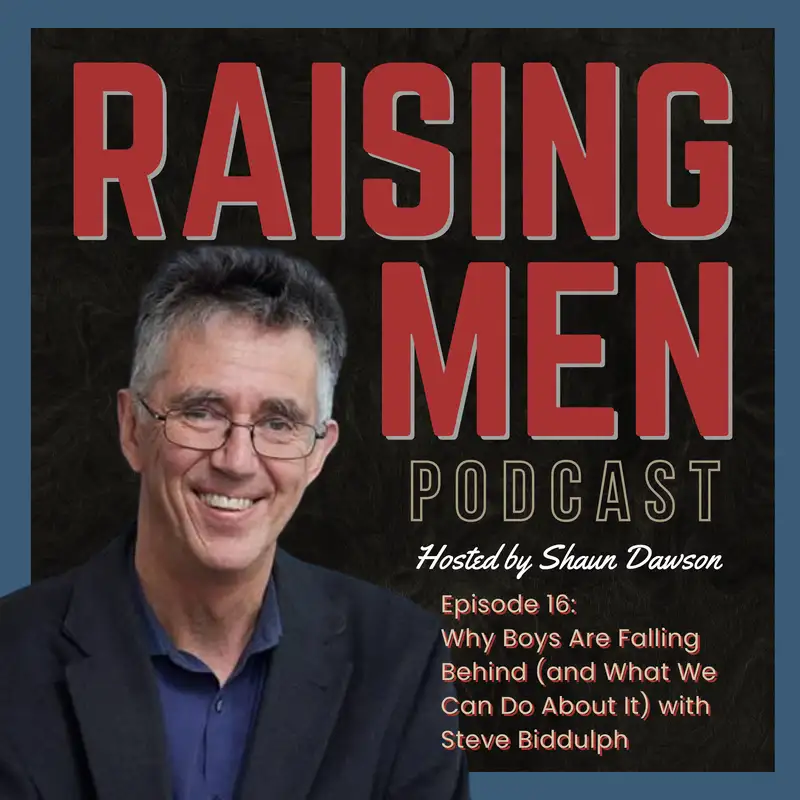
Why Boys Are Falling Behind (and What We Can Do About It) with Steve Biddulph
I would get stopped in the street and I still
I still get stopped in the street by guys
these big guys come over to me and say you're
you're Steve Biddulph aren't you
and I I said yeah
what what you gonna do to me
you know you gonna break my head off
ha ha ha ha ha
and and I said
that book that that
that effing book of yours
that that's the story of my life mate and
and it it really helped me
and I just wanna let you know I
you know sometimes
you know
like I wouldn't be alive if it wasn't for that
welcome back to Raising Men
one of the founding hypotheses of this whole project
is that there is a quiet crisis happening with boys
today across classrooms
playgrounds and homes boys are falling behind in school
they're struggling with identity
and they're being forced
to grow up in a world that's not quite sure
what to do with masculinity anymore
and my guest today Steve Biddulph
has been one of the world's leading voices on this
for over three decades he's a psychologist
an educator and an author of two books
Raising Boys and The New Manhood
and those books have shaped how millions of parents
and teachers understand
male development his message is simple
but I think profound if we want strong men
we need to raise emotionally healthy young boys
Steve welcome to raising men
hi Shawn
and hello to everyone that's watching
or listening to this great to have some time with you
well thanks so much
and now how did you come to focus
on boys and men and fatherhood
and parenting and education for your career
okay well
long people who are watching this can see
I've got grey hair and I'm seriously elderly and um
geriatric now and so
but in the 1970s I was a young um
keen young guy um this
this just graduated as a psychologist
and I got recruited to a
a new clinic that was being set up in a
an industrial kind of town in Tasmania
Australia
and this clinic was doing something pretty radical
it was seeing the whole family
it was a family therapy clinic
which in those days was a new idea
and so we uh
someone had a a kid with all
with some kind of problems uh
with the law or with with behaviour or something
my boss said the whole family's gotta come
we're not seeing kids on their own
which is pretty sensible thing when you think about it
um let's yeah
I'm astonished that that was revolutionary
but it absolutely is
that seems like an obvious thing to do
yeah cause in those days
it was like you getting your car serviced
you know you would
you drop your kid at the psychologist to get them fixed
and that that never worked but
but anyhow we
we got to see hundreds and hundreds of families
and these were what we call
I think you call it in the States as well
blue collar families that's right
um
families
parents who worked at the mill or worked on a farm
or worked in the forest and um
and what we found was that the mums were great
the mums pretty much knew what they were doing
um but the dads really struggled
and and in
in in the families that came to see us
you could tell that dads they love their kids
and they work their guts out
all their life to provide for their kids and um
but the when it came to actually relating to their kids
they were kind of distant and stiff and awkward
um and
and so I'm so began to think well
someone's gotta help the dads and um
and then something happened Sean
which was more personal that I was a
a young I
I was married with Sharon
I had a farm and we had a
um
had um
a little boy and we are ready to have another child and
um and the
the pregnancy of our much hoped for second child um
miscarried and um
and that's the thing that happens
very common thing
happens to millions of people every week
um but it really knocked me around
I don't I didn't understand it
but it put my wife Sharon and I
we kind of we had a
kind of
a grief reaction that was on a different timetable
her grief was different to mine
and she didn't want to talk to me
and I I didn't know
what was happening and I just got very
very sort of depressed and
and really affected by that
and when I tried to talk to my friends
they didn't they just didn't come through for me Shawn
they just didn't know what to say
and I began to realize well
have I even got friends you know
I thought these were my friends um
us guys don't um
we don't support each other properly and um
and this began a lot
a journey right into the whole thing
Robert Bly had just written Iron John
his book about men um
the idea of father hunger and the father wound
and so
manhood was the book I wrote out of that experience and
and so I it was it was personal
but it was also something professional
I saw the need for
and manhood started 500 men's groups around Australia
and I would get stopped
I would get stopped in the street and I still
I still get stopped in the street by guys
these big guys come over to me and say
you're you're Steve Biddulph
aren't you and I
I said yeah
what what you gonna do to me
you know you gonna break my head off hahaha
and and I said that book that
that that effing book of yours that
that's the story of my life mate and
and it
it really helped me and I just wanna let you know I
you know sometimes
you know like
I wouldn't be alive if it wasn't for that book
and that was just you know
I'm a quiet sort of guy
and I'm very unsure of anything that I do
but this was very affirming message
that we were onto something here
and we had to we had to help the guys
and the guys would respond to that
and they would turn around
you get you give a man the right help
he will turn around you know and
and um
it's just that no one ever did that
and so that was this that's enough of
of the origin sort of I'd story but
but that's that's where it began
that is such a powerful story I
I love it and I love that legacy that
that you have
I love the fact that you get recognized on the street
that is that's
that's fantastic hmm
now you have argued that uh
and I agree with this argument
that boys might benefit from starting school later
um but that
you know that's a big kind of systematic change
and I don't think we should be holding our breath
waiting for the culture to catch up to this
so since
traditional school environments can disadvantage boys
in in areas like
like reading or behavioral expectations
emotional development that sort of thing
what do we
what can we do to support our son's education when
you know within the current system
that funnels them into a situation that's
frankly suboptimal yeah okay
well we gonna take a while to unpack that one
um sure
because okay well
we got a while first of all to understand um
what's going on is that when
when a little baby is still in the womb
you know it was still inside his mum um
if it's a boy baby in his
his
there's a point about third trim
third sort of month of pregnancy
the little testicles start to pop out and start to grow
and straight away they make testosterone
that's their job and they start making testosterone
and they start shaping this little fetus into a boy
baby
and one of the main effects they have is that they
they put the brakes on the testosterone
slows down the development of a boy
and whereas a little baby girl in the womb is kind of
kind of surging on little baby boys grow more slowly
and we have no idea why that is
but at the moment of birth they're
they're probably three
three or four weeks less developed than baby girls
wow that that's counter intuitive yeah
yeah and um
and maybe it's got something to do with that
they've got extra things they need to
to develop but we
we don't know but the
the result is that with a little baby boy
he's a little bit harder to switch on in
it's sort of like you know
when you hold when mum's holding him and talking
to him and you know
how you going little fella
you know you
and tickling him and and smiling at him
you have to work a little harder to get him
on the outside and uh
Richard Reeves who's written about the science of this
it's it's
you know that they're um
they're even more likely to
you know to die in
in in early childhood um
it's a vulnerability in boy babies
and and so
and by the time they are starting school
it would coming to your question
um so age 5 or so
4 or 5 the difference
between the boys and girls is from 6 to 12 months
difference Sean
so it's a you know enormous
the gap gets bigger
yeah at that age
it gets bigger and and
and then they slowly start to catch up
but they don't catch up till they're about 22
and so so it's a lifelong thing
and so girls for instance
have puberty um
a year and a half to two years sooner than boys do
um and
but if we stay with our school be
school starting what this means is that little boys are
can be a year behind the girl that's sitting beside
in the desk yeah
and and that's not good and and
and a year behind what that
what they're behind in is two things um
talking
you know be able to put a sentence together
and express themselves and
and getting finger control
you know
picking up a pen and being able to do nice work
in which
and schools have traditionally been very big on
you know neat work
you know and answering the questions and and
and so if you're a little boy
and you just get this pretty immediate
you know they're not silly
they're not stupid
they can see that those girls are so good at it
you know um
what can I do um
and so very likely to get restless
discouraged not be able to follow the teacher
and the whole trajectory which of course
ends up in not very good places sometimes
and so I began when I wrote Raising Boys
which was 1996 um
I said don't send them
if you if you got any doubts
just hold your kid back um
send them the following year
and so many parents as I said
Raising Boys
is the top selling parenting book in the world
so far this century and
and it was massive particularly in Europe and
and Asia and
and so I
I met someone who was a Scottish education bureaucrat
he said your book gave us so much trouble
he said we had
like 10,000 families held their kids back
the year your book came out
we had to we had empty classrooms
we had to build other classrooms in other places
because they this great wave came through the next year
yeah the year that gets implemented
you don't have any boys in school no
that's right that's extreme
but yeah but but
but I get you know
I get stopped by mums and dads
especially when I used to do my speaking tours
and they say we did that
we kept our son back and and he did great
you know he
he was a year more mature
he could hold his own and um
I'd never met
in out of thousands of people who told me that
I never met anyone who regretted doing that
you know cause it paid off in high school as well
and it does does that make sense Shawn
just as a as a dad to you
so yeah
I mean what your
your description of that problem is
I mean it's like you're talking you're
you're telling my story of my childhood
I I have this distinct memory when I was quite young
maybe kindergarten aged and I went
my parents brought me over to a friend's house
and they had a daughter my same age
and we were sitting down
and the parents were socializing
and me and the daughter were hanging out
and she had a bunch of coloring books
and I was coloring with her
and she colored beautifully
she outlined the area that she wanted to color in
the color that she wanted to use
and then she was just filling it in
and it was her pictures were gorgeous
and I desperately wanted to be able to do
that and she was getting on me like why
you know stop coloring outside the lines
stop coloring outside the lines
and I couldn't physically do it
I I
I I
I was so frustrated
because I actually couldn't physically keep
the crayon from going outside the lines
and it it ended up I ended up in in school
I I have a September birthday and in September
you can kind of fall on that edge
where you can be in the earlier school year
or in the later school year
and my parents put me in school early and and then
and to make matters worse
I was big for my age and I started skipping grades
and I prided myself on that
I was so smart that I'm skipping grades
but my emotional development
and my intellectual development
diverged and I was and frankly
the best thing that ever happened to me is
after 8th grade my parents decided to put me in a
I was in a public school for 8th grade
and they decided to put me in a private school
and the private school said
we don't want him to go into 9th grade
we want him to repeat 8th grade
wow and that was actually a blow to me
because it was such a an area of pride
that I'd skipped all these grades when I was younger
and did all that stuff and they said listen
like he's just he's gonna fit in better if
he repeats 8th grade and cause
he's not gonna be the youngest kid in class anymore
and um
and I I
they could very well have cited your book
it would not have surprised me
and that's what they did
and it was the best thing that ever happened to me
it wow
it just I
I wasn't playing ketchup anymore and I didn't feel
I felt so much I didn't even understand
how much anxiety and stress I had
associated with this having to perform at this level
that I just wasn't ready for
and it took that all off the table for me
and now I look at my son who has my same makeup
he's he's only 6
unfortunately he's a January baby
so he's like
fully smack dab in the middle of the school year
um but
and and
but he's very big he looks
he's 6 but he looks like he's 9 or 10
and so people have expectations of him
that he has maturity that he doesn't
he can't access
and I can see that same frustration in him and
and it is I'm
I'm just like
I really struggle with knowing what to do about that
and we've had conversations where I
where I've sat him down and said listen
this is what happened and it can't happen that way
people it's not fair
but people have expectations of you
that are well beyond your age
and that's not fair sometimes life isn't
fair and this is one of those times
we're gonna have to figure out how to
how to do the right thing here
and it's it's been a real tough thing for us
hmm and he's only 6 still and and
and yeah
yeah and
and and so yeah
so we need to we need to do both we
we we gotta
as an individual mum and dad
we have to do what we can to slow this down
and and the school systems need to change um and
and give people a option and
you know in the school of the future Sean
the average boy will be a year older than the girl
he sits beside yeah
and and
and that'll and because it
for people listening it's you
what happens is the way girls bodies develop is they
they get their fine motor skills at about 4
you know they pick up their
those crayons and pencils you were talking about
and they're good at it straight away
their fingers work properly
but boys develop and so what if you've got a daughter
anyone listening who's got a daughter
what you've got to do with girls is you build that
you have to build their core strength
you know so you get girls on trampolines
you know and
and throwing um
throwing big netballs and baseballs sorry
um basketballs to them
because girls need strength in the core
but boys develop core outwards
and so so first
of all they develop the trunk muscles and
and then they develop their arms and legs
and also the nerves running to those
you know the nerves that control those arms and legs
and then when they've got that
finally it's the fingers that come last
and so what a boy's body tells him to do is move me
you know a little boy sitting in the classroom
and his body is saying you know
move me ha ha
run around yeah
yeah noise yeah and
and he's he knows
he knows you know
a good kid is a still kid
you know in a elementary school classroom
you're supposed to be still
but his body's screaming and
and guys that are listening to this
if you think back you'll remember this feeling
it sitting at a desk
it hurts it actually physically hurts
it was yesterday
I remember that feeling like it was yesterday yeah
yeah
and so I work a lot with elementary school teachers
and I and I help them to
to realize you know
that little guy get them moving
you know and so a lot of our schools now they
they have exercise at the start of the day they
they do a lot of moving around that you you
you can get up from your chair and
and you know
stretch yourself and stand up and
and you won't get sent to the principal
um so you
you've got to find a boy find
a boy friendly school and and
and the teachers are are attuned to this Boyd needs um
then it's it's my
it's a whole lot better but but
but the main one of course was
you know that
I mean I think that probably changed your life
Shawn changed the trajectory of your life
it really did it there's no question
it changed the trajectory of my life
no question at all and if it had happened earlier
it would have changed it even more
even better I
I would have gotten involved in sports
in a different way and
or much earlier
which has been a wonderful part of my life
but you know I it
you know it would have been it
it really would have changed things for me
let's shift gears a little bit
I wanna talk about you know
it's increasingly the case that households
are becoming separate
moms aren't living with dads as much and
and there's a bunch of research
that links the absence of a father
in the home to higher risks of
bad outcomes delinquency
poor academic performance
and you know one
and at least here in the US
more than 1 in 4 children are living without a
a male in the home
and for a lot of parents it's just simply
that's just the reality mom and dad don't live together
so what what do you think we can do to mitigate
the issues there I
I
if you're staring down that reality
what do you do about it
okay so again
this is this is huge um
and it's it's lucky this is not new
this has been the case for
for the whole 30 years that I've been writing about it
that that um
a lot of kids are in single parent homes
um and it's always really important to say to to
to single mums that are listening to
to the podcast um
that women have raised boys on their own
for thousands of years um
and and done just fine
had them turn out really well and
and what I it just means you gotta understand the
the landscape and
and because when I came I came back to live in
the town I live in is called Launceston and
and I I came back here um
after a 20 year absence
I lived in the UK and I lived in
in up in the rainforest of New South Wales and
and I but I came back to Launceston and
and when I go to the supermarket
I'd sometimes bump into people who'd been
clients of mine back in the seventies
and and
and it's kind of like the elephant in the room
it's it's like um
I'd have to ask them they say
oh Steve
it's us you know
we saw you when we came with our little boy
you know and and
and it was a single and the elephant in the room
was well
was it any help you know
I was a young yeah
how'd it turn out
yeah how'd it go and
and but more well
and that they say well
you know um
yeah look
it was it helped and um
and I'd say well
what would you
what would you pass on to a young single mum today
what as
as you've raised a son I've met him he's doing great
what would you pass on and they'd say
it was always the same thing Sean
they'd say
I made sure he knew what a good man looked like
because you can't turn into one
if you've never seen one
and so those mums they
they recognise OK
I can do I can get him 90% there
you know if I'm loving and if I
if I'm understanding of his boy energies
and I don't get into negative
um you know
put downs and fights with him um
then I can get 90% there
but he's got to see some good men
and so that's right you know
so we we say don't send him to Kev's College of karate
um unless you like the look of Kev
ha ha
you know if
there you go you know yeah
whether it's a sport or a musical instrument
or whatever it is um
role models are the real thing
and in a second
we can talk a bit about that if you've got time Shawn
cause it's a big theme of mine
but but those mums they
you know they kind of recruited
you know they said OK
he hasn't got a dad um
but he's got an uncle who's really nice guy
you know so uncle
can you take him fishing every
you know couple of times a month
and um
Grandpa you know
can you take an interest
he's having a bit of a struggle
can you take a bit of an interest in him
um you know
it doesn't matter who it's what
you know the
the guys who the two guys who live next door
you know if if um
he can he gets this kind of
palette of a lot of different styles of masculinity um
then he can begin to
to have a bit of that and a bit of this and and
you know learn what kindness looks like in a male and
and um
and that it's a combination of of
kind of taken in the the
this this
the way of being male
but it's also feeling validated as a male
you know Grandpa and I hang out
Grandpa thinks I'm alright
even though I'm struggling at school
Grandpa says I'm a great kid and I'm good company
and I'm good with a fishing line and
and so um
and that that's what those mums did
they made sure that the
the boy didn't go up in a kind of hostile
a world hostile to males um
yeah does that
make sense Shawn
it does well
and I think that there's
you know the
the thing that we talked about in the very beginning
where men aren't supportive of each other
in the way that women are right
my wife has eight friends
that she tells every detail of her life to
and I
I really struggle to open up to even my closest friends
and in that same way
we're not we don't seek out
you know young men to to to mentor necessarily
or we're not necessarily going to seek out mentors
if we're a high school age boy
or something like that and it's so critical
and the cultural institutions that used to exist
to make that happen your church or
you know local programs and those sorts of things
those are all gone now
and so it's not gonna happen by default
and that
that means you have to take responsibility of it
you have to design it yourself
you have to be intentional about it
now that also means that you can customize it
you don't just have to go to the Catholic Church
on the corner where there might be some problems
you can customize it for your own needs
but you have to do it
yeah
and and um
knowing that
I think people can get very intentional about it and
and and
and and
and and it's not it's not rocket science
it's not that hard the guys that are in the
the terrific thing about the psychology of us as men is
if someone points us to a job
we'll do it yeah
um and and and
and we we have a
a really great quality which is a
we like to do heroic things and
and if someone says my kid's in trouble
you know can
can you know it's
I think it's it's
you know it's gonna be a year or two
where he needs just someone a bit that
that's a bit involved in his life um
so you know
we think OK
well if that's what you like
yeah I'll
I'll give it a go and
but we would have been there is a man on the planet
I don't think that there is a man on the planet
a decent man on the planet
that being asked that question
wouldn't love the opportunity to do that for somebody I
I think I I just
if I just can't imagine anybody I know
any decent man I know when come
when having that question posed to them
every single one of them would jump at the opportunity
to do that is yeah
yeah it's a hopeful message
and Sean
can I talk about a little part of this that will make
it make sense to people more and
and because it's um
it's to do with um
there are qualities that you would wanna have
you know when we talk about um
a good man or a life affirming masculinity um
that that um
it opens up into some things and and for instance
you know you would be patient
you know he's always gonna grow up
he's probably gonna be a dad
and be a husband or a partner um
so you want him to be patient
you want him to be kind
you want him to have stickability and endurance
and want him to be a man of his word
and those kinds of
whole bunch of things now
if we take take patience for example
that's
it's actually quite a complicated thing to be patient
yeah um yeah
it's not you can't sort of say to a kid be patient and
and I'll have it in a Powerpoint presentation and
and because what it is
it's actually it's a way of breathing
you know when you when you're patient
you kind of change how you breathe
and you change how you stand
and yeah there's a physiological component to patience
yeah yeah
there's and there's a whole um
you you drop you drop your agenda that
you know and you say okay
this is gonna take a bit
I'm gonna listen to this kid while he
unpause something out
or I have to wait'cause he's really slow with this
and so so patience is a very complex
nonverbal multifaceted skill now
the only way to learn that is it's a right brain thing
you have to see it going on and you take and
human beings it's called mirror
mirror learning and and we
our nervous system I
you know I watch you and I
and I take in your movements and your breathing rhythms
and your the
the way that your face moves and your eyes move
and I've got a
kind of a Shawn sense that I can take on board
if I if I spend it
you know a couple of days with you
I could do Shawn
and qualities that you have that I don't have
and I can put those into my masculinity for future
you know use
and so so the
the the role modeling is made up of
you know
the a boy
we drink in what we are
is
we're a bundle of all the good people we've ever met
male or female and so if your
if your son has seen patience
and he's seen forbearance
and he's seen stickability and
and vulnerability and and all those qualities
then it's it's
it's it's programmed into him and he can do it uh
and and so we
so they they need thousands of hours of male company
um school teachers and coaches and guys on TV and and
and um
and in the old days that was there you would yeah
it happened by default all the yeah hmm
yeah I wanna touch on one more really
really big subject and I know this is something
we could probably go hours on but
but I really wanna get your opinion about it
and that is navigating the digital wild west
I'm talking about like
stuff like screen time and pornography
and gaming
and gambling in our pocket and all of those things
I'm terrified about these things
this is in fact
one of the reasons that I started this whole project
is because I realized that the world that my boy
is gonna graduate into is so completely
it's a foreign territory for me
it might as well be a different planet
from the one that I grew up in
and and because of these things
how what is your advice to parents
to navigate these boundaryless
digital realities rather
I mean
I think a lot of us just stick our head in the sand
and pretend it doesn't exist
or pretend it's you know
a matter of force of will or something like that
but they rewire your brain
what do we do what what what is your advice about that
very important question
Sean and it's a it's a combination of two things um
one is just restricting the the whole phenomenon
you know putting the brakes on um
and the other is giving them some
giving them some guidance and
and tools to use when they do encounter it um
and I can spell those out a tiny bit now in
in my country Australia
I don't know if you know this but about I do I love it
go go ahead and tell everybody four weeks ago
the government passed a law
legislation
that social media companies are not allowed to
subscribe under sixteens
and so under sixteens and are not are not able to go on
not able to have a um
a Facebook account an Instagram account
a whole bunch of the of TikTok
all of those
they can still do YouTube's
but they can't have an account
so that they can't be algorithmed
and because it's the it's when you have an account
the algorithm steers you into
you know the matter sphere and the
and the toxic stuff
and so already parents are incredibly um
relieved and and it meant that
you know if
I mean if you had a involved mum or dad
they were already putting those brakes on
but if you had a a kind of deadbeat parent who didn't
just was too exhausted or didn't care or whatever
it meant you didn't miss
you didn't have a horrible childhood
because the government had solved that problem for you
yeah um
and this is sweeping the world now
there are countries in Europe are just following
quickly they're watching our
you know the experiment here
and they're pretty much bringing it on board
but meantime yeah
I mean and it's just
it's the kind of thing
the government has to step in and do
because I mean you could say oh well
you know just
don't let your kid use social media until they're 16
alright good luck
that's somebody who doesn't have kids
that's somebody who isn't getting pestered day by
when can I get a smartphone
when can my kid my six year old boy is asking me
when he can have an iPhone already
he's already pushing me on it
and yeah I mean
I don't it's tough
yeah and so
so it's like um
we're a herd animal and and
and it's very hard to stand against the herd
and so um
so it helps um
you know there's
it's called in Australia
there's a thing called the Heads Up Alliance
and it's kind of heads up from your phone
from your device yeah
and it's a school communities
it tends to happen school by school
um that the school will say look
can every let's all get on board
let's
none of us give kids smartphones till they're fourteen
um and and
and and our whole
let's all do this
so it makes it easier on the individual
um and I know we're running out of time Shawn
and so I'll come around
to the other part really quickly for you
um yeah
that um
the
the other part is that particularly with pornography um
kids they will see it um
and there'll be some kid in the in
you know usually by the age of 10
some kid in the school will have shown them some
horrible thing on their phone or
or in a photograph and so we
have to let them know you say look
there's this thing around it's called pornography and
and it's people doing things with each other's bodies
and
um and you'll be if you see you'll be kind of
you know like wow
what's that you know
you you wanna have a look
cause you're curious and that's alright
and if it's a you know picture of a
you know girl with no clothes on
of course we're attracted to girls and they're
they're beautiful and um
but there's some problems with this stuff
and it's in particular the
what happens in pornography is different to real life
and um
and in in our books we have we list the differences um
that you can teach your kids for instance
people are not up for sex
the minute they first meet each other um
and um that um and the most specific one is that um
real girls don't like being strangled
they don't like being slapped
and they don't like being um
put down you know
with put downs and and verbal abuse
because I think it's
70% of pornography depicts those things
wow
and and and the actresses are are are paid you know
they and you explain to your kids
the actresses are often really poor
and they have a lot of trouble
you know paying their
for their food and their kids and their apartment
and so sometimes they make this
these movies to make some money and
it's really sad that they have to do that
and they have to pretend to like it
uh and so
trust me girls don't like that stuff and
and if you do that stuff to girls
they won't like you and
and so you know
so pornography is is mis
miseducates you and
and so
this is the sort of thing you talk to kids about
when they're about 12
Shawn um
when their age you just
look what a powerful way to
to communicate that and I
I love that trigger of when they see it
they're gonna come to you
I mean you've got to have that kind of relationship too
and then you have
you get prepared for that conversation
hmm yeah
and and so
and because the effects of all of these things are
are to do with exposure with
it's a dose related thing
the more you see the worse you are was is
is you don't have devices in bedrooms and um
and and
and only in in the public parts of your
of your house that
where everyone sees what each other's doing
um yeah and
and very you know
very important
because the kids get so messed up with this
and there's huge companies
making a lot of money from messing your kids up
and so you have to fight back
yeah
wow that's
that is tremendous advice
I appreciate it now
I always love I like to finish off every single
one of these discussions
by asking the same question of everybody
you know I'm gonna put you on the spot here
feel free to take as much time as you want to
think about it but um
give me one principle that you think is important
for raising strong powerful
uh excellent men
okay look
I think it's a paradoxical thing Shawn
that tenderness is um
is the secret of
of strength and that what happens if we
if we tender and gentle with our little guys um
including when we wrestling with them
and fighting with them and things like that
where we where we never ever hurt them yeah
and and they know that they can um
that they're deeply loved um
then their natural empathy will stay and so
so when they see someone hurting
they'll wanna help them
and they'll never be the cause of hurt
to somebody else
and so it's the stuff you do in the first two years
you know where
where you're gentle with them and
and patient and and um
and even when they're just impossible
you know and you gotta kind of
you know hold them
you know carry them back to the car in a screaming heap
um um
don't get angry don't hurt them because when you
when you put hurt into a kid
the hurt will come out on someone else down the track
you know kids
kids who are hit will hit when they grow up
kids who see their dad hit their mum
will hit their wife as well
and you know
if if you hit your kid and you hit your wife
it's almost a guarantee your son will end up in jail
guarantee and so um
so that that
those are things if if you're a dad
you know and this is not just a minority
it's all of us all of us dads
me too we had to learn how to be safe and
and how to
to manage our strong feelings to walk away when we're
when we just don't know what we're gonna do
and so that so that a kid can say
I always feel safe with my dad um
he's he's my safety go to guy
that's the foundation of everything yeah
yeah that's what I mean
half of masculinity is being a protector right
you're being a you're a protector and you're a provider
yeah and you're not a protector
if your kid can't say that about you right
you know he's not protected
he's protected from you that's right yeah
yeah
I love that that is a fantastic principle
thank you for adding that to my list
I I
that is that is tremendous
the books are raising boys and the new manhood
check them out this
you can learn more about Steve's work at Steve
bedoff.com the link is in the show notes
if this episode moved you
please share it with another dad or
a mentor a teacher or
or another parent
who's in the fight for the soul of our boy
Steve thank you so much for joining me today
great interview Sean
thanks very much and
and love to everyone who is watching or listening
see you later bye bye
raising men is produced by Phil Hernandez
this episode was edited by Ralph Tolentino