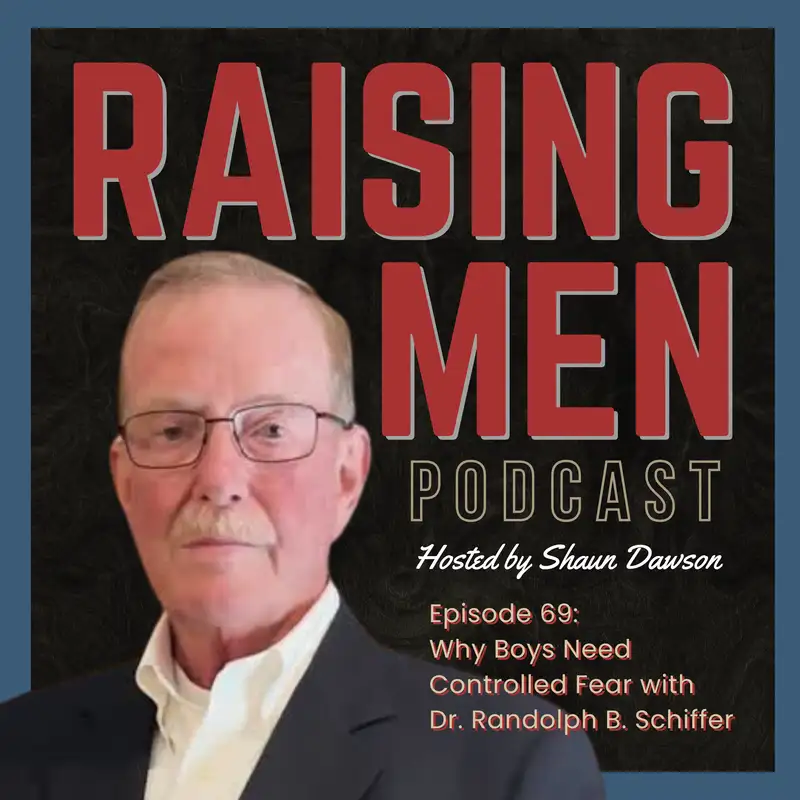
Why Boys Need Controlled Fear with Dr. Randolph B. Schiffer
what is the right way to to deal with that
well I'll remind us all that fear is built in to
to children uh
all infants and young toddlers uh
are fearful sometimes they just come that way
however courage the
the capacity to speak
think and act in spite of our fears
that is not built in we have no courageous infants
or young toddlers that I ever saw
that has to be Learned
welcome back to raising men
in a parenting culture that often defaults
to protecting children from discomfort
we might be missing an opportunity
to help them build real resilience
Doctor Randolph Schiffer he's a neurologist
former Marine and the founding director of
the Cleveland Clinic's Center for Brain Health
offers a different perspective
that strength isn't built by avoiding fear
but by helping children understand and move through it
in this conversation
we're gonna explore how storytelling
language and a parent's presence
can shape how boys experience fear
and how those early experiences influence
the kind of men that they'll become
Doctor Schiffer welcome to raising men
thank you for having me Shawn
so most parents I think
and I'm definitely one of them
instinctively want to protect their boys from fear
right and we say don't be afraid or when
when a child is scared but as a neurologist what
you know what is actually happening in a boy's brain
when they experience fear
and when we tell them to suppress it
rather than process it
um what happens
I think that you're correct
we have kind of a parent mythology now
that we need to protect all our children
boys and girls from upsetting experiences
fearful situations difficult topics
uh like death
whatever uh drugs
sex uh
and as a there are consequences for this
and I think they're for boys and girls
all their boys and girls are different
but the consequences in my view
are that we have now a fearful society in itself
these are tangible results
there are um
I mean I can give
what are we afraid of
I think we're afraid of so many things now
we're afraid of failure
responsibility development of responsibility
the capacity to say
there has been a terrible mistake here
and I am responsible this
I can just I can tell we're afraid of death
the wellness movement now is uh
widespread and to for
to that
all Americans
are assumed to want to prolong their lives uh
without regard for whether it's a good life or not
I think we're afraid of life itself
suicide rates have risen 40% over the last 20 years
at all ages I'll just give one example
um
I'm coming back I'm not forgetting the brains
but I'm coming back to I'm just
the context here of what what the results are
in the area I know best in medicine
the consequences of this uh
new kind of parenting
protecting the children from upsetting
fearful dramas uh
experiences we now have young doctors
a major medical center one of the top in the country
not mentioning the name
where in the internal medicine department
the residents
the first year doctors are afraid to be on call
and so they're not on call
they never get the call in that first year
from the emergency room doctor you
wow you have to come
you better come down here because we have this problem
or that they're protected from that
and um
as a result
well the long term outcomes
I think are
I have consequences
yeah that you're
it's not that that's a framing that I
haven't thought of before
which is that some of what ails our culture
and I talk a lot about
what I consider to be a masculinity crisis and
and
a significant portion of that is explained
by what you're talking about
which is we are
at the same time kind of stoking fear in our culture
like through social media and
and you know the whole engagement
economy
but
but are also trying to avoid it right and
and uh
trying to avoid it for ourselves
trying to avoid it for our children
and that's that
that's not the way the world is
it's not the way we've evolved
that's not necessarily healthy and
and I think that the demands for
some of these value development
things are greater now on boys than girls
because we have very powerful
cultural ideas about what it means to be a boy
or a girl a man or a woman
those are changing and I think that right now
my view of the cultural mythos
certainly for young men
has become almost impossibly difficult
because the more traditional masculine type behaviors
leadership strength
courage um
implicit violence those things are still there
although some people wish they weren't
but now in addition
the more traditional feminine values compassion
conflict avoidance
nurture nurtureance etcetera
the young men are now expected to write poetry as well
uh as take command of a Marine Corps platoon in combat
hmm it's almost impossible now the
the women have kind of
of through the looking glass alteration 2 because now
but I think it's less dramatic for them
but now they are not expected
but they have permission to develop more
some of these traditional masculine qualities as well
on top of the more traditional feminine roles
but I think for the young boys
it's more difficult
I think so too and I think
we do ourselves a little bit of a disservice by
these things being associated with gender
as strongly as they are um
because then you have to
then you have to go through this kind of mental
gymnastics to
you know explain that
that it's not necessarily like
like men can exhibit traditionally female qualities
and women can exhibit traditionally
masculine qualities and
and it's it's just a shame that we don't have
gender neutral ways of expressing those things
um
but but
but yeah I mean there's
there is a a challenge
and an opportunity for us to experience the world
in an in a
in a new way by embracing what
you know the traditional values and
and just you could decide
instead of society imposing those values on you
because of your gender you could pick what you want
but then
that imposes upon you the responsibility to pick well
and I think that we're doing that first thing
our culture is thrusting us into the position of oh
okay well
you know the
the the traditional
um the
the traditional roles are no longer valid
so pick what you want and that's freedom
that's great and then
but we're not
embracing the responsibility of doing that well
and I I
I think that's kind of the
that's the illness that is happening there and
yeah so going back to the notion of fear
what is a better way you know
when my daughter is comes to me
and she's claiming to be afraid of
just being in her room alone right
what
how how
what what is the right way to
to deal with that well
I'll remind us all that fear is built in to
to children uh
all infants and young toddlers uh
are fearful sometimes they just come that way
however courage
the uh capacity to
speak think and act in spite of our fears
that is not built in we have no courageous infants
or young toddlers that I ever saw
that has to be Learned
and I think that's Learned uh
from the parents or grown UPS around them
through several mechanisms
one is modeling we demonstrate
they know who we are
we show them how we respond to fears
um and a key thing there is
I think many of us as parents have
now
you're mentioning your daughter talking about her fears
uh I won't personalize this
but how many of us parents
have talked with our children about our fears
so that they can see that we too
are afraid of things and see how we process them
so that's kind of an identification process
it goes on for about 50 years
they learn from us how to deal with um
man that's such a powerful statement
and I one of the
just constant refrains in this whole project has been
that 80% of it is modeling
whatever it is you're trying to impart to your
to your to your kids 80% of it is modeling yes
and but I'm I'm in spite of that
and in spite of being very aware of that
it's never occurred to me
that I need to be
talking to my kids explicitly about my own fears
or that was a way to handle
so I have this interesting
reoccurring situation going on with my daughter
which is why I brought it up
and she's going she's 4 years old
and she's going through a phase where
it feels to me like she is trying
to manipulate me using fear
she knows that
claiming to be afraid of things is a way to get me to
respond
and and so you know
I she recognizes that if I tell her to go into her room
by herself that she can say
I'm scared and I now have to do something
she she recognizes this
but it feels to me like pure manipulation
I don't I don't know if she's
I don't think she's actually scared
but she might be but I also think she to the extent
she is actually scared she's manufacturing the fear
and I'm really at a loss to do what I to
to figure out what to do about that
and I know there is a productive way to handle it
but I don't know what that is
and go ahead
so you think she is um
creating special father time with herself
by these behaviors then you come into the room with her
in this case it's usually when
when she's been acting out
and she's going to her room to take a break
and she's trying to avoid punishment
parenting is the most difficult task in our lives
it's more difficult than marriage
it's more difficult than work
and we all make mistakes we do
but I would what I
what I have been working on
and thinking about is stories
and storytelling because
in addition to identification processes
with the adults and the parents
children learn from the stories
about who our heroes are how they process fear
how their courage comes into play
their conflicts their failures
and so I think so called bedtime stories
and I've written this book
bedtime stories I love to get into this
this is great so uh
the figures the heroic figures in the stories
stay with us to the very end
and the nice thing
the good thing is you can craft the stories to fit your
your children and yourself so that they fit
but if the stories are told
children love stories well
so do grown UPS um
if the lead figures
the heroes in the story are shown to overcome fear
frustration whatever
and develop positive skills courage responsibility
respect for others uh
those figures from the story stay with them forever
all two our
our two boys now age 40 and 38
they still talk about some of the figures from the book
I love that yeah
so your bed
your book is called Bedtime Stories
that will Terrify Children right
and so why why is that such a powerful way
a powerful training ground for
for the nervous system there
well um
remember the um
memory systems and the fearful systems in the brain
are colocated deep in the brain
medial temporal lobes above the brain stem hypothalamic
uh
I mean if you have any doubt about memory
and emotional arousal being connected
uh we don't want to personalize this too much
but if we think now at our age
it's very difficult to meet people
and remember their names but not
if the person you meet is particularly obnoxious
or particularly attractive
those names are with us in a second
because the emotional arousal
it's probably neurological
inside the medial temporal lobes
just locks those all together
so with the bedtime stories
if they're told right
and the stories and the figures are captivating
they'll stay with these children forever
they are legacy uh
to the children and the
the book that I wrote is told in the voice of a father
who has but one year to live
hmm
so the stories are his legacy to the two boys
uh about his values and what he thinks are um
the important things in life
and the children are in the stories too
and the father's in the story
so that's another you
that's one way to make sure that there's engagement
if you put the child and yourself into the stories
in ways they really like that
yeah are you uh is
is the book geared towards a particular age range
of kids um
uh you know I the
the truth is I don't know
I think it's more a book for parents than for children
now it can be read as uh
suspenseful dramatic stories
bedtime stories for children
it can be read that way but I think fundamentally
it's about if our time is limited with our children
which it is for all of us
but what if it were just one year
what stories would we tell them
yeah I've
I love that sentiment
I used to tell stories um to my kids
at bedtime and I
I still do but um
but it's it's less common now for some reason and um
I would make up the stories
yeah and they would all start the same way
so I started this with my son and and
and he was he was in the story
so it was uh
once upon a time there was a little boy named Lake
and he had two dogs named Penguin and chicken
and then one day something happened and he would
lake would just
he loved these stories and he would beg me for stories
and there were so many times at the end of a long day
where I was mentally exhausted
and just I
I really had a difficult time coming up with a novel
story
and um
sometimes I gave into that and man
I just too tired to come up with story today
but most of the time I I
I tried to push through it
and I would normally be successful
you know to some degree
some of the stories were really good
some of them weren't
and
finally I
once I I intimated to a friend
who had a son about the same age as mine
and I said man
you know how do you deal with this
and uh
and he goes you know
you don't he doesn't know any stories
you don't have to make them all up
and he goes he goes
like I'll just tell Cinderella as if I made it up
and it never even occurred to me
that I could plagiarize other people's stories
and pretend that they were my own
when telling my kids stories
and I eventually decided not to do that
because we kind of
have this principle that we don't lie to our kids
about anything
it's I
don't know it's very similar to
to what you're saying
like we need to be able to confront hard truths
and as parents it's our duty to figure out how to
do that in an age appropriate way
um but uh
but I just thought that was an interesting
interesting little point that my buddy made
like you don't have to make up every story
you can tell stories that have already been made up
well here's what I say about lying
um cause I used to lie to my patients sometimes too
interesting a lie is a deliberate
alteration or adjustment of truth or facts
that is self serving
if the time should come
that some adjustment of what we tell our children
or our patients uh
which is not true is done genuinely for their benefit
that's not a lie
interesting I yeah
I think that that's a yeah
that's a good way to think about it
yeah I also I
you know the
it's also
I I
I encountered this interesting definition
of suffering recently
and um
the definition is that suffering is when
you find out that
the map of reality that you have in your head
is different than the actual reality on the ground
and it's that
disjoint that disconnect
that is suffering
and and so when you think about it in that lens
the reason lying is such a problem is because it
results in suffering right
you you are
you are creating that disconnect
or you are allowing it to
you're fostering that disconnect
but what you're what you're
what you're kind of saying there is
there is a there is a place for
for reducing suffering
in allowing some of that disconnect to persevere
you know maybe easing somebody into the transition
into making that realization
is that am I making sense there
I I feel like I'm now just rambling yeah
no I'm
it's the idea I'm still on the stories of yeah
telling the stories and the characters in the stories
in a way that is good for the children at their stage
and that's very individualized
but the there can be uh
children are quite comfortable with magic
good evil spirits
uh
transformations of the household dog into a rabid wolf
beast if the moon rises red in the October sky
they're quite
they are quite comfortable with all these things
but I think the stories were
the hope is to transmit heroic figures to them
in ways that are uh
good for them and
and they'll give you clues about that too
sometimes you can ask them
you know well
you why don't you tell the story tonight
and then it comes from their imaginations
which are which are very creative or a variety
but the transmission of these figures
and there are figures which are not simplistic
um timid
fearful figures which so many children's books are now
I think complex figures growing up
learning to take responsibility to be courageous
to be self reflective and figures like that
they'll stay with these children just forever
and um
I can give one story about that
um yeah
let's hear it if I can uh
I I'm I
I have to be careful I
toward the end in medicine
I developed pathological weeping
so I cry now so um
so that gets in my way sometimes but um
um that's really why I had to quit medicine
is that right I
I I feel like I'm in the process of developing that
I I'm like I
I mean the first 10% of that I
I really find myself
a lot more likely to cry these days than I was
five or 10 years ago you'll see it on this podcast
but anyway as to these figures um
this Frank Marywell
mythical heroic figure at Yale from the 19 or so
always fair always kind uh
always successful well
one time in Vietnam I just walked around the bend
and there were four
North Vietnamese soldiers just standing there and um
the rest of my patrol had gone further down
and I thought well
I'm gonna kill these guys
oh my gosh so um I
step towards them um
to picked up the rifle to do it
they weren't very far away and they didn't do anything
they just stood there looking at me
and then right in the middle of all that
the image of Frank Marywell
intruded into my mind and I asked myself
would Frank Marywell
shoot these four poor Asian guys down
and I decided well
in a second no
Frank Murray wouldn't do it
and I'm not gonna do it either
so uh
I went on my way they went on their way
so that's the power of those uh
those kind of internalized heroic figures
wow of course it was a terrible mistake
life punishes you for every good deed
those guys were on a mission that was evil for us
and which they then carried out later
but I that part I choose to forget
that is such a powerful story
I
I can't imagine being faced with that and
wow
you know what
what made you decide to write this book
the way that you did
when our boys
were three and one this is now 37 years ago
the three year old developed leukemia
a L L acute lymphocytic leukemia
at that time
I I
I I took care of these children
I was always in pediatrics
uh uh
uh
for for some disease treatments
and I knew a lot about the leukemia children
I'd taken care of some of them that time
that disease was 50% fatal
um
but of the 50% who died I knew that it
they didn't all die from the biology of the disease
a number of them died because they
or their families were unable to tolerate
the prolonged and painful treatments
so I designed the bedtime stories
to toughen up the older boy
wow
so so basically what
what you're saying here is that
is that like
the storytelling was
almost a necessary part of the treatment
it was it was
I mean you're sitting here faced with
with having to to accelerate this 3 year old's ability
to really withstand fear and pain and discomfort
and so how did it work you know what
what was that process like
well he survived
um I can't prove what role the stories had but uh
I think they were a comfort for him
and positive for him cause I
of course I knew what lay ahead for him some
so the some of the elements in the story
they're not about well
actually one or two of them are about sick children
but they're about children facing difficult
traumatic conflicts between good and evil
doing the right thing failing even death itself
some children
uh in the squirrel story
the squirrel is an evil animal
who presides over the ragged hole in space and time
between this world and another
and he drags children through it
um
that's just what he does so um
by the way the squirrel was the favorite character uh
of of our boys
so is that right
so anyway the stories
I figured you know
our boy has leukemia but every child is facing
the drama and the struggle of growing up
and it lasts for 30 or 40 years
so maybe all the stories are designed
each one
it's about a different kind of a dramatic challenge
the squirrel it's good and evil
life and death but there are
there are strange there are evil goddesses that come uh
who seek power and
uh anyway
so each story is different
but I thought well maybe um
and I tried to have them
pick up elements of the challenge
which lay ahead for our child with leukemia pain
courage endurance um
maintaining your your own self
maintaining your your school work
your keeping your room
you know variety of things
uh and I hope that those are in the stories
and I hope that maybe you know now um
other children
might be interested in hearing these stories
what was your
what's your son's recollection of that time period
they talk about him both of them will talk about him
I don't ask
you know but it comes up now and then
they mention the squirrel
they mention the bear
um that's the final story
as I say I don't unpack it with them
but I know they're still in their minds
yeah interesting
yeah I mean I love this concept of
the thought that occurred to me when
when you were talking about the way that stories
can be used to to convey these stories
is that is that storytelling
one of the reasons it's so powerful
is because it's another form of modeling
yes it is
and and so
you know I don't have to necessarily
uh model courage directly
I don't necessarily have to face down the lion
in front of my kids
in order to model that kind of courage
I can tell stories about it instead
or stories about other characters
or even stories about them in situations
and then we can talk through how to
how to how to handle certain things and um
I think that's really where the power is there
yes
I wanna touch a little bit more
on your experience in Vietnam
and you mentioned the the story about the the
the 4 um
enemies that you encountered
um
did that
did did that influence your experiences in Vietnam
how did they influence your
the way that you think about this stuff
well the war in Vietnam in the 1960s
was the central fact
in the lives of young men in this country
in the United States yeah
you couldn't avoid it uh
it was so big and so long lasting
you had to make a decision about it
you could go with it you could go away from it
you could go to Canada whatever
but whatever choice you made in later years
you'd have regrets so we were all damaged
those of us who went those of us who avoided it
we were all damaged by it
we all have regrets now and one of the problems I have
is this pathological weeping which um
I think probably is from that
so I didn't have it for a long time
but then about age 60 or so
I'd get up in medicine and in front of groups to talk
and I just
or people would come to see me at the Cleveland Clinic
from far away yeah
they'd tell their stories and I'd just start to cry
so I had to stop but
so I decided to go I went
I went in the Marine Corps
I was an infantry officer but um
I'm scarred by it too
yeah I can imagine
um
I can imagine
Dr Shiver I always like to end these conversations um
by asking people for a principle
so you've got 35 years or more than that
50 years of medicine of war
of fatherhood
if you could distil those experiences
into an operating principle one
and you know
obviously there are many
so you just have to give us one
one operating principle for raising men
of character and of courage
what would that be
um self curiosity
uh that comes more easily to girls and women in my
than to men but self curiosity about our
about who we are and who we wish to be
if that can be begun and nurtured and modeled
that's the most valuable skill of all
that's perfect
Doctor Schiffer
thank you so much for joining us today on
on Raising Men thank you for your time
thank you for sharing this uh
this wonderful book um
I really
really look forward to
to reading it and for sharing those stories
or using them to inspire stories
that I tell to my kids it's such a tremendous way um
you know to model the
the those right kind of values not
not just courage and and not just
you know teaching them to
to deal with fear but also
teaching them to deal with other kinds of difficult um
situations I really appreciate the lesson here
thank you for having me Sean
and if you're listening if this episode challenged
how you view your son's big feelings
I encourage you to try what Doctor Shiver calls
a safe scare this week
put down the device
turn down the lights and share a story that
that matters and check out the book
the book is called
Bedtime Stories That Will Terrify Children
and the link is in the show notes
as always thank you for listening to Raising Men
and you are a great parent
raising men is produced by Phil Hernandez
this episode was edited by Ralph Tolentino